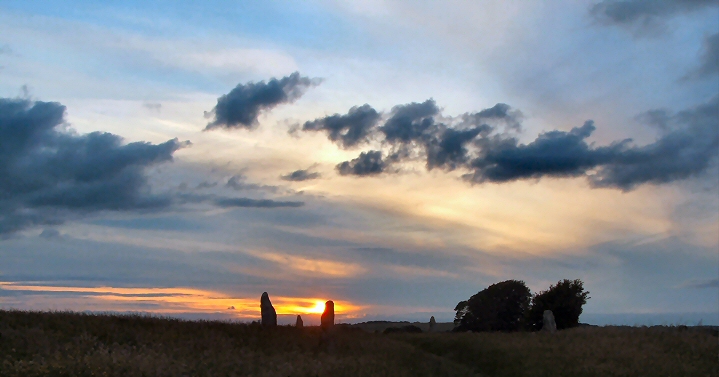
Visited May 2013
Image credit: Uwe Häberle 05/2013

Visited May 2013

Open Source Environment agency LIDAR


West Woods


Current extent of the UNESCO world heritage site around Avebury, as shown on the Silbury Hill viewing area information board.

Avebury restored showing three circles full of stones, one of the avenues and Windmill Hill

Green Street meets the Ridgeway looking out over Avebury towards Oldbury Castle

Interpretation of the Eastern side of the Avebury complex looking West. Model from the Great Barn and created by MDM Props Ltd. Hearne Hill – London

Flint axe from Alexander Keiller Museum

Little Avebury Stone Circle with the Ridgeway in the background

Croppy Central
Map of the Avebury area on the wall of the Barge at Honeystreet. Each dot represents a crop circle and the colour shows the year it happened. Great pub to explore See themodernantiquarian.com/facility/50
or web site the-barge-inn.com/index.htm

Detail from Vince Palmers’ ceiling mural in the pool room of the Barge at Honeystreet showing Avebury looking south. See themodernantiquarian.com/facility/50 for directions.

Unpolished flint axe from Alexander Keiller’s collection

Looking into Avebury from the Avenue

2007 Avebury Megameet T-shirt design.


Beacon Hill from Oliver’s Castle – Chance April 2008

The Ladies of the Bristol and Gloucestershire Archaeological Society examine the Piggledean sarsen’s before an address by the Rev. E.H Goddard. – Summer Outing 1907

Christ Church, East Kennet. Christianised Site?
themodernantiquarian.com/post/66765/weblog/christ_church_east_kennet_christianised_site.html

‘Equivalents for the Megaliths’ (1935)
Paul Nash’s wonderful take on Avebury and Silbury (in exposed form to the right)


West Kennett Long Barrow and Silbury Hill from Harestone Down


Silbury from Waden Hill, West Kennett and (just!) East Kennett Long Barrows in background


Avebury & West Kennett Avenue from Waden Hill

From the Ridgeway near Delling Copse. Avebury (in trees on right) & Silbury Hill (very top of hill is showing on left – half way up...playing ‘The Silbury Game’)

Rogue 4x4 drivers a hazard at Avebury again.
Police are appealing for witnesses following the incident, which took place on a byway near Avebury.
At around 3.30pm on Sunday January 24 a man in his 50s – out walking with his family – was verbally and physically assaulted by another man belonging to a group of off-road drivers.
Following an altercation with the group, the victim was thrown down a steep bank and forced into a puddle; both he and his family were then verbally abused by members of the group. Fortunately, the victim was not seriously injured. The assault took place on the top of the byway which runs from Avebury Trusloe to the trees by Windmill Hill. Police are now hunting for a man they believe is responsible. He is described as white, in his mid-late 20s, 5ft 10ins tall, of heavy build with light brown hair, a goatee beard and moustache.
It’s believed he was driving a Land Rover with customised wheels. There were other vehicles involved, some of which did not have registrations plates. However, police believe that one of the registration plates contained the numbers 141 and letters BRM. PC Angela Holden said: “Despite the remote location we are asking if anyone out for a walk or run in this part of rural Wiltshire heard or saw anything suspicious during this afternoon.
“Perhaps you saw a convoy of off-road vehicles in the area or recognise the descriptions given.
“Please contact us on 101, quoting crime reference number 54210008149, if you can help.”
You can also report anonymously via Crime
stoppers on 0800 555 111.
......
... Rogue 4x4 drivers are blamed.
AVEBURY is leading the charge to get damaged byways fixed and protected.
Routes around the village, and the nearby ancient historic site of Windmill Hill are now so badly damaged that they have become impassable.
Rogue 4 x 4 enthusiasts – some who travel from as far afield as Germany to drive some of Wiltshire’s 695km of by ways – are being blamed for the damage.
The campaign is being supported by the countryside charity CPRE. Anne Henshaw, the Wiltshire representative said:
“I am trying to form a charity/community not for profit group of parishes and other interested parties to set up something similar to the Cotswold Warden scheme,” she said.
This could see some of the byways closed to traffic at certain times of the year to protect them from heavy traffic use.
Stephen Stacey, chairman of Avebury Parish Council said:
“These by ways are for everyone’s use, but the actions of a few selfish people have made them inaccessible.
“We would like interested parties like ramblers, horse and bike riders and other local authorities to work together, and perhaps work with Wiltshire Council to see if we can come up with a solution between us.”
Some of the byways are so badly damaged that tree roots are exposed, and the ruts are more than two feet deep in places.
Solutions, he said, could include a volunteer force using council equipment and materials to make repairs as he says cut backs at Wiltshire Council are to blame for the disrepair.
Contd.
The summer solstice is always very busy at Avebury – this year is likely to be no exception. If you are coming to mark midsummer at Avebury, do plan well in advance. Please consider coming for a shorter time so you don’t need to stay overnight and use public transport if at all possible.
Planning your visit during the solstice – Go online for full details
Solstice this year will be sunrise on Tuesday 21 June.
nationaltrust.org.uk/avebury/features/the-summer-solstice-at-avebury
Get an introduction to studying archaeology, exploring exciting discoveries in the Vale of Pewsey, near to Stonehenge and Avebury.
Join now – starts 20 Jun
ABOUT THE COURSE
Join us at the University of Reading as we chart the progress of an archaeological excavation from dig to lab and beyond on this free online course.
Take a virtual field trip to the Vale of Pewsey
We’ll be showing you around our field school – a month-long excavation at the Vale of Pewsey, which is a relatively untouched site compared to its world-famous neighbours, Stonehenge and Avebury.
The Vale of Pewsey is an archaeological treasure chest and the jewel of its crown is Marden. Built around 2,400 BC, Marden is the largest henge in the country and one of Britain’s most important but least understood prehistoric monuments.
Every object has a tale to tell and we’ll investigate how archaeologists paint a vivid picture of what life was like in Neolithic times through the astounding assortment of discoveries made in this beautiful part of England.
Explore every aspect of archaeology
An archaeological excavation isn’t just turning up with a trowel to dig. Drawing on case studies from our field school, you’ll find out about every aspect of archaeology, from deciding where to dig to the collection, recording and storage of artefacts.
We’ll investigate excavation techniques such as topographic surveying and scientific coring. And through distinctive discoveries at the Vale of Pewsey, we’ll take a closer look at what you can do with an artefact once you’ve found it.
Learn how archaeology can study the dead
One of the most intriguing and eye-opening finds of all is a burial site or grave, which provides fascinating insights into the past. In Week 2, we’ll examine the archaeological methods employed in the study of the dead. What can skeletal remains tell us about where someone lived, their occupation and their health?
University of Reading
FREE online course
Duration: 2 weeks
3 hours pw
Certificates available
REQUIREMENTS
No prior experience of archaeology is needed. This course is designed for anyone interested in studying an archaeology degree at university. However, anyone with an enthusiastic interest in archaeology is very welcome to join us too.
Join the conversation on social media
Use the hashtag #FLdigtolab to join and contribute to social media conversations about this
A remarkable new Stone Avenue has been located at the UNESCO World Heritage Site of Avebury in Wiltshire.
the-stonehenge-enigma.info/2015/03/breaking-news-new-stone-avenue.html
“Fears about the number of visitors a new 45-mile walking route will bring means proposed improvements to some rights of way cannot go ahead.
“As a result, a grant offer from the European Union of £27,700 for the scheme linking the World Heritage sites of Stonehenge and Avebury has been withdrawn.
“The Great Stones Way would run from the Iron Age hill fort of Barbury Castle on the Ridgeway National Trail, past the current end of the trail at Overton Hill near Avebury, along the Avon Valley to Amesbury, to end at historic Old Sarum near Salisbury.”
More here – gazetteandherald.co.uk/news/10225316.Avebury_stone_Way_hits_stumbling_block/
Lewis Cowen writing in the The Wiltshire Gazette and Herald today reports that -
TV archaeologist Julian Richards is to lead a series of walks around the World Heritage site of Avebury this summer and autumn. Dr Richards, who presented BBC’s Meet the Ancestors, is a noted expert on the archaeology of Avebury and Stonehenge and will be leading the Wessex Walks on Wednesday, June 6, Saturday, September 1, and Sunday, October 21.
The Wessex Walks are part of a programme of study days running at museums, galleries and sites all over Britain throughout 2012.
More here – gazetteandherald.co.uk/news/9730600.TV_archaeologist_Julian_Richards_to_lead_walks_around_Avebury/

An exhibition of oil paintings and woodcuts by British landscape artist Nick Schlee, focusing on Avebury and the Ridgeway.
This new exhibition features some of Nick Schlee’s most bold and vivid work portraying the ancient monument of Avebury and the nearby Ridgeway.
80 year old Nick says of the exhibition:
“More than half of the pictures in the exhibition feature those mysterious ancient stones that mean little to most of us, but must have meant a great deal to our forebears.
Painting them, without being able to share the feelings they engendered for the people who erected them, is a problem. I can only describe their outside appearance. The spirit within is closed to me. It is as if I were recording the skin of a peach without any idea of its taste, its texture and delicious succulence.
We are probably all aware of the difficulties and dedication that went into bringing these stones to where they stand today. This is what, to my mind, contributes to making them so unnerving. Their presence disturbs me in the same way the purposeful ditches of Avebury disturb me.
When I paint their portraits, from close up or afar, I am trying to find a place for them in the powerful rhythms, space and colour of the natural landscape. The result is that they take on the role of rugged, weather-battered statues.
Because I find it impossible to find an understanding of them that matches my own experience I deliberately inject a febrile nervous energy into my drawing of them. I hope that in this way I will convey to viewers the former power they held for early inhabitants of the area. I tremble. But at what I am not sure.
In contrast, the vast panoramas along the Ridgeway move me more directly. Here I feel more confident that I do not miss anything important. What I see of the rolling landscape with its sky and clumps of trees resonates powerfully in way that reaches inside me today as they must have always done to others over the centuries.
I use heightened colour and emphasised rhythmic line in my paintings to try make sure that those looking at them share the excitement the Wiltshire landscape creates in me.“
Although this is the first time Nick’s work has been exhibited at the Museum, he has had many solo exhibitions, including at the Yehudi Menuhin School, Gallery 27 in London and the West Berkshire Museum. He has also participated in many group exhibitions including Templeton College, Oxford and the Modern Artists Gallery. His work is held in public collections, including the City of London Guildhall Gallery, the Wessex Collection at Longleat House and Southampton City Art Gallery.
More information about the artist and his work can be found on his website -www.nickschlee.co.uk/
*Exhibition runs from 14 January to 2 September 2012.*Cost: Usual Admission Charges Apply
wiltshireheritage.org.uk/events/index.php?Action=2&thID=692&prev=1
G x
“An exhibition of oil paintings and woodcuts by British landscape artist Nick Schlee, focusing on Avebury and the Ridgeway. This new exhibition features some of Nick Schlee’s most bold and vivid work portraying the ancient monument of Avebury and the nearby Ridgeway. 80 year old Nick says of the exhibition –
“More than half of the pictures in the exhibition feature those mysterious ancient stones that mean little to most of us, but must have meant a great deal to our forebears.
“Painting them, without being able to share the feelings they engendered for the people who erected them, is a problem. I can only describe their outside appearance. The spirit within is closed to me. It is as if I were recording the skin of a peach without any idea of its taste, its texture and delicious succulence.”
Venue: The Wiltshire Heritage Museum, Devizes from Saturday, 14 January to Sunday, 2 September 2012.
More here – wiltshireheritage.org.uk/events/index.php?Action=2&thID=692&prev=1
Minutes of a meeting of Avebury Parish Council held on the 15th March 2011 at The Social Centre, High Street, Avebury SN8 1RF
c. Avebury Solstice Operational Planning Meeting:
(i) Policing will effectively be the same as last year despite the Swindon Music Festival. The police will have air and public order support. There will be police bikes, a passive drug dog, tow truck and two drop bins at the campsite and pub. The Police are encouraging a family event. Inspector Andy Noble will talk to people in the village if there are any concerns.
(ii) Problems are more likely Mon/Tues (20 and 21 June) than Tues/Wed due to people en route to Stonehenge.
(iii) Land incursions – police can only act if a breach of the peace occurs.
(iv) The campsite will be open 9.00 Monday to 14:00 Wednesday.
(v) Policing 6.00 Monday to 23:00 Wednesday
(vi) Parking in Manor grounds 20.00 on Monday to 10.00 Tuesday
(vii) Kevin Oliver Wiltshire Council Events Manager is looking at what can be done for West Kennett.
(viii) Silbury car park closed 18:00 to 10:00 on Monday and Tuesday
(ix) It is not yet known if the Glebe field will be available this year: approximately 30 campers were turned away last year
Draft minutes of a meeting of Avebury Parish Council held on the 19th April 2011 at The Social Centre, High Street, Avebury SN8 1RF
•Glebe Field: Minute ref. 11c. The Chairman confirmed that the Glebe field will not be available for Solstice camping.
aveburyparishcouncil.org/minutes2011.html
Information on past campsite consultancy
I’ve just been notified that the 49 bus has been included in funding cuts made by Swindon Borough Council to Sunday services.
It will no longer be possible for anyone to travel to Avebury WHS by public transport on Sundays as from June 5th 2011.
Statement made on service web-site:
“We regret that as a result of the total withdrawal of Swindon Borough Council funding for evening and Sunday bus services in Swindon that further changes will have to be introduced from Sunday 5 June 2011”. (stagecoachbus.com/extuploads/leaflet_lowres.pdf)
Andrew Collins will be attending the monthly Pagan Moot at 4.00pm in the Red Lion, Avebury on Sunday 6th February. He will be talking about his fascinating book The Cygnus Mystery.
I am currently reading this book and, as it says on the cover, it is “an intellectual adventure”. Unfortunately, I will not be able to attend but on the basis of reading the book am happy to recommend it.
(Thanks again to Faerygirl for mentioning book on the forum).
“The gateway to the Avebury World Heritage Site has been transformed after work to bury unsightly electricity cables was completed…”
“The project, which started over three years ago, was made possible by a partnership involving Wiltshire Council, the National Trust, North Wessex Downs Area of Outstanding National Beauty, English Heritage and local farmers. Funding for the work was provided by Scottish and Southern Electricity…”
“The new cables have been buried underneath the major monuments at Overton Hills Seven Barrows Bronze Age barrow cemetery and beneath the Neolithic West Kennet Avenue which originally linked Avebury Stone Circle to the Sanctuary.
“Scottish and Southern Electricity employed archaeologists to examine all the entry and exit points for the moleing machinery to check for any archaeological remains.
“Their work has been monitored by Dr Nick Snashall, National Trust archaeologist who said: “A major eyesore has been eliminated from the World Heritage Site with the removal or these power cables, bringing the landscape closer to its ancient appearance. We’ve also been able to record all the archaeology found during the works, which adds to our story of the development of Avebury.“”
More here – wiltshire.gov.uk/latestnews.htm?aid=107488&utm_source=Wiltshire+Council&utm_medium=twitter&utm_content=News
The West Kennet Avenue at Avebury. Photo by Heritage Action member Jim Mitchell, one of the winners in this year’s National Trust competition for photographs of Avebury.
Photo here -
heritageaction.wordpress.com/2010/05/30/avebury-photo-competition/
And here -
themodernantiquarian.com/img_fullsize/76270.jpg
(Well done Jim :-)
Following the request made by certain members of the Council of British Druid Orders in June 2006 for the reburial of ancient ancestral remains excavated from the Avebury Complex in Wiltshire, in 2008 English Heritage and the National Trust launched a consultation exercise to take public input.
This will be a landmark case that could set precedents for other cases.
While individuals were welcome to send their own responses, HAD gathered comment from its own councils of advisors and theologians in order to submit a response as an organisation. We have now published HAD’s Response to the Avebury Consultation. There is also available a Press Release on the response which summarises the case and HAD’s position.
The Museums Association response provoked HAD to respond once more.
HAD’s letter to the MA can be found on the main HAD website at honour.org.uk/node/280 along with all the other documents mentioned above.
The clock at the Alexander Keiller Museum at Avebury, Wiltshire, will be removed for repair on 8 April, the National Trust has confirmed.
The 18th Century turret clock on the Stables Gallery has been stuck at four o’clock for more than a year.
The National Trust’s Meg Sims said: “It’s always time for tea at Avebury.”
The clock will be restored in Somerset at a cost of £5,700. It is hoped the feature will be ready and reinstalled by Easter 2010.
The museum is named after the archaeologist and businessman, Alexander Keiller.
Kit helps pupils enjoy monument
The pack aims to make learning about the monument fun
A new teaching kit has been produced to help children get more out of school visits to Avebury and surrounding monuments in Wiltshire.
The resource is aimed at key stage two and three pupils and includes on-site investigation sheets, puzzles and treasure hunts.
“The site is steeped in a rich and mysterious history,” said Lucy Bradley, Education Manager for English Heritage.
“We want to encourage more schools to come to Avebury World Heritage Site.”
The kit came about after last year’s successful project at Silbury Hill to stabilise the ancient man-made mound.
“Pupils from two primary schools and a secondary school visited while the work was in progress,” said Ms Bradley.
“The visit was such a success. It really helped the children to get an in-depth learning experience of the mysterious hill so we thought it would be great if we could create a Teacher’s Kit which encourages active learning for visits to the whole World Heritage Site.”
Avebury World Heritage Site is a Neolithic landscape which encompasses Avebury Stone Circle, West Kennet Long Barrow and Avenue, The Sanctuary, Windmill Hill and Silbury Hill.
This year the Wiltshire Wildlife Trust celebrates the 20th anniversary of the Sarsen Trail, and to mark this milestone is encouraging us to take part in the ‘Walk for Wildlife Week’ which precedes the Trail, Saturday 26th April to Sunday 4th May.
The Week will culminate with the Sarsen Trail and Neolithic Marathon on Sunday 4th May.
The Sarsen Trail and Neolithic Marathon is a 26-mile sponsored walk and run between the two World Heritage Sites of Avebury and Stonehenge, with shorter courses available to those who prefer shorter distances.
The route offers some of the most spectacular view across Wiltshire’s undulating downland and the opportunity to walk on Ministry of Defence land that is usually closed to the public. Part of the route is also of major historical importance as it traces the approximate trail along which the Sarsen stones were dragged to build Stonehenge in the Neolithic times.
The event is the Trust’s most important annual fundraiser. Over 1,700 walkers and 400 runners from across the UK and from abroad, 100 dogs, and 250 staff and volunteers took part in last year’s event raising over £60,000, money that will be used to help protect Wiltshire’s wildlife and environment and safeguard its natural heritage for future generations.
There are frequent water stations along the route and once you’ve reached Stonehenge, you can lie back and enjoy a well-earned massage or feast on a hog roast.
The Sarsen Trail walk, Neolithic Marathon and Half Marathon are organised to raise vital funds for the Wiltshire Wildlife Trust.
The next Sarsen Trail and Neolithic Marathon and Half Marathon will take place on Sunday 4th May 2008.
The Marathon starts at Avebury at 10.30am. The half marathon starts at Charlton Clumps on Salisbury Plain at 11am.
wiltshirewildlife.org/ – Click link on right for Sarsen Trail
REGISTRATION FEES 2008 – Close Registration – 11th April
Adult Full Walk £24.00
Adult Half Walk £18.00
WWT Member £12.00
Child (under 16) £6.00
Watch Member £4.50
Child Group £4.50
Family (2 adults, 3 children) £50.00
WWT Family £35.00
Group Rate (5 or more) £20.00
Marathon £30.00
Marathon (WWT Member) £15.00
Half Marathon £25.00 £20.00
Half Marathon (Member) £12.50
Bringing the birds and bees and monkey babies together – Lovely
Fyfield Down and Overton Down Wilshire, near Avebury, the Sanctuary and the Ridgeway.
The megalithic trail of limestone blocks from which the ancients tooks stones to nearby Avebury leads from a footpath starting of the A4 near Fyfield up a climb to Overton Hill. Instantly you stumble across grey blocks which lie in the field like the sheep after which they are named. Following the river of blocks through a farm yard and on the far side in the overgrown hedge are two standing stones, about two to two and a half metres tall. Backtrack up past the barn and up the hill to Overton to where sarsen stones stand in a raw, wild landscape. This stands up above Avebury, but travel west across the gallops and you stumble upon the most awesome sight of all as hundreds of massive stones lay in a valley. This is a truly amazing place. It just doesn’t seem real. A landscape completely alien to any other I have seen in Wiltshire, perhaps even the UK, and yet to the ancients must have been truly significant beyond merely a source of stone for the nearby rings and avenues. This site was the one I think Julian must have visited, although I didn’t, know it by the name he used. Travel west past the massive rocks, south up over the hill through the lane to drop back onto the main A4 at Fyfield. Best in the rain or winter weather, when a sense of the gathering storm adds even more magic to an already impressive landscape.

Sometimes there breaks out water in the manner of a sudden land flood, out of certain stones (that are like rocks) standing aloft in open fields near the rising of the river Kenet in this shire, which is reputed by the common people a fore runner of death. That the sudden eruption of Springs in places, where they use not always to run, should be a sign of death, is no wonder. For these usuall eruptions (which in Kent we call Nailbourns) are caused by extream gluts of rain, or lasting wet weather, and never happen but in wet years (witness the year 1648 when there were many of them) In which years Wheat, and most other grain thrive not well (for a plain reason) and therefore a dearth succeeds the year following.
From ‘Britania Baconica: or, The natural rarities of England, Scotland, and Wales’, written by J Childrey (1662).
Always beware of local people spinning a yarn. Could this be useful advice to visitors during the circus surrounding Silbury’s latest excavations?
[Around 1776 when the miners were excavating Silbury] a correspondent of the Salisbury Journal, with the intention of throwing ridicule on the undertaking, narrated [..] that some years previously a poor boy who was carrying a pitcher of milk along the high road at that spot, fell down and broke the vessel. A tailor, who lived at Avebury close by, met the boy lamenting his case just at the same moment that a carriage appeared in sight. He, therefore, directed him to shout out lustily in order to excite the compassion of the passengers, and advancing up to the coach himself, observed that the poor lad had but too much reason for his lamentations, for the urn which he had broken had but just before been exhumed by his father, and as a piece of antiquity was of such rare value, that Dr. Davis of Devizes would no doubt have given a guinea for it. This declaration so wrought upon the curiosity of the travellers, that after due examination of the fractured vessel, and a consultation as to the possibility of uniting the fragments, they agreed to give a crown for the article, and drove off with their prize. The tailor then gave the boy one shilling, and appropriated four to himself.
From ‘A History Military and Municipal of the Town of Malborough. James Waylen. 1854. p406.
I was enquiring for the Sarsen Stones or Grey Wethers, when only about a furlong from them, but an old man and his neice did not know either name; at last they suggested that what I was seeking was what they called the Thousand Stones. The man told me (what I had heard before) that the stones certainly grew; he had seen this, for, when he was a boy, there were not nearly so many, nor were they so large, as now. (June 1901.)
Scraps of Folklore Collected by John Philipps Emslie
C. S. Burne
Folklore, Vol. 26, No. 2. (Jun. 30, 1915), pp. 153-170.
I recently came across a collection of essays about Wiltshire by John Chandler called The Day Returns – Excursions in Wiltshire’s History (published 1998). This one is from a previous publication called ‘Life in the Bus Lane’. The bus in question no longer runs on the route described.
The Source of the Kennet
It is a crisp March Monday and we are sitting on a bus in Marlborough High Street facing the college, and waiting for 9.35. It is that time in the morning which is common to all small towns, when those who have to be there have arrived and are at work; those who don’t aren’t, or if they, they can still drift along the capacious street to find a parking space.
While we are waiting I should tell you one thing that any intending bus passenger must understand. Buses (and I mean the ordinary country buses which we all used before we bought cars) – buses like this do not take you from A to B. They take you from A to Z, via B, C and D, not to mention W, X, and Y. This bus may say it is going to Swindon, if we persevere with it and have plenty of time. But Swindon is merely a by-product of the journey.
Let’s face it. If anyone is desperate to go from Marlborough to Swindon and they have a car, they will be there in 15 minutes. This bus takes over an hour. And one reason for the discrepancy becomes apparent as soon as we set off. We are going the wrong way! Swindon is due north and we are heading west. We are, in fact, embarking on a trip to the source of the Kennet, and on the way we shall call on most of the sixteen villages which grew up alongside the meagre waters of its upper reaches.
First above Marlborough is Preshute, its church hiding beyond the trees of the college. But Preshute is really part of Marlborough. The first real upper Kennet village is Manton, and here we leave the main road to make acquaintance with the river itself. It is lively here, eager to resume its old job of splashing over the millwheel, a teeming artery of winter rain surging bankful among its meadows.
In front of us are some six miles of Kennet valley and seven more villages before we reach Avebury. We cross and re-cross the river to visit them all. This is the land of the sarsens, the alien stones, the Saracens. At Piggledene and Lockeridge Dene they masquerade as drab sheep and lie asleep in flocks. From West Kennet to Avebury they march along upright like soldiers. In the villages they have been tamed and squared to serve as walls – incomparable walls of mottled silver, pink, and greenish-grey. And in Fyfield churchyard lie the men of the Free family, who tamed them and squared them, and who died prematurely from their dust.
The bus climbs from Lockeridge to West Overton, and at the crest of the hill a fine view is revealed. In the foreground Overton church, dressed in sarsen, looks down on a field of village earthworks. To our left the view is to Tan Hill, the highest place in Wiltshire; to our right the barrows on Overton Hill mark the line of the Great Ridgeway. And between them, in the far distance, we glimpse the Lansdowne monument above Cherhill. The bus winds down into Overton, slowing for an old border collie who is sauntering deafly along the road.
Now to East Kennet, where I have often admired the sarsen garden walls. But only from upstairs on the bus is their secret revealed, that behind them is hidden a swimming pool. On sultry summer afternoons, I daydream, some bronzed bodies laze by the water, and reach discreetly for their towels when the double decker trundles by. But no time now for daydreaming. The Kennet’s proudest moment is about to be revealed. We are back on the main road and approaching Silbury Hill. After a wet February the river has collected every drop it can muster from its downland springs and streams, to form a silver moat around the hill. It is a spectacle purely for the locals which the Kennet never repeats for the summer tourist trade.
At Beckhampton Roundabout we must give up this self-indulgence, and do our duty at last and go to Swindon. The northward turn up to Avebury Trusloe is surprisingly hard work for a bus. I glance across to Adam and Eve, the two solitary sarsens behind the stables. But I am thinking of breakfast. I heard a man interviewed on the radio, a manufacturer I think, about marmalade. He was talking about customer’s preferences. “Thick cut marmalade”, he said, as if had just thought of it, “Is essentially a male preserve.”
Avebury’s present appearance owes a great deal to marmalade – far more than it owes to the National Trust. It was Scottish marmalade that enabled Alexander Keiller, heir to family business to indulge a passion for archaeological excavation, first in the twenties at Windmill Hill nearby, and then during the thirties in Avebury itself. He drew on his wealth to buy much of the village and as building within the circle became vacant he demolished them, displacing the villagers to new house at Avebury Trusloe. He excavated the ditch, re-erected the fallen stones, and established a museum which still exists. He died in 1955.
Beyond Avebury we settle into a different landscape. The bus is heading north now, so the Marlborough Downs are to our right. They have formed themselves into a steep escarpment which rises green to sky. Here and there ribbons of white climb the hill, remnants in sunless holloways of last week’s snow. Against the snow the grubby chalk horse on Hackpen is a miserable creature. To our left now there is no corresponding hillside, just undulating farmland which teeters to the edge of a second escarpment unseen from here, then suddenly down to the clay. Above Silbury the Kennet loses its vigour and has not the strength to form a valley. It has become seasonal, gratefully receiving whatever normally dry tributaries can offer, and flowing only after winter rain – a true winterbourne.
John Chandler ends his passage (which I haven’t reproduced in its entirety) with a quote from Richard Jefferies’ book ‘The Story of my Heart’ and the observation “Such a man would never have understood a bus timetable.”
‘It is eternity now. I am in the midst of it. It is about me in the sunshine; I am in it, as the butterfly floats in the light laden air. Nothing has to come; it is now. Now is eternity; now is the immortal life …. For artificial purpose time is mutually agreed on, but there is really no such thing. The shadow goes on upon the dial. The index moves round upon the clock, and what is the difference, none whatever. If the clock had been never set going, what would have been the difference? There may be time for the clock, the clock may make time for itself: there is none for me’ (Richard Jefferies)
A small tribute to the 49 bus between Swindon- Avebury-Devizes.
The 49 bus route from Swindon to Devizes via Avebury is my favourite bus journey. For quite a few years I only really went as far as Avebury, having joined the now defunct internet forum set up to discuss all aspects of Avebury. A disparate collection of people though we were, we often arranged ‘meets’ at Avebury, immersing ourselves in the WHS landscape. All good things come to an end and the Avebury Forum eventually folded but even now there is nothing better on a breezy day than a walk along the Avenue to Waden Hill – climbing up to see Silbury against the cloudscape of the day.
These days life has moved on and I now have a regular commitment in Devizes so make the return journey at least once a week, always sitting upstairs. When the bus climbs the hill out of Wroughton just south of Swindon, the landscape opens out into downland; on we go past the Hackpen White Horse at Broad Hinton. Sheep grazing, a buzzard or two sitting motionless in a ploughed field, very occasionally lapwings or fieldfares. Sometimes the downs are covered in layers of mist which is always beautiful to see. Then through Avebury, always people wandering about regardless of the weather – always a different view, depending on which side of the bus I sit. On past Silbury sitting enigmatic as always in the landscape, past the Adam and Eve stones and the Beckhampton long barrow. Then a long stretch of straight road between Beckhampton and Bishop Cannings. Bronze Age round barrows strung out at various points on either side of the road (a couple in the garden of a farmhouse). I believe there is also a long barrow out there somewhere though I’ve never been able to identify it. Travelling upstairs on the 49 bus is a great way to see a truly unique archaeological landscape and to see the way modern day farming practices intersect with it.
The latest here may be of interest – heritageaction.wordpress.com/
Wiltshire Downs
The cuckoo’s double note
Loosened like bubbles from a drowning throat
Floats through the air
In mockery of pipit, lark and stare.
The stable boys thud by
Their horses slinging divots at the sky
And with bright hooves
Printing the sodden turf with lucky grooves.
As still as a windhover
A shepherd in his napping coat leans over
His tall sheep-crook
And shearlings, tegs and yoes cons like a book.
And one tree-crowned long barrow
Stretched like a sow that has brought forth her farrow
Hides a king’s bones
Lying like broken sticks among the stones.
Wiltshire Downs – Andrew Young (1885-1971)
A Village Republic
Sarsen is a village that has no great landlord. There are fifty small proprietors, and not a single resident magistrate. Besides the small farmers, there are scores of cottage owners, every one of whom is perfectly independent.
Nobody cares for anybody. It is a republic without even the semblance of a Government. It is liberty, equality, and swearing. As it is just within the limit of a borough, almost all the cottagers have votes, and are not to be trifled
with. The proximity of horse-racing establishments adds to the general atmosphere of dissipation. Betting, card-playing, ferret-breeding and dogfancying, poaching and politics, are the occupations of the populace.
A little illicit badger-baiting is varied by a little vicar-baiting.
Richard Jefferies, 1879
“These downes looke as if they were sowen with great Stones, very thick, and in a dusky evening they looke like a flock of Sheep: one might fancy it to have been the scene, where the giants fought with huge stones against the Gods. ” Twas here that our game began, and the chase led us through the village of Avbury....”
John Aubrey, c.1650.
Two widely spaced letters about the threats to the stones:
To the editor of The Times.
Sir, -- [..] you will perhaps agree with me in the regret, amounting to horror, which I have just felt in observing, as I passed the “Gray Wethers” on Marlborough-downs, that the utilitarian work of destruction is actually breaking up these ancient stone, whether for repairing the roads or extending the herbage I know not.
Surely no modern barbarian, whether he be a commissioner of the turnpikes or a wealthy agriculturist, has any better right to deprive his country of these fine Druidic relics of the earliest age than he has to blow up Stonehenge and then to chip it into fragments; or to level the stupendous barrow of Silbury-hill in order to bring a few more acres into cultivation.
What are the county members, or the county magistrates, about, to suffer this work of spoilation to proceed! Are there no newspapers in Wiltshire! [..] Antiquarius.
The Times, Wednesday, Aug 12, 1840; pg. 3
[..] In consequence of a recent change of ownership.. there is every probability that the work of breaking up the Sarsens will be undertaken on a greatly extended scale.. the Grey Wethers in Pickle Dean and Lockeridge Dean would be the first to go, owing to their situation adjacent to high roads – while for the same reason their disappearance would be a greater loss to the public than the disappearance of those in more remote parts of the Downs.[..] it was felt that steps ought to be taken to secure the preservation of some characteristic examples of the stones in their natural condition, and representations were made to the owner by the National Trust and the Wiltshire Archaeological Society. Mr. Alec Taylor, the present owner, met the representatives of the two societies in a friendly spirit; he stated at once that he intended to preserve.. the Devil’s Den, and, after some further negotiations, he has given the National Trust an option to purchase about 11 acres in Pickle Dean and about 9 acres in Lockeridge Dean for £500 [..]
The Times, Friday, Jul 05, 1907; pg. 4
The stones were bought by the National Trust in 1907.
A curious watery factoid about the edge of the downs:
..The chalk ridge of Martinsell and St. Anne’s Hill, not far from the centre of the county, furnishes three springs, which, as old Aubrey, the Wiltshire antiquary of the seventeenth century observed, ‘do take their courses thence three several waies:’ one to the German ocean through the Thames, one by Salisbury to the Channel, the third by Calne and Bristol into the Atlantic.
Renoted on p109 of a curiously anonymous article on Wiltshire in ‘The Quarterly Review’ no205, v103.(1858)
From the Diary of Richard Symonds, on Fyfield, 1644.
a place so full of grey pibble stone of great bignes as is not usually seene; they breake them and build their houses of them and walls, laying mosse betweene, the inhabitants calling them Saracens’ stones, and in this parish [deposit] a mile and a halfe in length, they lie so thick as you may go upon them all the way. They call that place the Grey-weathers, because afar off they look like a flock of Sheepe.
Yes he really did say ‘Sheepe’. But I do like the image of him hopping from one stone to another, the whole length of the stones.
quoted in ‘Sarsens’ by H C Brentnall in v51 (1945/6) of Wiltshire Archaeology magazine.
“Grey Wethers or Sarsen Stones” is a cartographic shorthand (some of these stones really do look like sheep from a distance) and crops up on the map all over Fyfield and Overton Down. There may be some confusion caused by the use of this name therefore. It should not be confused with the Greywethers stone circle in Devonshire.
I have just read Steve Marshall’s book “Exploring Avebury – The Essential Guide” and am absolutely thrilled by the wealth of detail, the fantastic photos and the underlying ideas about Avebury and it’s landscape.
Highly recommended!
Connecting Wiltshire web site for the Avebury area.
Contains detailed information of all bus stops, service times and routes, together with cycle routes, walking routes, cafe/restaurants and toilets.
Wiltshire council web page detailing some of the more environmentally friendly ways to get to Avebury other than by car.
My Life in Stone(s) by Chris Brooks
Chris outlines his life in stone(s) writing that, “Eventually we had our first field trip and were taken to Lanhill and Lugbury Longbarrows. These two places are just a few miles from my doorstep and I never knew they existed. I was particularly interested in Lanhill with its stone walled entrance and little chamber. This was my first barrow experience and until this day I feel quite protective about it. Our next field trip was to the Avebury Complex including Windmill Hill, Silbury and West Kennet which just blew me away. The lectures and the field trip had such a big impact on me and gave me a love of the Neolithic people and their awesome structures which has remained with me ever since.”
Life of Sir John Lubbock, Lord Avebury
by Hutchinson, Horace G.
Published in 1914, Macmillan (London)
Download the complete book in pdf format
Clive Ruggles’s photographic walkabout at Avebury (includes resident sheep). You can imagine you’re walking from the Sanctuary down to the circle (amongst other directions).
Stukeley’s map of the ‘snakey’ avenues going through Avebury, and the various monuments around.
From ‘Avebury – A Temple of the British Druids’ courtesy of Lithops’ excellent website.
All the latest news and observations from around the Avebury World Heritage site, brought to you by our friends at heritageaction.org
Photos and information – plus (if your computer can take the pace) circle effortlessly above your favourite monuments with an aerial video clip.
One of the Web sites relating to a collaboration between the Universities of Leicester, Newport and Southampton. This page links to interim reports on the 2001 and 2002 seasons, including the excavation of Falkner’s Circle.