Showing 1-50 of 68,955 posts. Most recent first | Next 50 
This was one of the first places I went to after buying the big orange book and it sent me on an almost fervoured Cope inspired ramble all across the UK, Ive been here in blazing sunshine, at sunset, at night in the snow, foot n mouth drizzle, and now an equinox foggy sunrise, todays was by far the best.
At 6.15am I slung the heavy wooden stepladders over my shoulder and made my way through the farm yard paying the obligatory quid on the way.
The fog which had plagued the whole drive here now threatened to obscure any sunrise, but on the, erm, bright side there was no-one here but me, no pagan dafties, no stupid dog, no livestock, nothing, just me the camera and some stepladders, we had a good time.
Then to top it all the sun came out, weekly at first but as the fog thinned intermittently it shone through brighter and more beautifully than ive seen in quite a while. Alas the fog and bright light outfoxed me and my extremely limited camera knowhow, but the ladders were a good idea for getting above the stones a little.
Before I knew it the sunrise was well and truly over but the light there was so gorgeous that I spent nearly two hours just trying to capture the scene.
|
Posted by postman 21st March 2010ce |
   
|
Posted by postman
21st March 2010ce
|
Whenever I come to the Peak district I have to go through Buxton, if I then want to go south to say Arbor Low or Minninglow, a substantial shortcut can be taken through the Buxton suburb of Harpur hill, for years the bump on the hill had drawn my attention as I drove past, this sunday morning was the ideal time for a visit.
I had tried once before, but theres houses on one side and some kind of underground facility on the other, and then gave up. But today it was 9.00am on a sunday morning so I decided to go for a sneak whilst no-one was about.
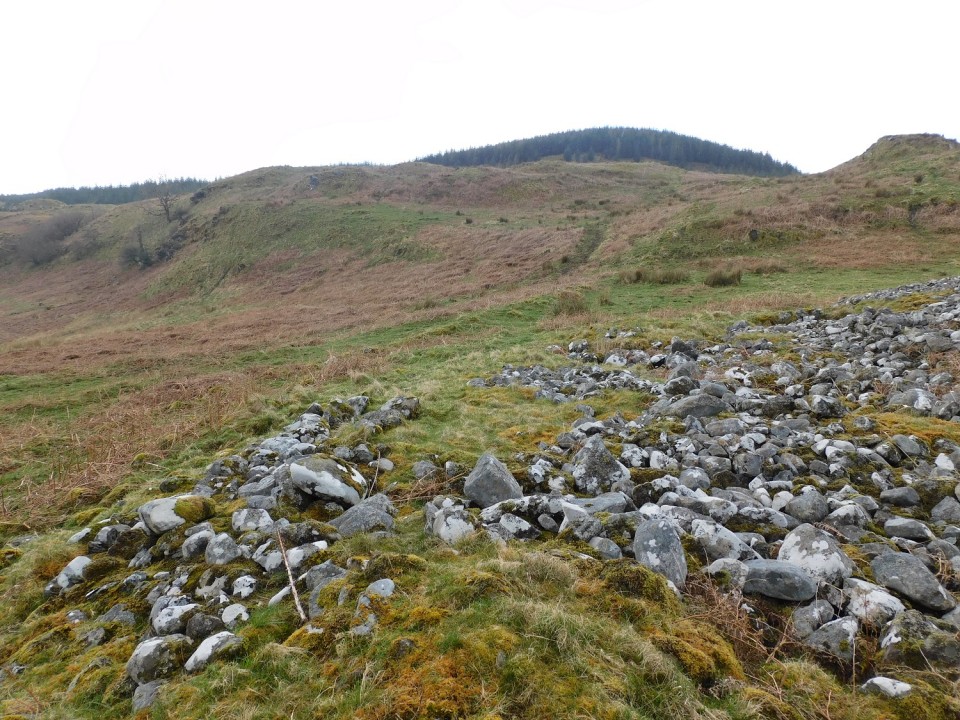
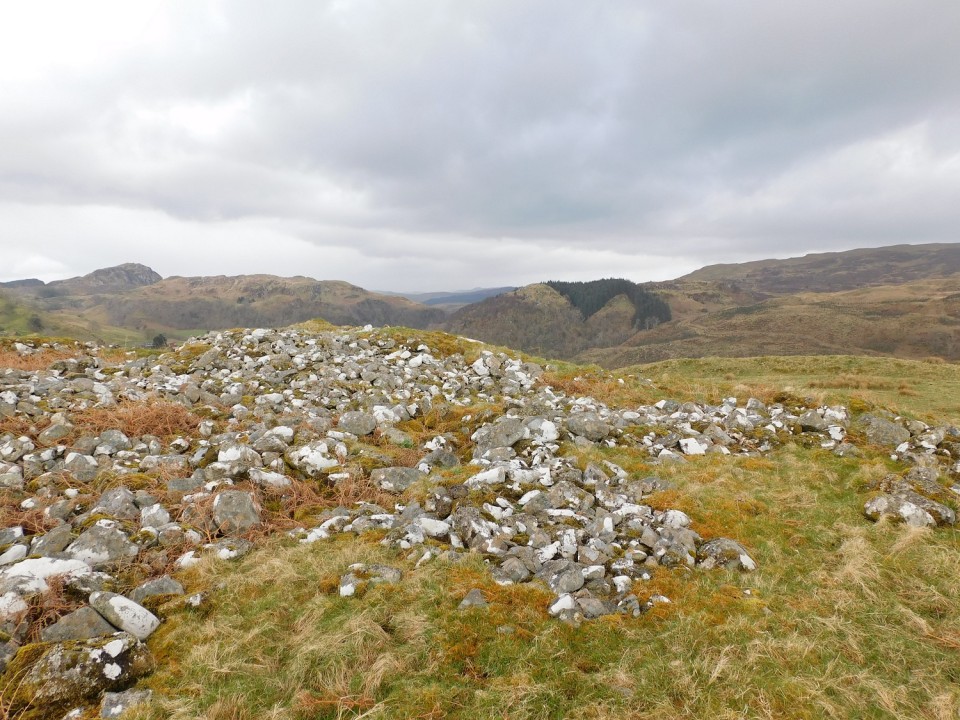
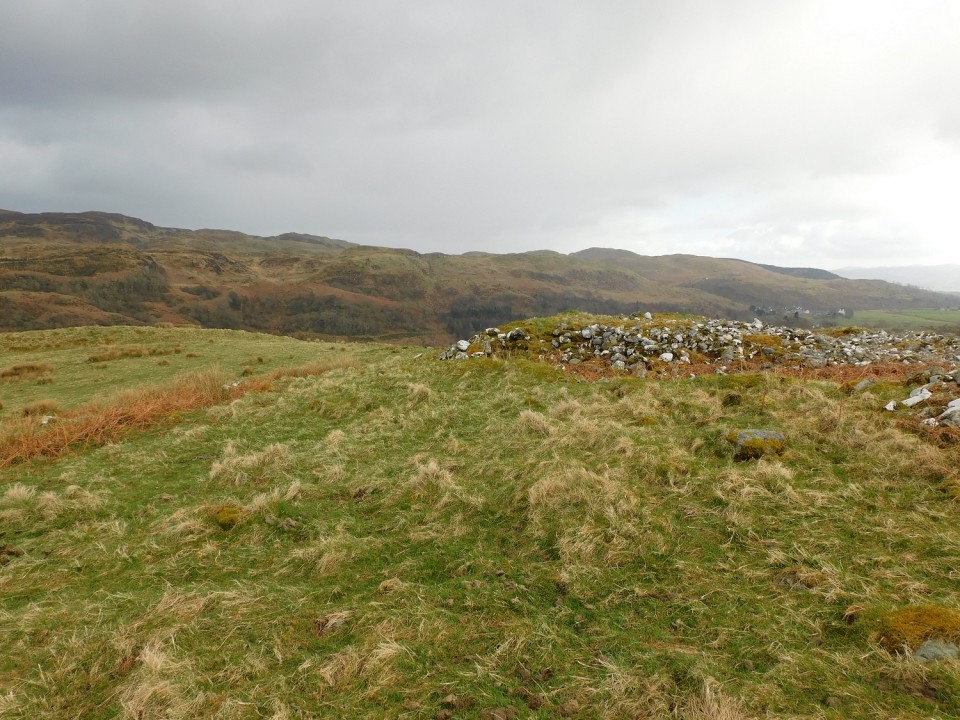
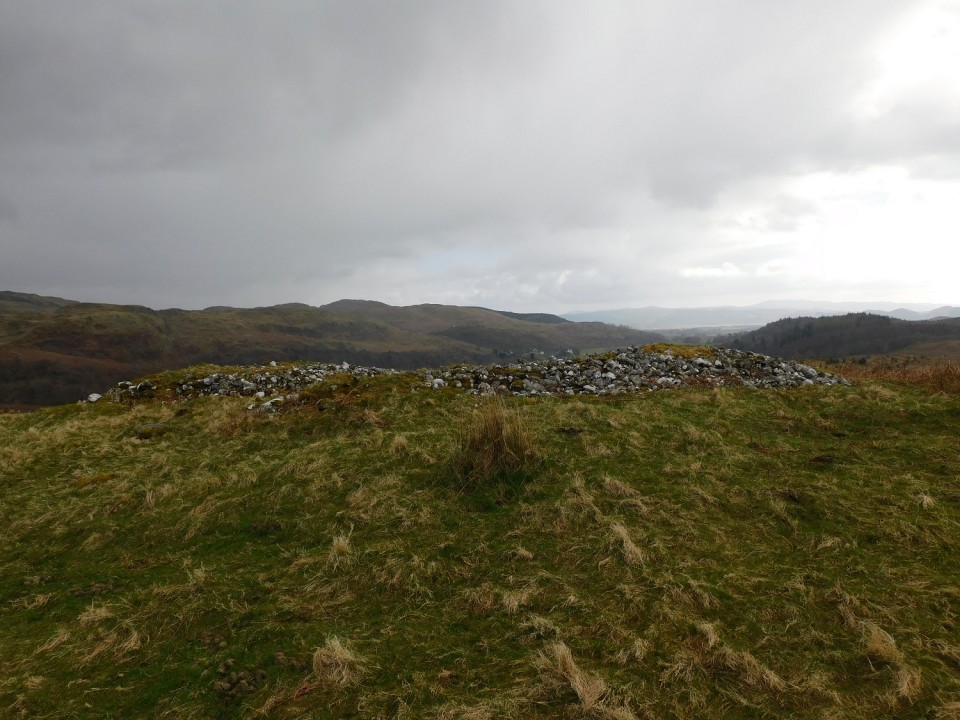
I parked on the A515 to the north of Harpur hill and walked up to the gate then skirt left round the fence and there it is. A manmade hill on a hill on a hill. The cairn is maybe 6ft tall and is strangely spread down the hill to the west, it has been dug into on the east exposing bedrock, the barrow is mostly round except for the spread to the west making me think the ancients picked an already prominent hilltop bump then elongated and built it up.
Watch out for the distasteful abandoned party tent, one shudders at the thought at what might occur here at night.
|
Posted by postman 21st March 2010ce |
 
|
Posted by postman
21st March 2010ce
|
Bejasus... these Cork 'circles are hard for the outsider to find, are they not? And without a lot of time/patience, forget it! Not worth asking the locals, either, since everyone assumes you're a tourist looking for Drombeg and - since that's signposted - you must be a muppet. One gentleman in particular looked me up and down and gave me the stereotypical 'I wouldn't be starting from here, mind...' directions to the honey-pot site even though, in retrospect, we were less than half a mile from Bohonagh.
However such tribulations can have unforeseen benefits, for example one false turn leading us to Woodfield, birthplace of Michael Collins. The name apparently still arouses heated, divided passions within Cork; the deep scars the Civil War inflicted upon Irish society clearly fade very slowly indeed.... nevertheless an enigmatic, intensely 'human' man worthy of much personal study in my opinion. But I digress.
Eventually the proverbial 'one last look' (seriously), whilst descending a steep hill, highlights the 'circle stones silhouetted upon the skyline opposite. No objections being raised at the nearest house, I set off up the hill and am promptly blown away - metaphorically this time - by the scene which greets me. With due respect to this morning's fabulous Drombeg visit, Bohonagh is in a different league altogether in terms of vibe and sense of place. There is an absolutely sensational aura upon this overgrown, unkempt hill top today. Possibly this has something to do with the towering, black storm clouds, washes of sunlight streaming across the landscape following a sudden shower. Then again it could be the sweeping views out to sea, or the joy of finally standing here being accentuated by the difficulty of the pilgrimage. Or the silence reflecting the overgrown impression of 'rawness' here? In truth I guess it's a combination of all these factors. The only (very) minor gripe is the cattle fence, but hey, so what?
But what of the circle itself? Nine substantial uprights stand in the ring, two of which, big beauties, are set radially to the circumference, acting as portals. Opposite, the conglomerate recumbent has been described by Mr Burl as ..'like an old white loaf thick with currants...' Wonderful words, indeed. Some way to the east is located a companion 'boulder burial', a sort of dolmen-variant with an (apparently) approx 20 tonne capstone resting upon much smaller supporting stones.
So everything's in its place at Bohonagh. I tend to think of the place as Drombeg's beautiful, reclusive sister who doesn't get the boys because she's too shy to come to the dance. Doesn't make her any less enticing, though, does it? I'd argue it makes her more so.... just like the landscape she graces, gloriously uplifting and melancholic by turn. Just like her even more reclusive nearby sibling at Reanascreena, another essentail visit.
We head back to Ballyvourney via Beal na mBlath (the site of Collin's ambush by anti-Treaty IRA forces), a spot which, like Bohonagh/Reanascreena encapsulates the heart and soul of Cork for me. Places which invoke real, raw human emotion; places which can make you actually feel something. How refreshing......
|
Posted by GLADMAN 21st March 2010ce |
Ballynoe is cited by none other than Aubrey Burl as 'one of the great rings of Western Europe'.... so an overcast morning, threatening rain, is probably not the optimum time to visit. But then experience has shown that dear Roisin Dubh rarely accommodates the insignificant wishes of Gladman, so he's well advised to take whatever's on offer, so to speak.
The circle is located a couple of miles south of Downpatrick, the town, as its name implies, more than happy with its association with yer man himself (although the claim that St Patrick's actually buried in the cathedral here is perhaps somewhat, ahem, tenuous). The final approach on foot is along a tree-lined track, the unintentional effect of which, combined with such a distinguished write up, is to heighten the anticipation of the traveller to, well, you get the idea. It therefore comes as quite a shock to find.... no fanfare... no fence, no turnstiles, no hype... in fact not even any people. Just a deep, lush pasture with Slieve Donard (one of the 'Mountains of Mourne') gracing the horizon to the south west and a slumbering arrangement of large stones poking above the grass. Right on!
The sense of anticlimax, albeit most welcome, is fleeting, for the validity of Mr Burl's assertion is soon very much apparent. And then some, since the circumference of the ring is still nearly intact, featuring numerous large orthostats. There's more, however, in the form of a long mound partially surrounded by a heavy, incomplete kerb. Whether this originally enclosed the mound is unclear, although further kerb stones at the western end suggest it did, I guess. The mound itself possesses remains of a cist at its eastern end. So, Ballynoe is a fine, multiphase monument. But which came first, long mound or circle?
Well, perhaps the siting of portal stones outside the (approx) western entrance at Ballynoe might shed some light here, for Mr Burl hypothesises that since this (amongst other features) is very similar to the arrangements to be found at several Cumbrian 'circles (in particular at the wonderful Sunkenkirk), there is a case for suggesting Ballynoe was erected by incomers from across the Irish Sea, perhaps trading axes from Langdale? And of course the great Cumbrian circles do not surround tombs. An intriguing theory, also discussed, incidentally, by Mr Cope in his 'You Gotta Problem...' sleeve notes.
Ballynoe has many other stories to tell, including possible Mid Winter alignments upon the aforementioned Slieve Donard. But perhaps the most significant story is that here we have one of Britain's finest stone circles languishing in relative obscurity. But don't just take Aubrey's word for it..... I happen to think so, too.
|
Posted by GLADMAN 20th March 2010ce
Edited 21st March 2010ce |
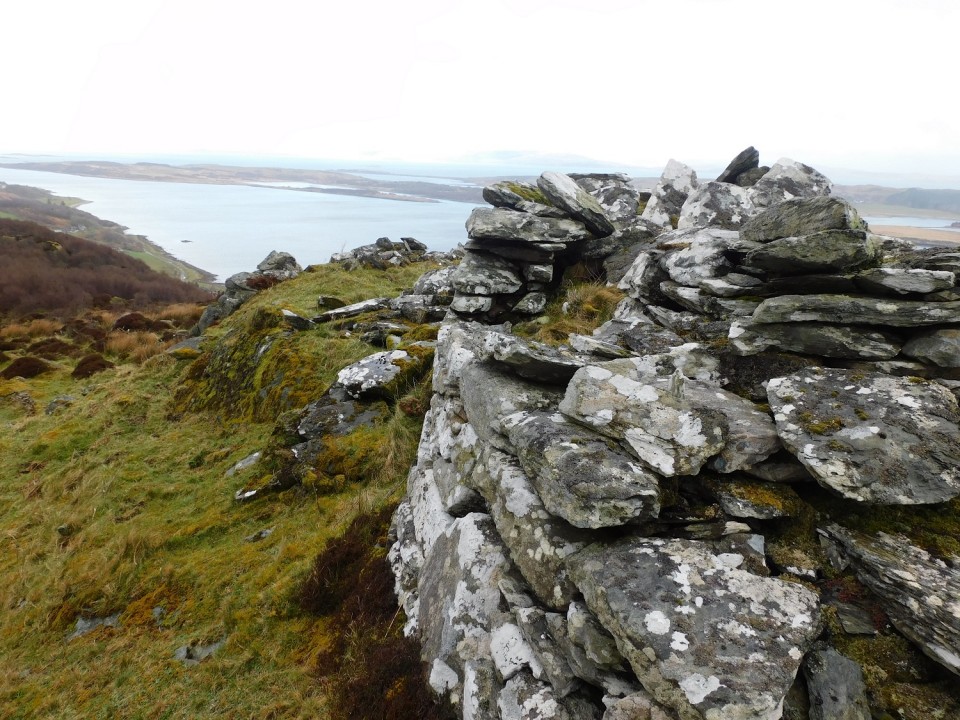
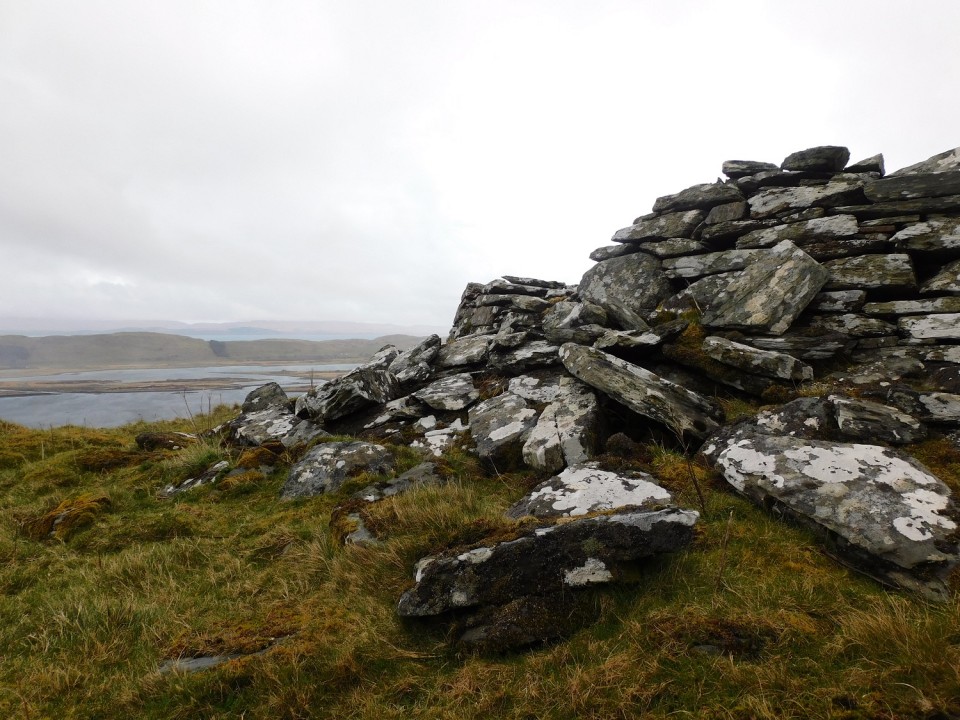
This camp is known as Whitefield-camp, Soldier's-fauld (now its recognized name), and Witches-neuk, said to be derived from the legend that 'Meg o' Meldon' in one of her midnight flights on broom shank, or a piece of ragwort, rested on the rocks that form its northern defence. There seems to be some confusion over the names up here. But the folklore goes with the name regardless I guess. Found in volume 10 of the Proceedings of the Society of Antiquaries of Newcastle-upon-Tyne (1902), p50.
|
Posted by Rhiannon 20th March 2010ce |
Although rising to a relatively modest 1,078ft, the incredible mini-mountain of Knocknarea (Cnoc na Riabh) appears much higher to the passing traveller, the result of its isolated coastal position emphasising its full elevation literally from sea level. Indeed, water would appear to be key to its significance within the landscape, the deep incursions of Sligo Harbour (to the north) and Ballysadare Bay (to the south) combining with the Garvoge River, draining Lough Gill (to the east), to form the peninsular upon which the mountain stands, to the west of the great Carrowmore megalithic cemetery. That Knocknarea and the latter are linked, I guess, must go without saying?
Knocknarea is visible - nay, dominates the skyline - for many miles around the locality, making it a suitable spot to erect surely one of the most enigmatic pile of stones in all Ireland... Miosgan Meadhbha, or Maeve's Cairn. Unexcavated, like nearby Heapstown Cairn, the monument is on a par with the great passage graves of Bru na Boinne in terms of size, but, for me, eclipses them in terms of visual impact and siting. Although generally thought to contain a burial chamber (or two) - oh come on, it must, surely? - I suppose we could even have an Irish variant upon the Silbury theme if this was found not be the case after all? Hmm. Unlikely, I think.
The monument is bordered by a substantial bank and several smaller cairns, further emphasising its stature, as well as a small prehistoric settlement to the north east. And of course there's the sweeping sea views across Sligo Bay and beyond Sligo itself to the elegant escarpment of Yeat's Benbulben, the evocative scene enhanced by cloud swirling around the cairn and across the summit plateau. Suffice to say if there isn't a great queen buried within... there bloody well should be!
Knocknarea truly has it all, so you won't be surprised to know that there's a price to pay for an audience with Queen Maeve... that of a steep climb. I'd suggest the easiest approach is the obvious one, via a pretty rough track starting from the Grange North car park to the south east.. not easy, but within the capabilities of the average mortal, I'd have thought. We took approx 45 minutes, although this included a diversion to eulogise with a typically rosy cheeked farmer over the beauty of his two magnificent horses whilst his cattle curiously looked on. Bear in mind the aforementioned cloud, however. Although a mini-mountain, normal rules apply, so take care.
|
Posted by GLADMAN 20th March 2010ce |
Interesting place, the mounds are Romano-British but the whole site has a much older feel to it.
The notice board says that five roads used to meet at the crossing and the Romans built a temple on the riverbank. I suspect that all this activity took place on an exisiting site.
Anyway it was chucking down with rain today and the Mounds look a lot nicer when the suns out so I will come back and explore further in the Sping.
|
Posted by north bucks 20th March 2010ce |
Cong is a small, historic town sited between the loughs Mask and Corrib, large bodies of water which restrict the approach to the mountains of Connemara from the east. Its principle claim to fame is the ruined 12th Century abbey, the building besieged by schoolboys as we arrive from Galway, thoughts of their heritage no doubt the last thing upon the minds of the little shites.... The other attraction is a ghastly, mock-medieval structure known as Ashford Castle. Hmm. Nothing here to satiate the megalithically minded then?
Appearances, of course, can be deceptive, for just a mile(ish) to the north-east sits as varied a four stone circle complex as you could wish for. Needless to say, without a map, or road sign of any description, we struggle to find the rings at first. But 'endure and perservere' has always been an unofficial Gladman motto.... and eventually the first of the quartet - the northern most, and coincidentally finest - comes into view. It is worth finding, being a variant recumbent circle, the recumbent and odd little flankers set on the northern arc of a ring enclosing the remains of a kerbed cairn. The setting is exquisite, too, the stones having been erected upon what would appear to be an artificial platform, overlooking a pasture from beneath a copse of trees. This, then, is the 'cared for' site for the occasional visitor.
The second site lies beyond the stone wall to the south. A large, embanked stone circle - the largest ring of the group - it is dishevelled, semi-derelict and overgrown, but nevertheless still possesses several large orthostats in situ. The visitor retains a perception of having a 'stolen moment' here; such experiences are, of course, often all the more sweeter and memorable because of their illegitimacy, whether actual or supposed. It is an evocative site, indeed.
The third stone circle, to the north east, is a ruinous cairn-circle of four surviving uprights. It is also engulfed by vegetation but well worth the calf graze I suffer climbing the dilapidated dry stone wall to get to it. Show sites have their place, but arguably these half-forgotten, hidden monuments offer more reward to the inquisitive.
The final circle of the group stands within the private grounds of Deanery Place, shrouded by yet more foliage. But unfortunately time has run out. Burl cites this as being a 'plain elipse' with a 'score of light-grey stones...'
Back in the car it's time to head into yonder mountains, well happy with a visit to perhaps the most neglected stone circle complex on the western coast?
|
Posted by GLADMAN 20th March 2010ce |
Megalithically-minded visitors to Lough Arrow and its environs - a most beautiful part of Ireland, it has to be said - are quite rightly captivated by the great Carrowkeel cairns crowning the Bricklieve Mountains. These are a 'must visit', if ever there was one. Other visitors, not so inclined, carry on down the N4 to Sligo, perhaps to indulge in some Yeats, or, if that doesn't appeal, 15 pints of Guinness. Hey, it's a nice town, so it is.
However virtually no-one, it would appear, makes the short detour beyond the northern tip of the lough to Heapstown crossroads. Time is money, or so the proverbial 'they' say, but if you do make the effort I guarantee your 'account' will be in credit. And you can't say fairer than that, can you?
For here, a little north of the aforementioned crossroads, sits a veritable slumbering giant of a cairn - I assume 'passage grave', although, like nearby Maeve's Cairn upon Knocknarea, it remains 'unopened'. And what an unassuming behemoth it is, too, hidden away in a wooded field set back from the junction of minor roads. A full 60m in diameter, it is one of the largest cairns in Ireland outside of Bru Na Boinne, far larger than those at Carrowkeel. The site is bordered by a kerb which infers that the cairn was once far larger than it currently is, the missing material probably now adorning many a local wall, road or building.
According to the local, excellent guide (issued by the Arrow Community Enterprise Limited), George Petrie (yes, himself) visited Heapstown in 1837, at which time a large monolith stood upon the cairn's summit. Unfortunately this is now long gone, apparently lying smashed somewhere within the lush vegetation surrounding the site. More's the pity. The site is known as Carn Oillriallaigh in gaelic folklore... which apparently alludes to it being the tomb of Aillil.... must study up on Irish mythology.
We visit upon a typically Irish day of fine, misty drizzle - the 'dry sort of rain which won't soak you to the skin', according to one of our many B&B hosts, I forget which - this lending a somewhat soft focus to the landscape and cairn-topped mountains beyond the lough. Does wonders for the female skin, too. Oh yes, this phenomenon being another of the wonders of Ireland. But I digress... Anyway, climbing the slippery cairn material with the intrepid 'Gladmum', a dog barks in the yard below as it spots the intruders, so momentarily breaking the silence which seems to envelope the great cairn like a warm blanket. We sit at the summit in hushed awe - reverence, even - trying in vain to contemplate the mind-blowing expenditure of effort it must have taken to erect this monument. And why build it here, aloof from the great nearby mountain top cemetery? Putting it simply I believe there is a lot more to Heapstown Cairn than currently meets the eye, and it could well have been an integral part of the Carrowkeel 'experience'. This is a very, very important site, indeed.
It certainly deserves to be better known...... but in a curious way is fine just the way it is, so to speak.
|
Posted by GLADMAN 19th March 2010ce
Edited 20th March 2010ce |
The most amazing thing I have ever seen was at Glastonbury Tor. Myself and my partner visited in early December and found the countryside was thick with fog - a real 'pea souper' - you could only see about 20 yards in any direction. Despite this I insisted on climbing the Tor as this was something I had never done. As we climbed (visability now pretty much zero) we feared it would be a wasted trip. However, as we reached the summit we literally walked up out of the fog, into brilliant sunshine - dark blue sky with not a cloud in sight. (The fog ended about 10 feet lower than the top). All you could see in any direction was the top of the 'cloud like' fog - as far as the eye could see. There was complete silence and a lone dove sat on top of the church tower. A truly memorable moment in my life. I only wish I hadn't left the camera in the car as we assumed it would be fog all the way up.
We later drove to Bristol airport where we had booked a flight to see the Northern Lights over northern Scotland. What a day!!!
|
Posted by CARL 19th March 2010ce |
This is one of those sites which I found to be 'jaw dropping'. I had of course seen many photos before visiting and had read many articles on the site. However, this did not prepare me for the sheer size of the place and the unbelievably large and deep ramparts - they are MASSIVE!!!!
The defenders of this hillfort must have felt very confident when they saw the Romans approaching......................... Allow as long as possible when visiting this site, It will certainly take a time to walk around the outside edge!
|
Posted by CARL 19th March 2010ce |
|
One of those sites you drive right up next to - in this case, even through it! Easy to park and obviously easy access. The circle is huge and Long Meg itself is very impressive. This is one of the best stone circles I have visited. Highly recommended.
|
Posted by CARL 19th March 2010ce |
|
With the aid of an O/S map I found this site easy enough. Park in the layby and it's only a short walk to the stones. This is the 'perfect looking' tomb - stunning - with great views all around. I would highly recommend a visit if at all possible.
|
Posted by CARL 19th March 2010ce |
|
Park on the main road and take the short walk up a 'resident's only' small walk. The site is on your right hand side behind the houses on the main raod. A lovely little place despite being in the middle of a residential area. Still, I imagine the stones will be here longer than the houses?!
|
Posted by CARL 19th March 2010ce |
|
Drive up Gaer Road (road on left off main road into Newport from the Tredegar House junction of the M4 - next to a traffic lights). Drive to the top of the hill and park in any of the side streets on the left. Most of these small side streets have a kissing gate at the end which gives access to the site. There is a grass walkway around the site which looks as though it is kept mown by the council. Good views on a nice day.
|
Posted by CARL 19th March 2010ce |
With the music of Arne, Purcell, Schubert, Schumann from todays Moray Music Festival in Elgin and the sound of Stiff Little Fingers (Aberdeen Tues 17th) still birling in my head some much needed fresh air was needed.
The 2 remaining stones, both standing over 1.7 meters tall, of a circle near Llanbryde provided the perfect escape. Sadly the other stones were destroyed to build a railway bridge. Still it must have some place in the past.
Heading west from Fochabers on A96 turn south just before the first Llanbryde roundabout over the railway bridge marked Greenfields. The garden centre has a tearoom. Follow the footpath sign until the tar track runs out, the stones are in the field slightly to the south.
With that it was back Elgin for the songs of Britten, Grieg and Strauss. Sometimes I love my job!
Visited 18/03/2010
|
Posted by drewbhoy 18th March 2010ce |
.. "Pepper Hill" at Weeting is said to be so called because from its poplar-crowned summit "Oliver Cromwell peppered Weeting Castle." From 'Norfolk and Suffolk' by W G Clarke (1921).
|
Posted by Rhiannon 18th March 2010ce |
Though there are surprisingly few traditions concerning the barrows, yet the curiosity they aroused in the minds of dwellers in the neighbourhood is shown by the fact that so many of them have names. That it was "a very mysterious mound" was all that I could glean from a shepherd concerning a barrow at Croxton, but he was able to inform me that it was called "Mickle Hill" (a name hitherto unrecorded)... From 'Norfolk and Suffolk' by W G Clarke (1921).
|
Posted by Rhiannon 18th March 2010ce |
How discovery off the Norfolk coast holds the key to Norway's past Lost land under the sea.....
It is just eight inches long, but its discovery changed what we know about prehistoric Europe and our ancestors.
The harpoon, which was found by a Lowestoft fishing trawler in 1931, was yesterday under the lens of a Norwegian television crew, who are making a documentary on the origins of Norway.
It is 14,000 years old, but in perfect condition, the points carved into it still sharp. It would have been used for hunting by modern man in late Paleolithic or early Mesolithic times; a time before written records when people lived in hunter-gatherer communities.
But it is where it was found, 25 miles off the coast of Cromer, that makes it important to history. When it was dredged off the sea bed in 1931, hidden inside a lump of peat, it was taken home by Pilgrim Lockwood, the skipper of the fishing boat Colinda. It later ended up in Norwich's Castle Museum, where it fascinated archaeologists. They thought it might have been dropped by hunters on a fishing expedition. But later tests showed that the freshwater peat it came from would have been on land thousands of years ago. They realised the existence of land in the North Sea, long since drowned, called Doggerland.
The harpoon is now on display in the Museum of Rural Life in Gressenhall, near Dereham, but was being filmed in the study centre at the Castle Museum yesterday.
Its significance to Norwegian history is that it shows how people from south-west Europe could have got to Norway. The theory is that in the last ice age, people from Iberia moved up into Britain, across Doggerland and into Scandinavia.
Producer Ole Egil Strkson said: "This particular object is the first clue that that happened."
The producers had been hoping to find relatives of Pilgrim Lockwood to tell the story of how he found the harpoon. What is known is that he returned to the site in 1932 to take the peat samples which were used for testing.
The television crew said they felt moved by the age and significance of the deer antler harpoon, known as the Leman and Ower harpoon after the sandbanks where it was found. Presenter Samina Bruket said: "I was allowed to hold it. To think it is 14,000 years old is just amazing. I had seen pictures of it but it is even more beautiful than I thought, it was so shiny and well preserved."
Mr Storkson said: "It has been carved, so you can see it really has been used by humans."
Alan West, a curator of archaeology with Norfolk museum service, said: "It was originally part of a pair. The barbs faced each other with a long shaft used to stab down, like the eel spears you see from the 19th century."
The programme, which will be called Norwegian Roots, is due to be shown in December on the biggest Norwegian television station in prime-time.
The film crew went on to visit Holme-next-the-sea, near Hunstanton, where they filmed peat and remains of tree roots visible at low tide, showing that there was once land which is now covered by sea.
They are also planning to visit Vince Gaffney, of Birmingham University and an expert in Doggerland. He says that: "a very real, human tragedy lies behind the loss of this immense landscape", and that with global warming and sea levels rising, it has relevance today.
About Doggerland
Doggerland, named after the Dogger Bank sandbank, is thought to have existed between 12,000 and 8,000 years ago.
During the last ice age, much more water was contained in the polar ice caps, and the North Sea included an area of land larger than England and Wales, linking East Anglia with Holland and Belgium, with a much narrower stretch of water cutting off Britain from Norway.
It is thought to have been a land of rivers and marshes, which offered good hunting grounds for people. As the earth warmed and sea levels rose 8,000 years ago, the land was covered by water. Sea levels rose at one or two metres per century, creating a loss of land which would have been noticeable to the residents but not enough to drown them overnight.
http://tinyurl.com/yhupq53
Europe's Lost World - Rediscovery of Doggerland..
http://www.britarch.ac.uk/books/Gaffney2009
|
Posted by moss 18th March 2010ce |
|
Where else can you get a drink and a meal sat right next to a prehistoric site? (Avebury is another place) At least you could when the pub was open!
|
Posted by CARL 18th March 2010ce |
Archaeology, folklore and history of Guiseley's standing stone.
|
Posted by Paulus 18th March 2010ce |
|
Park in the car park in the village of Killin and walk over the old stone bridge (above the waterfalls) and turn left heading towards Kinnell House. Walk up the private road, through the trees, and as you approach the house the stone circle is in the field on your right. Easy to access although I imagine you should ask for permission first. A Nice little stone circle - worth a visit.
|
Posted by CARL 18th March 2010ce |
|
Easy to get to. After visiting the ancient yew, turn left down the road (church behind you) and in about 100 yards look in the field on your right. Access is through a gate and a gentle walk will get you to the stones.
|
Posted by CARL 18th March 2010ce |
|
Visited this site on the way to Castlerigg. Park at the start of the (private?) road which leads up hill to the farm. A bit of a walk but on a nice day lovely views to be had looking down the valley. The circle is right next to the farm track and access can be gained via a gate. I really, really liked this place and actually prefered the circle itself to Castlerigg. Make the effort to visit this site - you won't be dissapointed.
|
Posted by CARL 18th March 2010ce |
|
My favourite stone circle. The views are simply stunning. I had a 'jaw dropping' moment the first time I visited this site. I had read a lot about it before visiting and I am pleased to say that it not only met, but exceeded my expectations. The circle itself is a joy to behold, but the setting is something else.
|
Posted by CARL 18th March 2010ce |
London Stone: Making a Myth Lecture. Museum of London, Tuesday, 13 April. 6.30-8pm. Free.
"John Clark has recently retired from a long and distinguished career as Senior Curator (Medieval) at the Museum of London. In this talk he investigates the strange history of London Stone, the mysterious block of limestone that currently sits, ignored by passers-by, in an alcove in the wall of a building opposite Cannon Street Station."
More here - http://heritageaction.wordpress.com/2010/03/17/london-stone-making-a-myth-3/
|
Posted by Littlestone 17th March 2010ce |
Showing 1-50 of 68,955 posts. Most recent first | Next 50 
|