Over the hole in the roof towards Seahan back in County Dublin.
Image credit: ryaner

Over the hole in the roof towards Seahan back in County Dublin.

What I believe is some sort of trig point that collapsed into the chamber, and whose construction may have contributed to the collapse. You can see the ring of concrete a third of the way up the stone.

The second recess chamber on the left, eastern side, lit up with flash.

What may be the capstone of the corbelled roof soars above the hole in the chamber roof.

The exposed corbelling on the north-western side of the collapsed roof.

The tomb entrance and passage are aligned on the cairn on Seahan, 15 degrees east of due north.

If there is a better tomb entrance in Ireland I haven’t seen it yet.

The line of kerbstones at the south-east is 3 metres away from the cairn, showing that robbing occurred even up at this height.

Approaching from west-north-west.

Detail of a passage roofstone, with chocking stones. The colour on this is beautiful.

At the back of the tomb, some of the kerb stones have fallen away.

Corbelled granite stones in one of the five subsidiary chambers.

Construction of the passage was quite a complex affair, packing stones and chocking stones abound. Again, note the quartz encrustation on the stone direct centre.

This is a shot from just inside the tomb entrance. The stone on the left is quartz-encrusted and is the first stone after the entrance stones. The stone on the right side has traces of quartz encrustation but this looks like it has eroded badly over time but originally covered the whole facade of the stone.
The passage here is a tight squeeze and bends slightly to the right, a seemingly deliberate kink to force you between these two stones as you enter this tomb, away from the light and into the darkness.

This is the chamber entrance, looking back down the passage towards the outside.

An archive image of this wonderful passage grave taken on 27/6/05 – a scorching hot day. In Wicklow, you ask? Incidentally, I was accompanied by my parents, both in their late 60’s at the time – also insisting on the extension to Seefingan! Simply one of the most magical prehistoric sites in these Isles?


3/5/10
The carving in the passage. It’s actually quite large, maybe a foot top to bottom.

Seefin Hill to the right, Seefingan to the left, two parts of the passage grave cemetery that includes Seahan Hill in Dublin.

The view south west over the entrance towards the Poulaphuca Reservoir


Looking down the passage from the entrance, with added flashes of course.

Inner chamber rock art under natural light.


This is a picture of Seefin on New Years Eve 2008, with the glare of the winter sun behind the site looking south towards the most northerly point of Pollaphuca Reservoir in Wicklow. Hope the frost makes it a worthy addition.

The south and west recesses showing more of the rubble clearance

Since I was last here quite a bit of the rubble has been cleared from the chamber entrance at the end of the passage

Seefin Hill passage grave, christmas eve ‘06

Seefin Hill passage grave, with Kippure in the background. See latest fieldnotes.

The hole in the eastern wall of the passage.

Passage roof stone.

Western recess cleared of rubble with new additions.

The newly built ‘wall’ around the lip of the hole above the chamber.

The freshly exposed part of the cairn.

The stone to the right of the firebase is the sill stone of the small court at the mouth of Seefin’s passage. Mama nature is already doing her slow erosion up here at 621 metres without some idiot helping her along. If you happen this way again, have your fire someplace else, far away from the tomb.

The south and west recesses with the heavy rubble from the roof

The roof of the west recess.

The passage from just inside the tomb entrance.

A view of the passage roof. Note the oxidation on the stone on the right.

Packing in the east wall of the passage, similar to that found between orthostats R3 and R4 on the east side of the passage at Newgrange.

Looking down the passage from the chamber entrance. This is where the rubble from the chamber roof begins, making access into the chamber from the passage difficult.

Sorrell Hill from Seefin, there is a cairn on top of this hill as well


Looking out of the chamber

The passage in good light

Seefin, taken from Seefingan

Mama Seefin

This beautiful stone is at the end of the passage just before the chamber entrance

Sunset on Seefin

Sunset taken over the passage entrance

The hole in the collapsed roof.

The very faint diamond shape carving in the neck of the tomb. Got the pointer for this from FourWinds.

Loved the colours on this one. Similar view looking down the passage. You can just make the entrance out.

Looking down the passage towards the entrance from the rubble of the collapsed roof

One of the chambers fill with rubble. What treasures lie beneath this rubble?
So another 7 years has passed since I last visited Seefin. I truly hadn’t believed it was that long – it’s so close to where I live and I see it so often from various angles as I explore the north Wicklow hills that I take it for granted. There was a break in the weather that coincided with a break in my schedule so I decided to head up. Recent reports of vandalism at upland sites had me wondering.
I parked in the forestry entrance just at the end of the army rifle range. It’s wide enough for a few cars to park and still have ample room for emergency services etc. There seemed to be some sort of hill-walking jamboree on in the area – or at least it was finishing by the time I arrived around 3pm. There’s a quite vigorous loop walk that you can attempt – Seahan (with its cairn and passage graves) to Corrig to Seefingan (with its unopened cairn) and on to Seefin and down and then back up the road. I’ve been to all save megalithicly barren Corrig and have never attempted the loop, which one could say takes in the whole of the ‘Kilbride passage grave cemetery’.
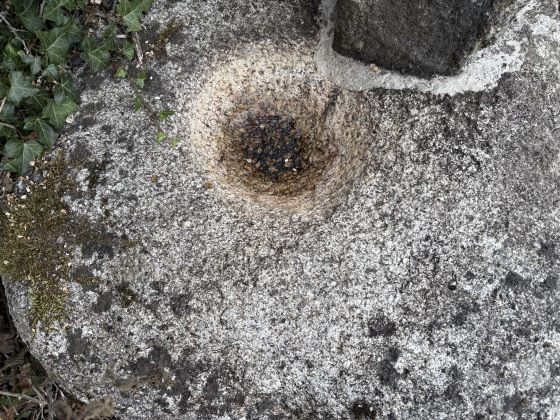
The ascent is a trudge for us mere mortals. There were rain clouds threatening all the while so I wasn’t waiting around. The hill starts to steepen once you pass the bracken fields and gain the heather line. There’s a well-worn track here but you’re clambering more than hill-walking. About 150 metres below the cairn I came across a dressed stone that has a very bullaun-like hollow. I can’t say I’m 100% sure of it. It’s splayed right across the track and stepped over or around by all those ascending and descending by this route. I’m tempted to add it here but maybe not.
The approach to the cairn here is from the north-west. It starts to appear on the summit horizon line when you’re about 30 metres below and 200 metres away from it. It looks just like any other mountain-top cairn from here, a pile of granite rubble – but looks can be deceiving. Were you blissfully ignorant you would be in for a major surprise. You might begin to suspect something greater is happening if, like I did, you skirt around the cairn anti-clockwise and begin to see the collapsing kerbstones on the west and southern arcs. Unlike at the north and east of the cairn, the hill here falls away steeply and the resultant pressure on the kerbstones has taken its toll.
Moving around to the east the kerbing continues, but further out from the cairn, showing that even at this height cairn material robbing has occurred. And then you reach the entrance to the passage, aligned almost due north onto the cairn and passage grave on Seahan. I used to be able to glide through the labial portal stones but daren’t risk it these days. The small forecourt in front of the entrance is intriguing – was it filled and sealed after a certain period of use? Is the drystone walling of its sides original? There is an entrance type sillstone/kerbstone about three metres in front of the entrance, but in front of it is a higher but narrower slab and then, in turn, cairn rubble in front of that.
I didn’t venture into the passage from either end today, but did guiltily climb down into the chamber through the hole in the roof. The corbelling of the remains of the roof is still impressive, leading one to wonder how magnificent it was when originally built. Macalister’s 1932 ‘excavation’ report (really just a survey) only runs to 5 pages and some of it is worth quoting. He says: “The chamber lay partly roofless, and had apparently been rifled and left derelict centuries ago. It was almost full of stones, thrown into it, as we were informed, by the soldiers in the camp [Kilbride] for a pastime.” Nowhere in the report does he mention the trig-point-like stone with it’s concrete skirt I identified on this visit. He goes on to muse that it was early Christians that broke into the roof, speculating that the carving of a cross into the uppermost remaining stone of the roof as evidence that they may have “cut the cross as a barrier between themselves and the possible vengeance of the plundered ghosts.” Hmmmm.
Macalister only emptied out the smaller stones from the chamber and a lot of stones have fallen back in since 1931 to join the large boulders from the roof. People come here regularly as it’s on that popular loop mentioned above. I’ve usually met people here on previous visits and today was no different. Nosing my way around among the rubble on the floor of the main chamber and into the recesses I heard voices above my head and resented the intrusion. My best interactions with the stones are usually an intimate and solitary pursuit so the arrival of outsiders broke the spell. The stones around the lip of the hole in the roof are not overly stable so I felt just a tad vulnerable and emerged from the chamber before I’d wanted to.
The rain clouds were gathering to the south as I sat in the sunshine and pondered all this. The chamber and recesses at Seefin have more secrets to reveal and the next time I come I must give myself more time to explore, especially at the neck of the passage where it joins the chamber. The complexity of the construction here is fascinating, as it opens out into the chamber and soars up to the roof. The five recesses and one mini-recess would all bear further investigation too and a better camera than my camera-phone. I love Seefin and was happy to see that the spate of vandalism that has occurred at other upland cairns hasn’t occurred here; which is not to say that it’s not vulnerable. It remains so and I’m hoping that the amount of water in the passage is only a sign of the very wet, late summer we’ve had and not something more sinister.
And so to Seefin once again… carrying an extra 3 stone more than the last time I was here. There’s a few places on the way up where I thought I might not make it. Dear me, I felt a bit of a disgrace. Was it enough to make me do something about it? Well, I’ve tried over the last while to get out there at least once a week, but Seefin is a challenge, and it’s not the gravest of challenges either, so while I was glad to be back, I looked over at the cairn on Sorrel Hill and promised myself that I’d ‘do’ it yet!
We had looked back down the hill at some hillwalkers below us and determined that we wouldn’t be overtaken – no pasaran! Arriving at mama Seefin I dropped my bag and headed inside, climbing down through the collapsed chamber roof and into the passage itself. I get emotional here, enclosed in the dampness of this slowly crumbling sepulchre, the beauty of the corbelling in the subsidiary chambers and at the passage entrance, before the roof rises to the imagined height of the collapsed central chamber.
I’d fretted before about Seefin, threatened by well-meaning but misguided excavators, as well as insensitive barbecuers lighting their fire on the sillstone. A short conversation with the hillwalkers who told us of the time they arrived to find some arseholes on their scramblers riding all over the tomb didn’t re-assure me.
We had a good root around this time. The opportunity for vaginal re-birth at the entrance to the tomb is something I never pass up, even in my newly more portly state. I did think ‘what if i get stuck?’, all the way up here etc. but still squeezed through.
The complexity of the construction of Seefin never ceases to amaze me, and that it was done at such a height all those 5 thousand years ago adds to its mystique. The commitment of the builders to construct and leave behind this memorial, this intricate structure, and then to maybe seal it up and leave it there, on top of the hill at Scurlocksleap, says something about our ancestors and their way of life that leaves me wanting to find out more and more and more.
12/5/07
The clearance of the chamber continues. Last time I was here (24/12/06) I had to lay flat and shimmy down from the rubble in the chamber to get access into the passage. Not any more. The entrance has been cleared, exposing the sillstone that separates chamber from passage. Even more of the roof rubble has been cleared from the chamber itself, revealing more of the giant capstone and some more of the collapsed corbelling. All this moving of stones, while it exposes more of the chamber, cannot be good for the structure. The collapse of the roof had settled for god knows how many years and seems to have supported parts of the chamber that may well collapse if any more is removed. Some of the lintels and roofstones around the chamber entrance are looking in a very precarious condition. While the clearing of the stones opens up the monument that bit more, the inexpert nature of the ‘excavation’ doesn’t instill confidence. Lighting fires on the old capstone can’t help either.
I guess I had a sort of coming of age today 5/9/06 on Seefin. The fragility of the tomb had never been clearer. Standing at the back of the tomb in a full force gale, I realised the slow erosion that the wind alone could cause to the rocks over thousands of year. Add to that rain, snow, frost, hail and occasional strong sunshine and it’s a wonder that so much of it has survived. For how much longer?
Well, the passage seems to have deteriorated further since I was last here 2 months ago. Maybe I hadn’t noticed it before, but there is a gaping hole about a metre and a half deep and the same in height in the eastern wall about 5 metres from the entrance. Cairn material is falling into the passage from this. There’s another, less serious, in the wall opposite. Rain is seeping into the passage itself and puddles are collecting on the floor.
The hole above the chamber shows major human interference. Some clown has used cairn material to bulid a wall around the lip of the hole. They’ve used the covering rocks of the cairn and dug down about a metre into the cairn itself, exposing the underneath.
The western recess shows signs of someone having performed some sort of ritual, with a lot of the roof rubble removed, and some of the ‘newer’ quartz stone from the exposed cairn formed into some sort of ‘altar’.
The slight remains of the firepack on the rock beside the sill/entrance stone that I saw 2 months ago should be well gone by now, but alas no: there’s even more ashes there now.
I headed down off the hill more depressed than angry.
15/6/06
This was my third visit to Seefin Hill in as many months and was quite an eye-opener. Should you happen this way, I would urge you to allow yourself at least half a day here. There is much to see on Seefin, and not just the main tomb, though your time would not be wasted if you devoted all of it to this relatively well-preserved monument.
On this day I gave myself more time than usual to explore some of the curious sites on the western ascent. There are many and various rock outcrops here. Sorting through them, cataloging them and understanding them would take more time and more expertise than I have. However, I am convinced that there are many traces of human activity here, whether they be neolithic, bronze age or more modern. It’s actually quite a diverting way to pass what can be a sometimes strenuous climb.
Arriving at the tomb itself is always a relief. That such an example of this type of grave is perched here, high up and far from the madding crowd, brings a joy and peace to the spirit. I’ve met people the three times I’ve been up here but none of them were very interested in the significance of the site. This time, however, I came across some activity that left me more than a bit perturbed. Someone had taken the trouble to bring a ready-made fire pack up with them and had used the sill stone as their fire base. Desecration may be too heavy a word, but that they didn’t bother to clean up after them was annoying.
This got me to thinking about preservation and conservation of the tomb. The access through the portal stones is quite difficult. I’m not of that heavy a build, but I still need to almost lie down and wriggle head first through the wider gap at the ground level. It seems that most if not all prefer to enter through the collapsed roof of the chamber. This is further degrading the perilous condition of this area and it seems that as time goes by more and more of the upper cairn material is falling in here. (I’m always aware when talking about this that I would hate to see some sort of regimen put in place that limits access to this site. The balance between conservation and access is a frustrating one to achieve. Besides, part of the beauty of this site is the free and easy access and the possibility of having a passage tomb in relatively good condition all to yourself.)
On entering through the portal stones you may experience a slight claustrophobia. The passage is quite narrow with some of the orthostats tilting inwards. Check out the base of the third one on your right for the faint diamond/lozenge carving. I’ve never brought a torch, relying on the camera flash to reveal glimpses of the structure of the passage (this adds to the slow revelation of the tomb to me. You may prefer the torch method. I live just a ten minute drive from the base of the mountain.) Limited to my method of survey I’ve not had much joy in studying the roof of the passage, but camera shots have revealed an intricate series of stones. I read somewhere recently that there is a christian cross carved on one of the roofstones but haven’t felt the need to look for it.
My favourite part of the tomb is on the left of the entrance to the chamber. The colours of the corballed stones here, revealed by the camera flash, are beautiful. It’s quite difficult to manouevere here as this is where the roof rubble begins. I’ve lain down on my back and wriggled around on my front in a bid to get better shots here. The pile of rubble gets steeper as you make your way into the centre of the chamber. Two of the recesses are visible but contain quite a bit of rubble. Moss covers a lot of the walls in both. You could, were you agile enough, sidle your way down into the recesses. The worn beauty of the roof stones here is similar to that of the chamber entrance. I’ve thought that I’d love to see this cleared out to check for carvings.
Surveying the lips of the roof hole it’s easy to see the continuing degradation of the tomb. At times the whole structure seems on the verge of collapse. I’ve tried to not use this as an entrance or exit but it’s too tempting. Around the south-eastern edge of the tomb you can see the original kerbstones, about 2 metres away from the cairn pile. These curve back into the cairn itself on the south side. From over the hole in the roof, aligning yourself with the passage by sighting on the entrance, the views across to Seahan are great. From this position, sister Seefingan is away to your right.
Seefin is my favourite place bar none on my new megalithic odyssey. However, from my last experiences here I would be quite a bit worried about the integrity of the site. I wonder when the last time an officer from the Office of Public Works was up here.