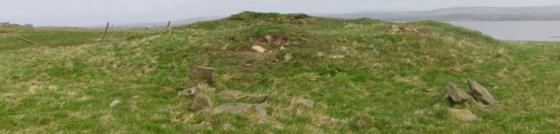
The Stone’o Hindatuin looking out, as most things on Orkney do, towards the hills of Hoy.
Image credit: Paul Kesterton

The Stone’o Hindatuin looking out, as most things on Orkney do, towards the hills of Hoy.

northerly view


westerly view

looking across quarry

easterly view

northerly view from quarry edge

westerly view

view looking across quarry

easterly view

one heck of a rubbing stone

standing stone under matrilocal care


Lovely stone

Visited 9th August 2012
Having a bit more time on Orkney this trip I thought I’d track down some of the less visited stones on the island, and first on the list was the menhir at the aptly named Staney Hill. Taking the minor road off the A965 just before the Maes Howe visitor centre at Tormiston Mill(a right turn if coming from Kirkwall as we were), the road runs right up behind Maes Howe. Not having access to Wideford’s fieldnotes, we carried on up this road passing the Grimeston junction, whilst I kept my eyes peeled for the Stone o’Hindatuin, which soon could be seen in the field to the right. Ellen pulled into a nearby passing place, as there seemed nowhere else to leave the car. The next difficulty then seemed to be the lack of any visible fieldgates. As I’ve often said I don’t feel I’ve had a proper visit to a place unless I can actually touch the stone, I don’t know why it just makes me feel more ‘connected’ with the place, so refusing to be put off by something as trivial as a barbed wire fence, and with no noticeable livestock in the field, I hopped the wire, barely managing to keep the seat of my trousers intact.
Ellen stayed in the car, both in case of having to move it if we had a sudden rush of traffic, and also, having better sense, deciding she’d quite like to keep her clothes intact. Once into the rather large field, I noticed a distant group of cows now glowering at me disinterestedly, as I headed up to the stone which sits on a natural ridge. From here you get a great view, out down to the Loch of Harray, where Stenness is just visible, and the hills of Hoy, still cloud capped rising proud to the south-west. The stone is huge, it must be about 9’ tall. Some stones around the bottom of the menhir look as if they have been packed at the base to pack the stone, and a grassy covering which has covered the stones now makes for an ideal seat, where I write up my fieldnotes.
This is a fine stone, it’s so peaceful up here, even though directly opposite across the road is a house, there’s no-one else around, with only the sounds of the occasional car interrupting the call of the birds. The stone has the usual light dusting of Orcadian sea moss, and seems to gaze towards Hoy like a silent sentinel, just another of Orkney’s many fine stones. On returning to the car we had a number of strange looks from the man living in the house just up the road, who Ellen said had come out of his house three times to suspiciously stare at the car (obviously thinking we were up to no good!) Aside from the slight access difficulties (which I’m sure would be removed if you follow Wideford’s notes!) this stone is definitely worth the visit.
Come up the minor road alongside Maes Howe [marked Fursbreck Pottery] up and past Hybreck until you reach the Grimeston road junction. Pass along the Grimeston road to a fieldgate on the left. Here I entered the place where the standing stone is, striking a diagonal by a small dry burn (these being all over and about Staney Hill I imagine one can rule out glacial deposition for the big rocks ?). From the Staney Hill road you can see the stone behind a ledge like a very low cliff, and then coming this way it reveals itself to be standing above one end of a long wiggly quarry
All that is recorded are the bare measurements and yet this is the stone that named the hill and the road . Unfotunately my scanner insists on cutting off the bottom of the slide , but just visible here on the very bottom right-hand side is an exposed horizontal rock stratum and I wonder if this extends behind to form a natural platform for this stone ( or even have to do with why it was stood there in the first place ) . Oriented ENE/WSW.
It is said that the party who transferred the bones of St. Magnus from Birsay to Kirkwall stopped here to await the Harray men who would share the task, these men were said to have scuttled out from their huts like crabs, which gave the inhabitants of Harray their parish nickname!
A possible alignment for the Ring of Brodgar , this was one of the stopping-off points in the procession of St.Magnus’ remains from Birsay to Kirkwall .
Apparently a local ex-archaeologist “once mentioned a mini stone circle on the Grimeston side road (between Staney Hill Rd and Harray Rd”. Another archaeologist friend, who related this, added that there was summat “visible on the S side of the road” but that she thought that “the OAT view is it’s a damaged and unusually wide bell barrow”.
In 1920 the author (J.F.) of a two-part newspaper account of Harray believed large irregular stones lying roadside (? over the other side, on the way to the horned cairn) could be the ruins or start of a circle.
There are some outsize stones in the roadside bank at the right as you go up to the standing stone, over half a metre and much too oddly shaped for any drystane wall.