|
 Log in |
Register Log in |
Register
|

|
FranceCountry
|


 16 discussion topics


 Show |
 |
|
|
Sites/Regions:
|
1 site
Alpes-Maritimes (06) Departement |
18 sites
Ardeche (07) Departement |
4 sites
Ariège (09) Departement |
|
6 sites
Aude (11) Departement |
1 site
Aveyron (12) Departement |
7 sites
Bouches-du-Rhône (13) Departement |
|
5 posts
235 sites Brittany Province |
3 sites
Calvados (14) Departement |
2 posts
6 sites Charente (16) Departement |
|
9 sites
Corsica (2a&2b) Island |
1 site
Côte-d'Or (21) Departement |
5 sites
Deux-Sèvres (79) Departement |
|
2 posts
4 sites Dordogne (24) Departement |
2 sites
Eure (27) Departement |
20 sites
Gard (30) Departement |
|
1 site
Gironde (33) Departement |
1 site
Haute-Loire (43) Departement |
5 sites
Haute-Vienne (87) Departement |
|
29 sites
Hérault (34) Departement |
13 sites
Loire-Atlantique (44) Departement |
1 site
Lot-et-Garonne (47) Departement |
|
2 posts
3 sites Lot (46) Departement |
1 site
Lozère (48) Departement |
21 sites
Maine-et-Loire (49) Departement |
|
3 sites
Manche (50) Departement |
7 sites
Mayenne (53) Departement |
1 site
Nièvre (58) |
|
1 site
Nord-Pas-de-Calais (62) Departement |
2 sites
Nord (59) Departement |
1 site
Orne (61) Departement |
|
Pyrénées-Atlantiques (64)
Departement
|
14 sites
Pyrénées-Orientales (66) Departement |
2 sites
Sarthe (72) Departement |
|
1 site
Savoie (73) Departement |
Seine-Maritime (76)
Departement
|
5 sites
Val-d'Oise (95) Departement |
|
3 posts
7 sites Var (83) Departement |
12 sites
Vendee (85) Departement |
1 post
3 sites Vienne (86) Departement |
News |
 Add news Add news |
Evidence of Europe’s first Homo sapiens found in French caveStone artefacts and tooth pre-date the earliest known evidence of the species in Europe by more than 10,000 years. Archaeologists have found evidence that Europe’s first Homo sapiens lived briefly in a rock shelter in southern France — before mysteriously vanishing... continues... |
 Posted by ryaner
10th February 2022ce |

Oldest ever piece of string was made by Neanderthals 50,000 years agoBy Michael Le Page A piece of 50,000-year-old string found in a cave in France is the oldest ever discovered. It suggests that Neanderthals knew how to twist fibres together to make cords – and, if so, they might have been able to craft ropes, clothes, bags and nets... continues... |
Posted by ryaner 10th April 2020ce |
Neanderthal footprints found in France offer snapshot of their livesScientists find 257 prints that were preserved in wind-driven sand 80,000 years ago Scientists have found hundreds of perfectly preserved footprints, providing evidence that Neanderthals walked the Normandy coast in France... continues... |
Posted by ryaner 11th September 2019ce |
|
Possibly Neanderthal cave structures in the Pyrenees 300 meters from the surface, circles of broken-off stalagmites stacked against each other, dated at 176,000 years old. There's a nice 3-D rendering in Nature and a nice photo in The Atlantic. |
 Posted by UncleRob
27th May 2016ce Edited 27th May 2016ce |
|
Messages from the stone age Stone age "writing" found in French caves, http://www.newscientist.com/article/mg20527481.200-the-writing-on-the-cave-wall.html |
 Posted by postman
19th February 2010ce Edited 19th February 2010ce |
Folklore |
Add folklore |
In France, as in England, and indeed most countries [Stones] are usually connected in the popular belief with fairies or with demons - and in England, with Robin Hood. In France this latter personage is replaced by Gargantua, a name made generally celebrated by the extraordinary romance of Rabelais. A cromlech near the village of Toury, in Britany, is called Gargantua's stone; a not uncommon name for the single stone or menhir is palet de Gargantua (Gargantua's quoit).From Thomas Wright's 'The Celt, the Roman, and the Saxon', parts of which are reprinted in a review in The Gentleman's Magazine v.193 1852 Jul-Dec (p233). |
 Posted by Rhiannon
17th January 2008ce |
Miscellaneous |
Add miscellaneous |
|
Sites in France are listed in their départements which are roughly equivalent to English counties. The only exception to this is the région of Brittany, which is subdivided into its départements of Côtes-d'Armor, Ille-et-Vilaine, Morbihan and Finistère. |
 Posted by Jane
21st August 2007ce Edited 22nd August 2007ce |
Links |
Add a link |
Megalithes du MondeInteresting site from France detailing all manor of ancient sites in France, Belgium, Scotland, Ireland and Wales. (Clearly not a fan of the English). English translation via Google. |
 Posted by Chance
6th March 2011ce Edited 6th March 2011ce |

Orientations of 935 Dolmens of Southern FranceOrientations of 935 Dolmens of Southern France by Y. Chevalier From the Journal of History of Astronomy, Archaeoastronomy Supplement, Vol. 30, p.S47 A full referenced Journal Article is available to download in PDF format or you can view the pages online in gif format. |
Posted by Chance 12th June 2010ce |
Dolmens lost and foundAll things Stone, Copper or Bronze in Languedoc. A personal blog by an Irish Englishman, living and working in the Corbieres - a member of S.E.S.A. [la Société d'Etudes Scientifiques de l'Aude.] |
Posted by roc 13th December 2009ce Edited 13th December 2009ce |
Oppida - Celtic townsOppidum (plural oppida) was the name used by Caesar to describe the Celtic towns that he discovered during his conquest of Gaul. In archaeology, the term is now used to describe all fortified Celtic sites covering a minimum area of 15ha and dating back to the second half of the 2nd and 1st centuries BC (the late La Tène period). These towns were both economic and political centres. They are considered to be the first towns to the north of the Alps. This website offers you the opportunity to find out more about each of the oppida via information sheets. For more information, click on an oppidum or go to the themed exhibitions… For more on Julius Caesar's conquest of Gaul in the Gallic Wars, 58 BC to 51 BC. See http://en.wikipedia.org/wiki/Gallic_War for more info on this period of European History |
Posted by Chance 15th May 2009ce Edited 15th May 2009ce |
Latest posts for France |
Showing 1-10 of 3,170 posts. Most recent first | Next 10 
Barnenez (Chambered Cairn) — Fieldnotes |
|
Visited 20.09.23 I was suffering from Stone-Fatigue after a week in and around Carnac. I opted to drive for 3 hours to Cairn de Barnenez as a relaxing change. The monument was well sign-posted. The entry fee was a reasonable 6 euros. The epic scale of Cairn de Barnenez was intimidating at first. There are 11 parallel dolmens in the cairn running SE-NW, however all but one of the passages are closed to the public. It took me 45 minutes to fully capture the essence of the monument. Cairn de Barnenez is a recommended visit. |
Posted by markj99 13th October 2023ce |
Crucuno Rectangle (Cromlech (France and Brittany)) — Fieldnotes |
|
Visited 19.09.23 Like Jane, I struggle with the concept of rectangular "Stone Circles". I am conditioned to expect rectangular structures to be modern and stone circles to be ancient. I had the same problem with Quadlatiere du Manio. I left Cromlech de Crucuno with more questions than answers. |
Posted by markj99 13th October 2023ce |
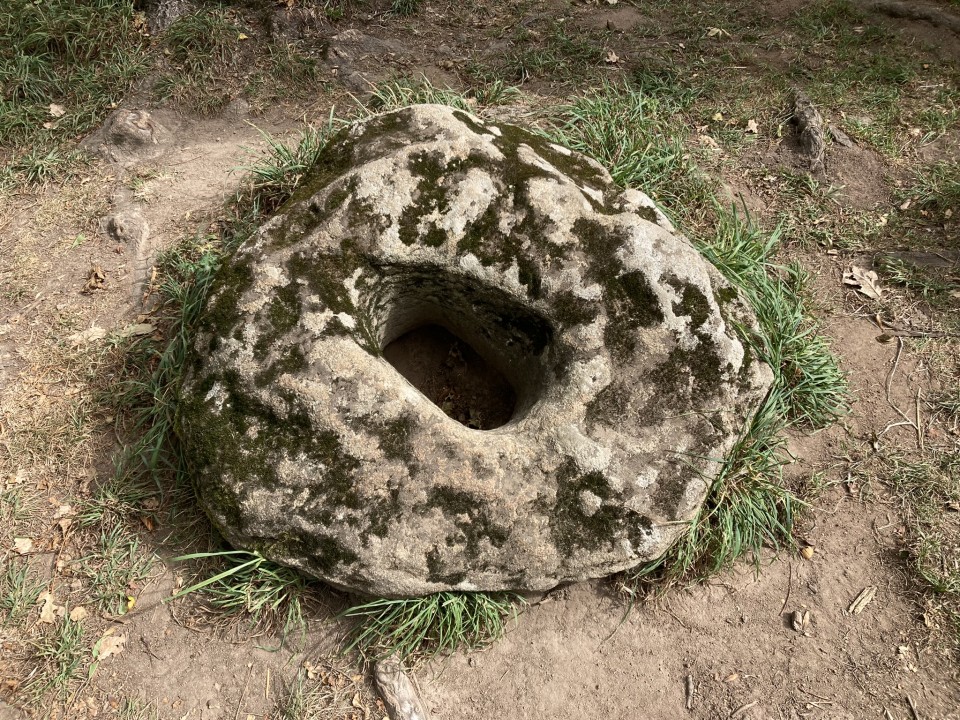
Alignements de Kerzerho — Images (click to view fullsize) |
|
Posted by markj99 13th October 2023ce |
Dolmen de Crucuno (Dolmen / Quoit / Cromlech) — Links |
Dolmen de Crucuno Street View on Google MapsDolmen de Crucuno Street View on Google Maps. |
Posted by markj99 12th October 2023ce |
Dolmen de Crucuno (Dolmen / Quoit / Cromlech) — Fieldnotes |
|
Visited 19.09.23 Dolmen de Crucuno is very easy to visit. It is situated adjacent to a house in the centre of Crucuno, a hamlet between Plouharnel and Erdeven. You can park 10m away from the monument. These facts don't make Dolmen de Crucuno any less impressive when you are standing beside it. A giant capstone measuring c. 7.5m long and weighing an estimated 40 tons is supported by 9 large orthostats. Take the Crucuno turn off the D781 at the Toul Siac'h roundabout. After c. 0.8km turn right into a car park in the centre of the village opposite the dolmen. |
Posted by markj99 12th October 2023ce |
Dolmens de Rondossec (Dolmen / Quoit / Cromlech) — Links |
Dolmens de Rondossec Street View on Google MapsDolmens de Rondossec Street View on Google Maps. |
Posted by markj99 12th October 2023ce |
Dolmens de Rondossec (Dolmen / Quoit / Cromlech) — Fieldnotes |
|
Visited 19.09.23 If you are near Carnac, Dolmens de Rondossec are a must-visit. There are three extensive dolmens in a mound in the centre of Plouharnel. There are numerous capstones on the wide passages and large chambers partially covered by capstones. From Carnac take the D781 towards Erdeven. Follow the D781 through two roundabouts in Plouharnel then turn right onto Rue Hoche to find the tumulus. |
Posted by markj99 12th October 2023ce |
Dolmen de Kergazec (Dolmen / Quoit / Cromlech) — Fieldnotes |
|
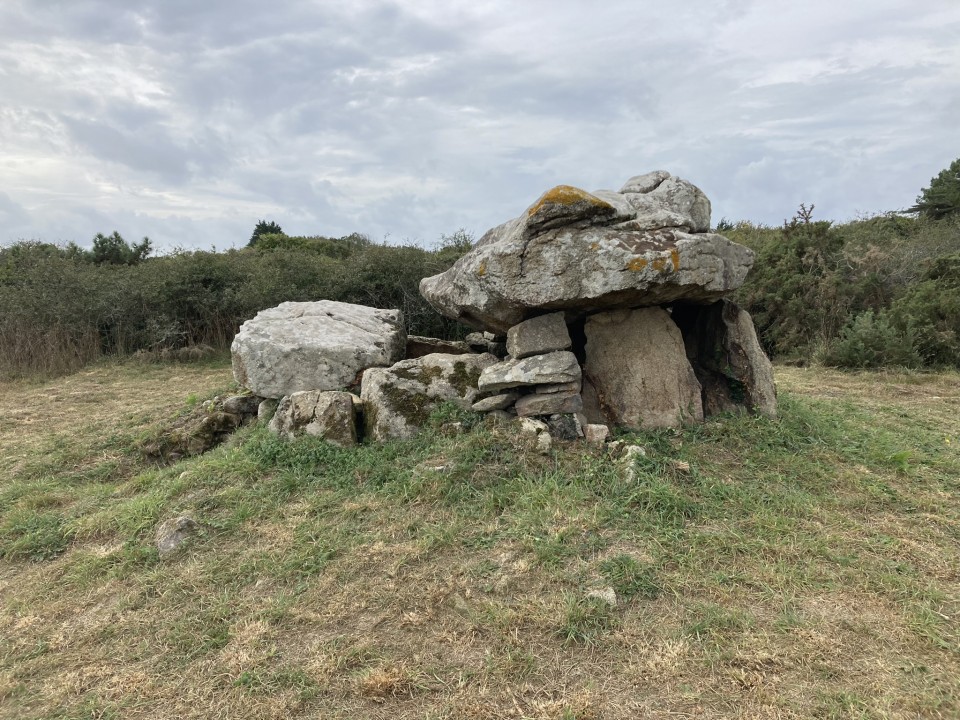
Visited 19.09.23 Dolmen de Kergazec is located c. 100m SE of Kergazec, a small village in Morbihan. The exposed dolmen is in reasonable condition, consisting of a large capstone on four supporting orthostats and dry walling. It retains a passage measuring c. 2m long. There is a small capstone on the SE end of the passage. The best way to find Dolmen de Kergazec is to visit Dolmen de Kernevé then walk c. 140m SW along the C106 to the edge of an open field. Follow a dirt track heading NE for c. 300m to reach Dolmen de Kergazec. |
Posted by markj99 12th October 2023ce |
Dolmen de Kergazec (Dolmen / Quoit / Cromlech) — Links |
Dolmen de Kergazec Street View on Google MapsDolmen de Kergazec Street View on Google Maps. |
Posted by markj99 12th October 2023ce |
Dolmen de Kergazec (Dolmen / Quoit / Cromlech) — Images |
|
Posted by markj99 12th October 2023ce |
Showing 1-10 of 3,170 posts. Most recent first | Next 10
 Top of page