
First sight of the well, when approaching upstream from the south-west, with Carn Galver on the skyline.
Image credit: A. Brookes (18.6.2021)

First sight of the well, when approaching upstream from the south-west, with Carn Galver on the skyline.


Stone circle arc. Looking south-west towards Deveral Common (topped with numerous barrows), Boswens Croft (standing stone) and Chûn Castle.
This one has been on the list for a few years. It’s been a bit lost over the years, but is now kept clear and is used in an annual “dolly dunking” ceremony.
We’re quite a way into our walk from St Just (18 June 2021), taking in Tregeseal stone circle, Kenidjack Common, Boswens Croft, Chun Quoit and Castle and a rare revisit to Men-an-Tol.
From the latter, a path heads south-east, slowly descending into a shallow valley. In other years, this area is a bog and we’re very fortunate that it’s dry underfoot for us today. I only have the vaguest idea where the well is, but I figure that when we reach the stream we can just head north-east and eventually we’ll find it.
The further we get upstream the boggier it gets, although it’s still perfectly passable today. The vegetation also gets higher, blocking sections of stream bank from easy exploration so that looking for a well-head becomes harder.
We press on, and we’re rewarded by the sight of some granite slabs protruding from the bank across a small pool – we’re here! It’s a lovely spot, the relative low-level compared to the rising moors giving a feeling of seclusion and peace. There are tadpoles swimming about in the pool, which is quite deep, and lovely and cool to a hand (we don’t sample the water’s healing properties!).
Really pleased to have found this and to come on such a lovely day. From here we head north towards the Four Parish Stone, which is probably an easier place to come here from once you know where you’re going. Then it’s up to Nine Maidens, our place of pilgrimage above all others.


What appears to be a possible kerb is appearing on the edges of the stone’s mound. I’ve never seen this before, perhaps the horses grazing the croft have exposed the stones.


Short shadows as midsummer approaches.

The light favouring the usually hard to see inscription today.

The cleared stones, with assorted blocks revealed.

No idea where the two blocks in front appeared from.


The excellent central barrow, with cleared chamber.
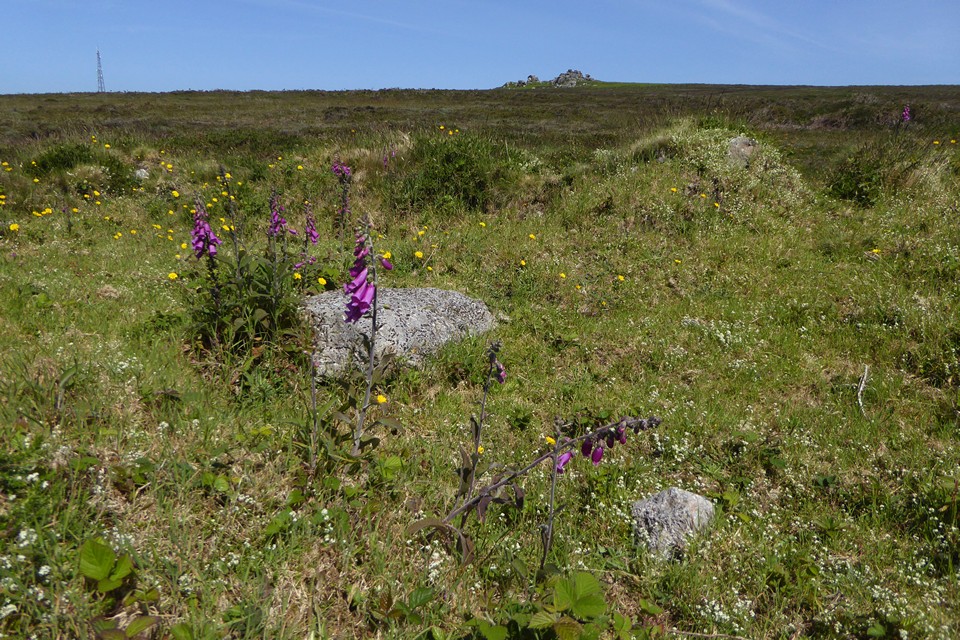
Looking across the SW barrow towards Carn Kenidjack.

The nicely cleared SW barrow. The central barrow can be seen far left.

The stones that were scorched in the 2004 fire are still a bit sooty.


Looking towards Tregiffian farm and the coast.


Looking north, with Carn Bean and Carn Kenidjack on the skyline.

Looking towards Sennen across the disturbed centre of the cairn.

The big granite lump in the foreground looks like a good candidate for a chamber or cist capstone.

This is a fine cairn, thanks to postman for bringing it to my attention after all these years!


Looking towards Bartinne as the cloud shadows race over the landscape.


The massive chambered cairn in all its trashed glory.

The smaller round cairn to the south of the summit monument.

Looking up towards the top of the hill. A round cairn is prominent on the right.

The stone mound with apparent kerb on the left, the incorporated outcrop centre and right.

Upright orthostat along the edge of the mound.

Looking south along the mound.

Landscape context for the destroyed barrow. The monument was in the pale field, centre of image. Seen from the north-western cairn on Chapel Carn Brea.
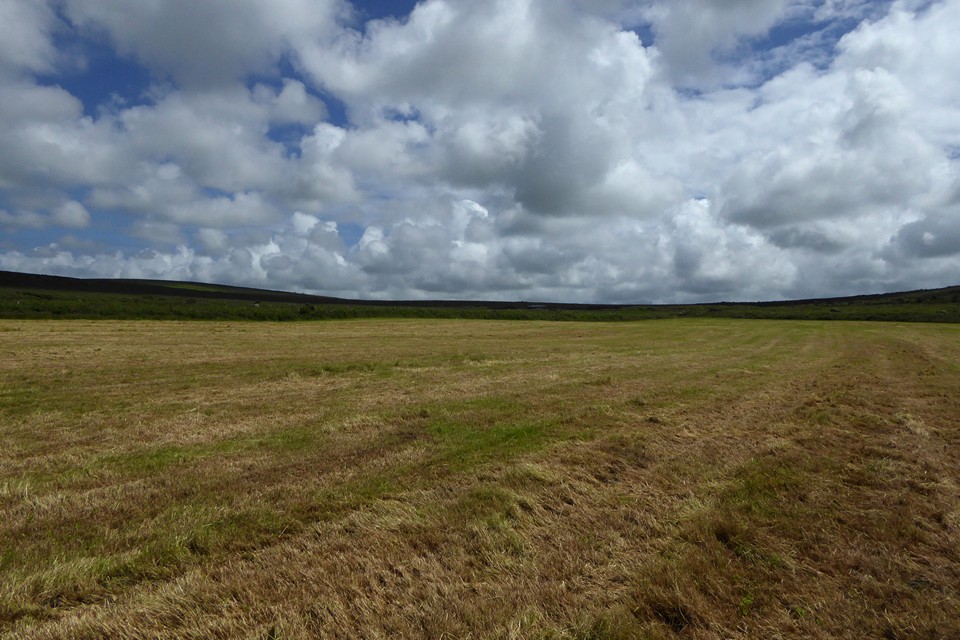
The site of the barrow is centre of image, near to the hedge. Sadly the barrow has been completely ploughed out, nothing remains above ground.

The impressive cliffs forming the south-western side of the fort, a haven for climbers even in less than lovely weather. The jagged arête of Porthmoina Island is far below, being pounded by the sea in the cove.