Showing 1-50 of 207 posts. Most recent first | Next 50 

|
|

|
|

|

|

|

|
"This chapel is built on a definite platform which could have been made originally for the pagan temple. But the chapel we see today was built in the expansionist 1300's. Wessex first became Christian around 800. It seems unlikely that a pagan temple could still be active 500 years after the conversion of Wessex to Christianity, so today's building presumably replaced an earlier Christian structure.
It would be interesting to try to guess the original pagan dedication. We suspect that Abbotsbury was the site of a Roman villa, if only because it is one of a small number of sites in Dorset - indeed in Britain - that are very fertile and have easy access to navigable water; in this case, the Fleet, a 10 mile stretch of semi-tidal water that runs behind the Chesil beach from Portland harbour. The Roman Army in Britain depended heavily on sea borne transport for its supplies, so Abbotsbury might have been a military farm providing grain for the garrisons at Exeter, Chester, Dover and Colchester. It is possible that the visible foundations of the medieval mill in the village are Roman. The Fleet is famous today as the home of a herd of swans who used to belong to the Abbey (a swan is theologically a fish and can be eaten on Friday). They are known to have lived here for at least 600 years."
|
 
|
After an excursion, causing mischief in the Vale of Blackmore, devouring several sheep, the Giant lay down on the hill to rest and digest his breakfast. On falling asleep the local people rivetted him down, killed him and then cut his figure in solid chalk.
Variations of this story can be found in:
Hutchins 1774 29292
Darlton 1935 p 80
Wightman 1977 p98
|
"Some years ago archaeological students, camping on the summit, were disturbed by the clash of metal, the sound of marching men and shouted military orders in a strange tongue. The camp is reported to have been abandoned in panic and one of the students suffered a nervous breakdown" (Wilks 1978, p66). There seems to be a stray member of this company, an old warrior with a twisted leathery face, gashed with wounds, who creeps up on people after dark, with a preference for scaring courting couples. The last sighting was in the autumn of 1977 (Coaster 12p5).
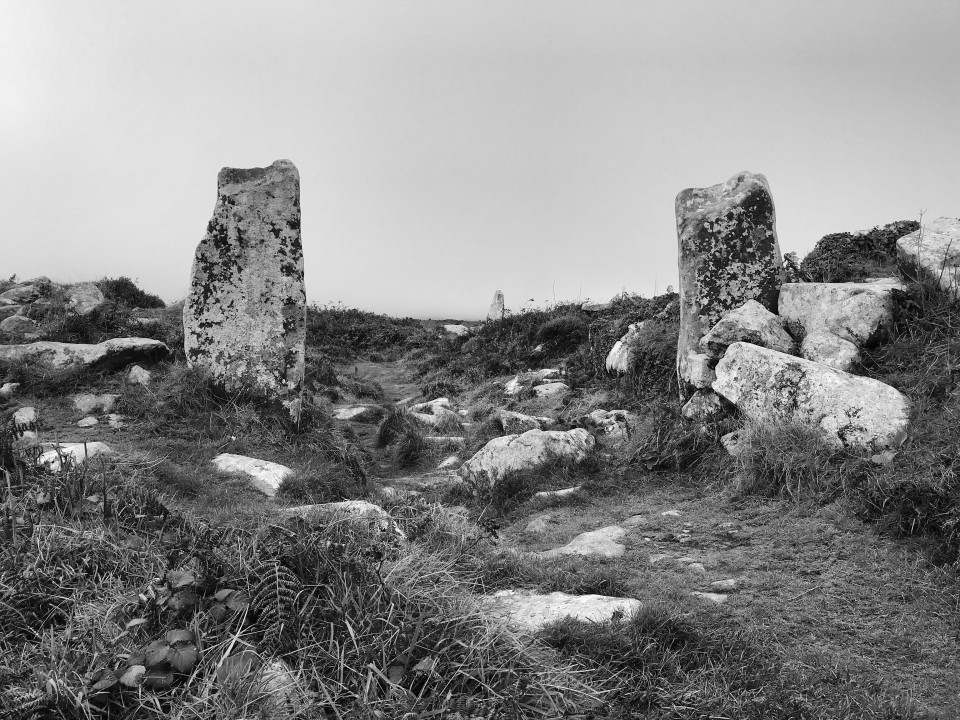
There is also a milder ghost, somewhat out of place amongst this archaic barbarity. The Dorset Evening Echo of 19 January 1979 interviewed a woman who had been walking on the site in the afternoon with her husband; he looked back and saw, standing on top of one of the banks, an old lady. "She wore a long blavk coat buttoned up the front and finishing in a little stand up collar. She wore one of those hats like Queen Mary used to wear". The husband turned round to say that they should help her down the slope, but when he and his wife returned to the area they found no such lady.
These ghosts are interesting in view of the popularity of the Rings among the Blandford and Wimborne people as a centre for day outings, picnics and so on. The warrior ghosts who frighten the modern visitor are in part a projection of historical musings on the fort, comparing its bloody origins with present tameness:the past is scary. The black lady, by contrast, is a realistic ghost, since little old ladies are quite common at the site on a warm afternoon."
Cuckoo Pounds and Singing Barrows - Jeremy Harte
|
| |