|
 Log in |
Register Log in |
Register
|

|
|

The Swastika StoneCup and Ring Marks / Rock Art
|


 Show map (inline Google Map)
|
|
|
News |
 Add news Add news |
Swastika Stone is Actually a Carving of a Boomeranghttp://news.bbc.co.uk/1/hi/england/west_yorkshire/3699593.stm A top children's writer is suggesting that the boomerang was invented in West Yorkshire rather than Australia... continues... |
 Posted by juamei
10th May 2004ce Edited 10th May 2004ce |
Images (click to view fullsize) |
Add an image |
Photographs: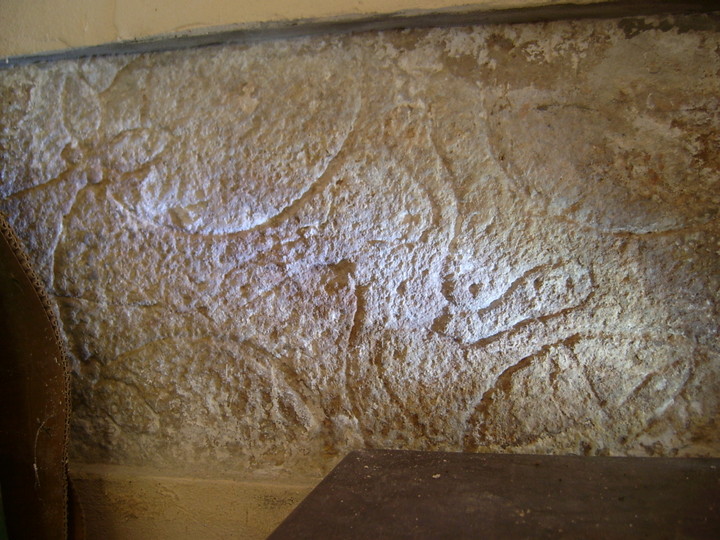

 Maps / Plans / Diagrams:
 Artistic / Interpretive: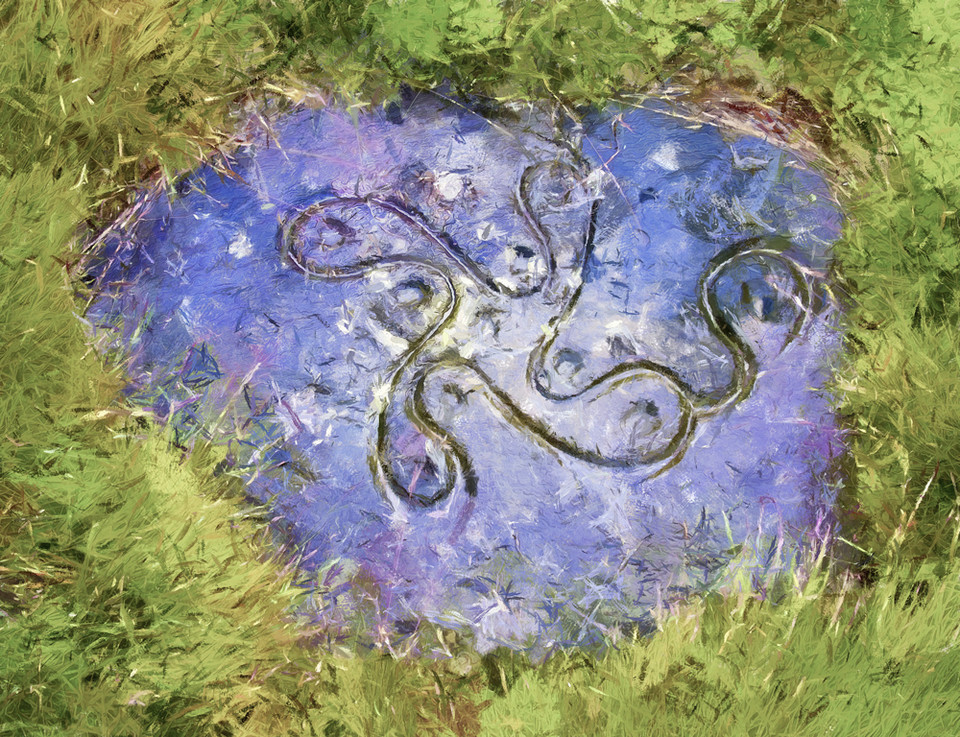
|
Fieldnotes |
Add fieldnotes |
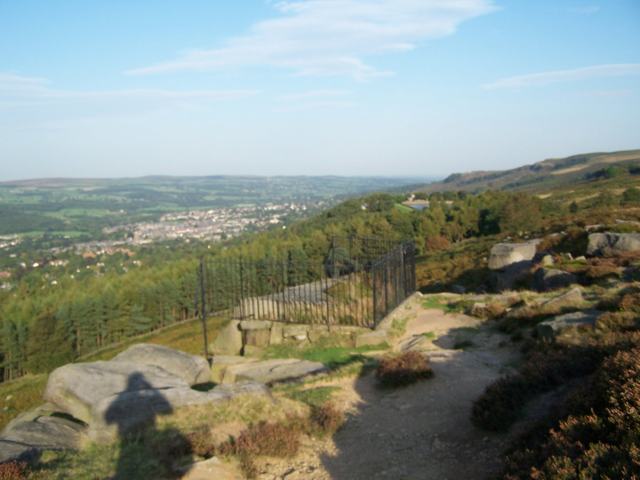
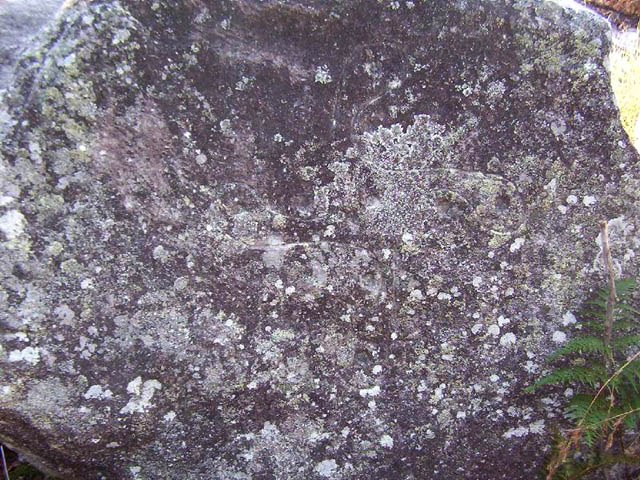
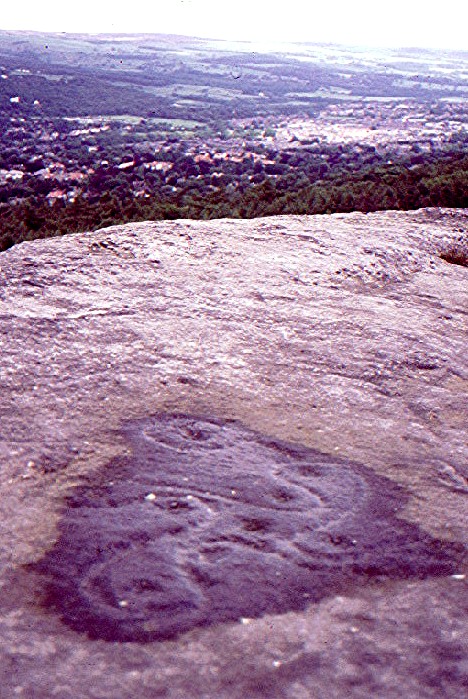
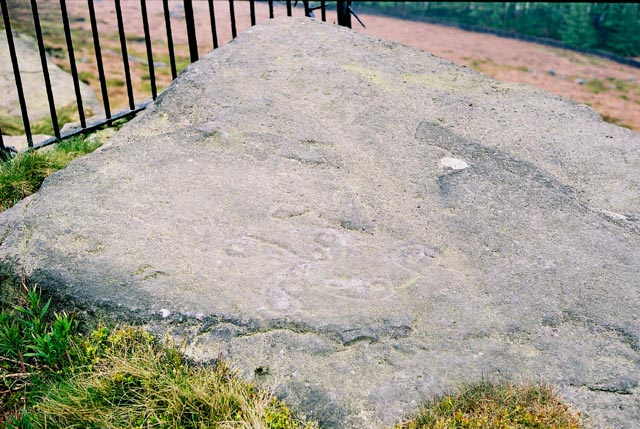
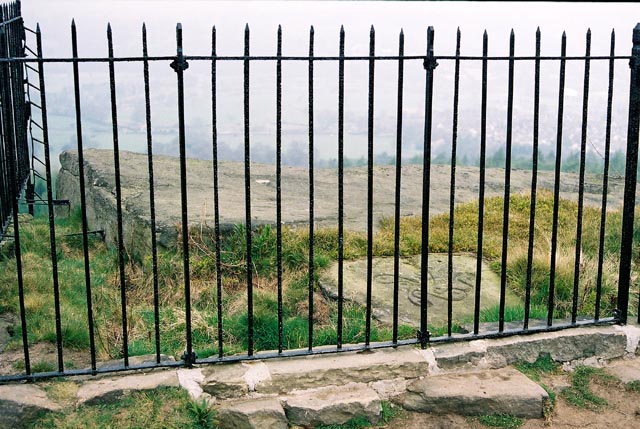
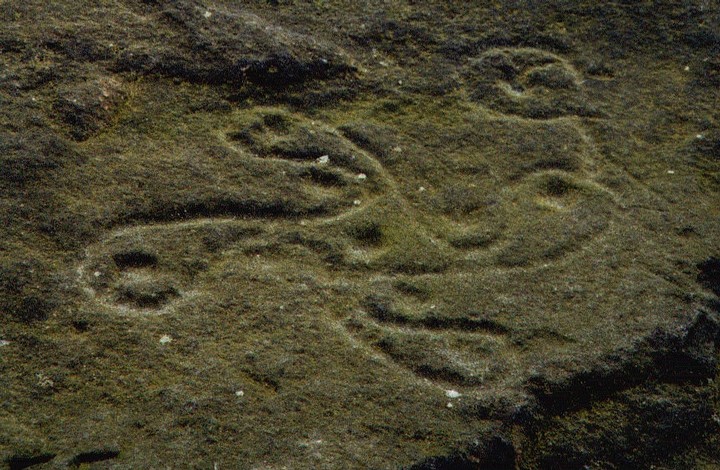
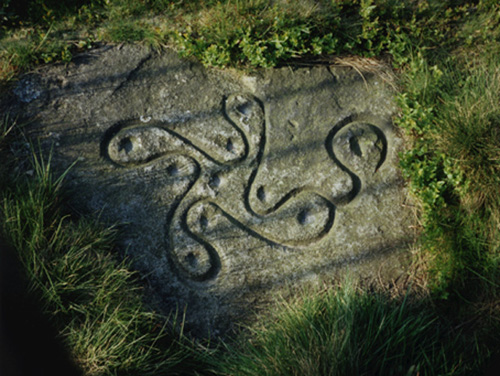
| Probably the most famous carved rock on the moor, the Swastika Stone is generally considered to be later than the other carvings here and to date from the Iron Age. If you plan to visit the site it is well worth parking at the bottom of Heber’s Ghyll and walking up through the woods – this is a picturesque route that snakes up the steep hillside and criss-crosses Black Beck via several wooden footbridges. Once you get to the top a gate leads through a wall and onto the moor. Turn right and you should soon see the iron railings that surround the rock a few hundred metres ahead. Once you get there don’t overlook the actual carving – the one nearest to you is a Victorian copy, the original is just beyond it and is now very faint. Like several other sites on the moor there are some fantastic views across Wharfdale, especially to the northwest along the river valley. |
 Posted by Chris Collyer
12th April 2003ce |
Miscellaneous |
Add miscellaneous |
|
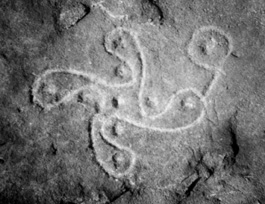
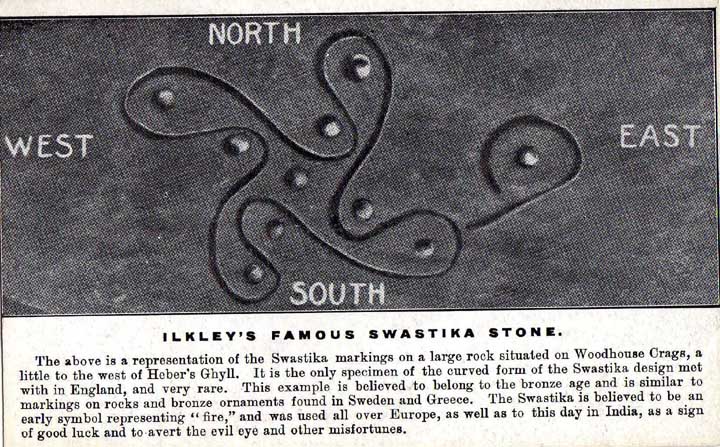
Details of stone on Pastscape [SE 0944 4699] SWASTIKA STONE. (1) The Swastika Stone, a sculptured rock, is considered by Cowling to belong to the E.B.A., but Elgee described the design as 'essentially characteristic of Late Iron Age craftsmanship'. [See Illus. card] (2-3) SE 0955 4696 The Swastika Stone is a large natural boulder with a well defined carving in swastika form on its upper surface. It is now scheduled (a) and is protected by iron railings. See G.P. AO/65/155/4 (replica in foreground). (4) Surveyed at 1:10,000. Condition unchanged from report of 15.9.65. (5) SE 0955 4696. Swastika stone, Ilkley Moor. Additional reference. (5a) SE 0955 4696. Carved rock known as the Swastika Stone. Scheduled RSM No 25388. The carving consists of a curvilinear carved figure of Swastika shape wuth ten cups fitted into the five curved arms, and eight other cups on the east side. The additional carving on a smaller piece of rock is a copy made this century. Scheduled text classifies rock as Bronze Age. (6) |
 Posted by Chance
9th May 2016ce |

|
Is the Swastika Stone really prehistoric? The Swastika Stone is always held up to be the classic example of Bronze Age rock art in Britain, but is it really that old? Whilst there is strong evidence for the use of the swastika symbol in general going back to the Neolithic, I'd make a case that the fylfot design of the Ilkley Moor Swastika Stone is mediaeval in date. In a small church on Anglesey I recently came across a 13th Century gravestone with a carved image that is virtually identical to the Swastika Stone. I've attached a picture here. Rock art is notoriously difficult to date, unless it is overlain with other datable material to give it context. Most dating is done on stylistic grounds. Since the fylfot design appears in a firmly dated mediaeval context on Anglesey, I'd argue that it is a mediaeval design. This means that a mediaeval date for the Swastika Stone is entirely possible, even probable. The chance of the design persisting almost unchanged across 2,500 years and from one side of the country to the other can be discounted. I'm happy to be challenged on this, but in the absence of any positive evidence I would not regard the Swastika Stone as ancient. |
 Posted by Dunstan
16th March 2008ce |
|
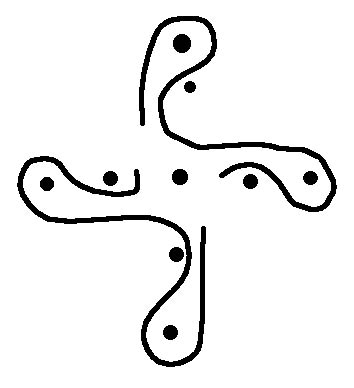
The fylfot motif is very similar to the Iron Age 'Camunian Rose' design of Valcamonica, in Northern Italy. This is a design based around a cross of nine cups, with an interweaving groove. Not always in a 'swastika' pattern. The Roman Fort at Ilkley (which may or may not have been named Olicana), was at one point the station of the Second Cohort of Lingones, who were originally recruited from among the Lingones tribe inhabiting the Adriatic coast of Northern Italy, the old province of Cisalpine Gaul. They were stationed at Ilkley during the 2nd century AD. It seems very likely, that the swastika was carved by one of the Lingones Celts during the Romano-British period. |
 Posted by Kozmik_Ken
9th June 2004ce |
Links |
Add a link |
Swastika Stone on BRAC UpdatedSwastika Stone on BRAC Updated |
Posted by markj99 2nd April 2021ce |

Verbeia knolI've tried to consolidate information about Verbeia, the Romano-Celtic goddess from Ilkley, here. It includes recent research that seems to provide a historical link between the Lingones troops who created the Verbeia altar, the Swastika Stone, and the Camunian Roses in northern Italy. (As Ken suggests above - I'm 4 years late on this one!) Please suggest any other good info on the knol... |
Posted by gyrus 2nd October 2008ce Edited 2nd October 2008ce |
Swastika - The Symbol of the BuddhaAn informative website about this worldwide known design. |
 Posted by rockartuk
14th April 2006ce |
Tracce no 9The motif of the "Camunian Rose" in the rock art of Valcamonica This post appears as part of the weblog entry The Ambient Rambler's Book of Journey - Ilkley Moor - April 2003
|
Posted by Kozmik_Ken 22nd September 2003ce |
 Top of page