|
 Log in |
Register Log in |
Register
|

|
|

Chauvet CaveCave / Rock Shelter
|


 Show map (inline Google Map)
|
|
|
News |
 Add news Add news |
|
Meet Our Ancestors Chauvet Cave: a 36,000-year-old art gallery, normally closed to the public, opens to everyone through immersive tech More: https://artsandculture.google.com/project/chauvet-cave |
 Posted by ryaner
4th March 2020ce |

Chauvet-Pont d'Arc cave art 10000yrs older than thought"Some of the world's oldest prehistoric artwork, located in the Chauvet-Pont d'Arc cave in southeastern France, is actually 10,000 years older than previously thought, researchers said Tuesday... continues... |
 Posted by thesweetcheat
13th April 2016ce |
Don’t fall for a fake: the Chauvet cave art replica is nonsensePicture this. Visitors to the Vatican arrive in St Peter’s Square and are shepherded into a modern reception centre cleverly hidden under Bernini’s colonnades. After looking at a display on Michelangelo’s Sistine Chapel frescoes, they are filtered into a full-scale replica, with a ceiling that is a giant photograph of the famous artwork... continues... |
 Posted by danielspaniel
15th April 2015ce |
The Cave of Forgotten DreamsWed Nov 6 12:05am - 1:55am Film4 Werner Herzog gains exclusive access to film inside the Chauvet caves of southern France, capturing the oldest known pictorial creations of humankind in their astonishing natural setting. He puts 3-D technology to a profound use, taking us back in time over 30,000 years... continues... |
 Posted by Chance
4th November 2013ce |
|
Rock Analysis Suggests France Cave Art Is 'Oldest' The oldest footprints of modern day man are seen in the Chauvet cave discovered in 1994. Experts have long debated whether the sophisticated animal drawings are in the oldest of their kind in the world. More info : http://www.phys.org/news/2012-05-analysis-france-cave-art-oldest.html |
 Posted by drewbhoy
14th May 2012ce Edited 14th May 2012ce |
Bear DNA is clue to age of Chauvet cave art"EXPLORING a gorge in south-east France in 1994 for prehistoric artefacts, Jean-Marie Chauvet hit the jackpot. After squeezing through a narrow passage, he found himself in a hidden cavern, the walls of which were covered with paintings of animals... continues... |
 Posted by thelonious
20th April 2011ce |
Images (click to view fullsize) |
Add an image |
|
Miscellaneous |
Add miscellaneous |
|
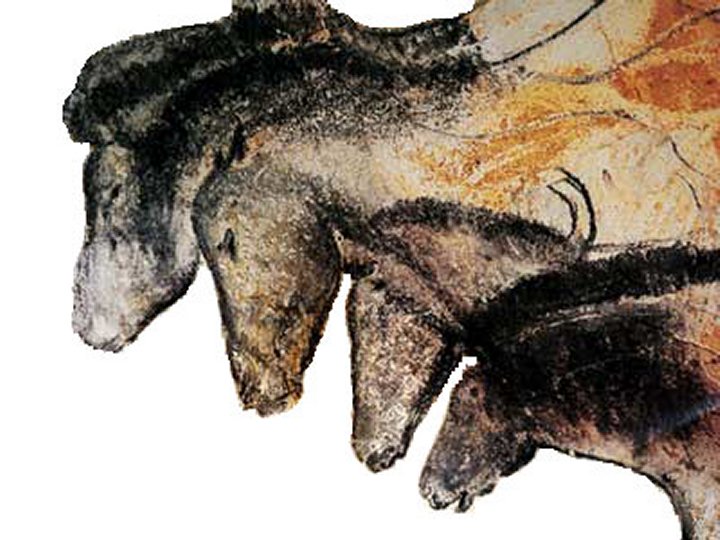
Extract taken from a superb novel by Edward Docx 'Let Go My Hand'. We can see nothing – absolutely nothing. So black is the darkness that I swear I can hear the shape of the walls, taste the taste stone, smell the water that has passed through from the Earth from above. ‘Now’, he says. ‘Now look with your eyes. Friends, look!’ Gradually, gradually, a light grows. Like a hallucination. Like a red shape behind our eyelids. So that we think we’re mad. Or reborn from the womb. But it widens and it spreads so that the opposite wall starts to shape itself, the light growing sharper and brighter, sharper and brighter. We see ochre hand prints; the human mark. We see strange red patterns and dots; human signs. We begin to see the outlines of animals – the beasts. The human mind, the human imagination, the human signature. And now the light starts flood the wall and we see that these animals crouch and creep and crawl this way and that all around us – lions, hyenas, panthers, cave bears. The light brightens still further. There is an owl daubed in white paint. We sense the finger that smeared the surface of the wall on that day thirty thousand years ago. There is rhino notched and scored in black. We see the artist has chosen a certain place on the wall where the shape of the rock serves his purposes. We see a heavy-haunched bison painted in sweeping flowing lines. We sense the human being standing back and admiring his artistry in a flicker of his torchlight. We see the curved flourish of the antlers of a reindeer. We see head after head of black-drawn horses, each on the other’s shoulder, as if caught in the instant of the herd’s fierce gallop, their black eyes somehow still alive. We are silent. Dad’s voice is full of wonder: ‘I’ve wanted to see this all my life’, he says. I get this feeling the opposite of sickness – the feeling that these paintings are being sucked inside me and that they will somehow live there for ever and ornament my soul. ‘This is it,’ Dad says. ‘The beginning’. His voice has the hushed tone of long yearning met – as though he has been trying to get to this moment ever since he was born. As though now that he apprehends the beginning, he might understand the ending. ‘This is the best we can know it, boys. The dawn of a distinctly human kind of consciousness. |
 Posted by tjj
9th January 2019ce |

|
The Chauvet-Pont-d'Arc Cave is a cave in the Ardèche department (7) of southern France that contains the earliest known cave paintings, as well as other evidence of Upper Paleolithic life. It is located near the commune of Vallon-Pont-d'Arc on a limestone cliff above the former bed of the Ardèche River. Discovered in 1994, it is considered one of the most significant prehistoric art sites. The cave was first explored on December 18, 1994 by a group of three speleologists: Eliette Brunel-Deschamps, Christian Hillaire, and Jean-Marie Chauvet, for whom it was named. On top of the paintings and other human evidence they also discovered fossilized remains, prints, and markings from a variety of animals, some of which are now extinct. Further study by French archaeologist Jean Clottes has revealed much about the site, though the dating has been the matter of some dispute. |
Posted by Chance 21st February 2011ce |
Links |
Add a link |
Cave Of Forgotten DreamsWatch the full Hertzog documentary on YT. There are a few full versions. https://youtu.be/q2J8kC7l650 |
 Posted by Howburn Digger
10th January 2019ce |

Guardian.co.ukWerner Herzog on Cave of Forgotten Dreams: 'The awakening of the modern human soul' - video. Werner Herzog investigates the 'proto-cinema' of the 32,000-year-old paintings inside France's Chauvet cave – the subject of his film Cave of Forgotten Dreams – and discusses his project with Cambridge University archaeologists. |
Posted by danielspaniel 25th March 2011ce Edited 25th March 2011ce |
The Cave of Forgotten DreamsWerner Herzog gains exclusive access to film inside the Chauvet caves of southern France, capturing the oldest known pictorial creations of humankind in their astonishing natural setting. He puts 3-D technology to a profound use, taking us back in time over 30,000 years. Includes trailer for the movie |
Posted by Chance 21st February 2011ce |
Ministry of Culture - The Chauvet CaveOffical French Ministry of Culture information site in English Includes an interactive map with photos. |
Posted by Chance 21st February 2011ce |
Dons maps - Chauvet CaveAn enthusiast web site by Don Hitchcock from Armidale NSW, with some excellent photographs and articles on the caves and the area |
Posted by Chance 21st February 2011ce |
 Top of page