


The setting sun looking from the ramparts back along The Ridgeway.


Panorama of the fort interior from the western entrance.


Just to continue the ongoing sheep theme....


Lord’s Seat in shadow in the foreground and Mam Tor in t’ background

Lord’s Seat barrow with Mam Tor just behind and the enigmatic Hope Valley to the left.


The disc barrow adjacent to the enclosure looking West

Inner banks of the enclosure looking West along the South Downs

Possibly the only sarsen in the village.... I meant West Sussex.
What it says on the packet.
We don’t really do big stones much down here in Sussex so it felt quite an honour to photograph this monster. I’d seen old photos of the Goldstone and didn’t quite appreciate just how bloody huge this stone is. This could stand proudly with anything at Avebury or a number of any other megalithic sites, it’s just the surroundings which make it all a bit surreal, the twee fencing, the rumble of traffic on the Shoreham Road only fifty metres away and the Burger King, DFS and Comet showrooms on the other side of the road! The Goldstone and the nine smaller stones surrounding it (from a different location, as is the Goldstone itself) is very similar to the stones I recently saw at Winterbourne Abbas, a conglomeration of flint and sandstone. The smaller stones also seem to have suffered more from erosion over the last hundred years or so judging by the older photos or maybe they’ve just been laid on their sides. The other thing that struck me, and I have to say I usually find this sort of thing extremely cheesey, was the face thing on the western side which looked like it was in a deep sleep. It must have looked very impressive before being buried, resurrected and re-sited here in the corner of Hove Park facing passively out to sea.


Eyes shut and in a deep, deep sleep, lulled by the passing traffic on the Shoreham Road. At least from this angle anyway.

Looking South towards DFS and Burger King!!

Sited conveniently next to the carpark for picnics. What foresight!
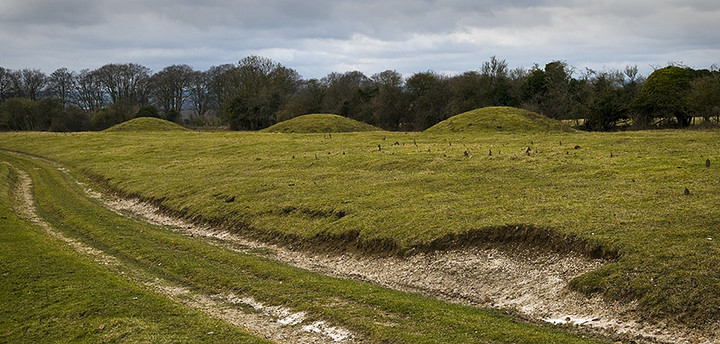
The 3 linear barrows flanking the carpark.
This was my first visit to Badbury Rings. Despite the fact that I’d been to college in Bournemouth some 25 years before, and was now here for the day taking my eldest son to an interview at my old college, I’d never made it out here. It was one of those bitterly cold days when you’re not sure quite what the weather is going to do – one minute snow showers, the next bright sunlight. The approach to the Rings is quite spectacular in itself as you come along the Blandford road through an amazing avenue of tall, mature beech trees bereft of their leaves at this time of year and then swing into the carpark past three of the large Bronze Age barrows to your right. It’s only a short walk from the carpark to the Rings and as you progress up this fairly low hill you’ll notice a fourth barrow on your right and beyond the ramparts away from the other three. It reminded me very much of Danebury in Hampshire which is also on a fairly low hill, multivallate and with a small wood planted within its enclosure. The entrance differs to that at Danebury, and to its enormous neighbour at Maiden Castle nearby at Dorchester, in that it goes straight in towards the centre instead of zigzagging, so you can imagine they must have had some formidable gates here to prevent an easy ingress. Having walked anti-clockwise around the inner rampart to the Northern side you can see a couple of hundred yards off what looks like a low bank running roughly SW/NE which I guessed to be either a fourth defence or boundary marker. This is infact the Ackling Dyke, a Roman Road which takes a turn to the left just North of the Rings and continues towards the Dorset Cursus. Another interesting thing on Google Maps is the cropmark of what looks like an echo of the Rings reflected in the line of the road. Does anyone else have a theory about this?

360’ panorama from the middle rampart at the main entrance.


Looking back up to the Rings from the carpark. The 4th and smallest barrow in the cemetery group is just visible on the right hand side.

The faint trace of the Ackling Dyke, Roman Road running NE/SW to the north of the Rings.


Panorama from the top bank looking south towards Worthing and the sea.

The stones in all their cold, sombre, wintery glory. My first visit although I must have passed it dozens of times without noticing it’s secluded delights!

The ring looking from the entrance.

Looking back towards the road and the back of the mighty truncated tree.

Panorama of Ranscombe camp and the South Downs from Mount Caburn.


Another of the many barrows around the top of Firle Beacon, this one slightly truncated by a farm track.

If the large barrow at the top of Firle Beacon is a long barrow, what is this? Conjoined round barrows? This is the view looking South West.

Bell barrows are ten-a-penny in this neck of the woods and even the odd long barrow isn’t too much of a surprise so I thought my eyes were deceiving me when I noticed these two disc barrows. They’re right next to the footpath of the SDW near the carpark and disused and quaintly named ‘Bo Peep’ chalk pit. There are also fantastic views over the Downs here and the tiny village of Alciston.

The lower and reasonably well defined disc barrow next to the South Downs Way footpath.

The higher, and much less distinct, disc barrow adjacent to the South Downs Way footpath.

Panorama from the top of the bowl barrow looking west over the South Downs. The long barrow, barely visible, lays at the edge of the hill and to the right.

Panorama of Windover Hill and the long barrow viewed from the ascending SouthDowns Way path from the west.

I must have wandered past this several times in the past and never noticed it, but because of a lot of recent clearance of thick gorse and dead yew trees it suddenly revealed itself and quite a find it is too. Possibly contemporary with the Devil’s Humps at Kingley Vale just a stones throw away, it’s described on the Pastscape section of the English Heritage site as ‘A rectangular earthwork of about an acre possibly as early as Late Bronze Age. Scheduled.’ It also says that it’s similar to enclosures in Germany from the last century BC. Most of the banks and ditches are in a reasonable state and the southerly bank extends beyond the enclosure further west as a cross dyke. There seems to be only one discernible entrance on the Eastern side next to the track.

Interior of the camp at the furthest point from the track.

Panorama of the camp from the track running alongside looking North West.