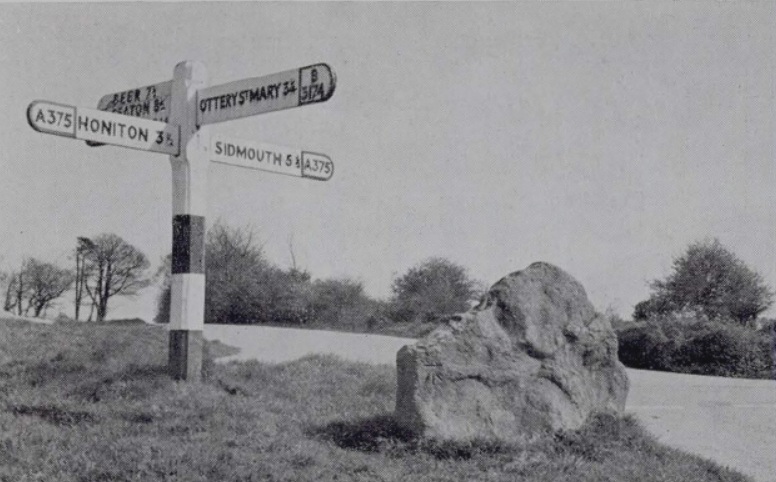
Accompanying ‘Bywayman’s’ letter to Country Life (9th May 1957). In contrast to his theory, the East Devon National Landscape website suggests its geology is actually local.

Accompanying ‘Bywayman’s’ letter to Country Life (9th May 1957). In contrast to his theory, the East Devon National Landscape website suggests its geology is actually local.


From ‘Cycling’, 5th October 1895. (Tip for cyclists in the accompanying article: “Besides the ancient temple at Callanish, there is a modern inn which produced capital oatcakes and butter”.)


From the Illustrated London News, 24th September 1864.

Also called “Kilander’s Stone”. Drawing accompanying an article in the Dundee Evening Telegraph, 12th December 1900.

With trees, in an article in the Dundee Evening Telegraph, 12th December 1900. (It looks a bit pointy? But is labeled Clachan-Iobairt, Bruar. So I assume just a different viewpoint?)

Rubbing of the rock art on the cist cover (in low resolution, sorry, but you can see what it’s getting at). From ‘Further excavations of cairns at Poltalloch, Argyll’ by J. Hewat Craw. PSAS vol. 65 (1931).

“A striking feature of the monuments in the Poltalloch district is the great size of slabs used as standing stones and as the covers and side-slabs of cists. At many places in the neighbourhood can be seen outcrops of rock where such slabs could be got with little labour. One of the most striking of these is shown in fig.13 at Torbhlaren Hill near Kilmichael Glassary. By the process of denudation the slabs stand out isolated from the face of rock, merely requiring to be broken off. Others that have fallen away lie ready for carrying off, on the steep slope below.” from ‘Further excavations of cairns at Poltalloch, Argyll’ by J. Hewat Craw. PSAS vol. 65 (1931).

Plan showing the hut circles inside, from ‘Field Work in Colonsay and Islay 1944-45’ by Stuart and C.M. Piggot, in Proceedings of the Society of Antiquaries of Scotland, vol 80 (1948).

From the back of this postcard: “Druidical Stones of Buile-Riabhach. Above the pretty Scalasaig Hotel stands this lonely memorial of bygone ages. archive.org/details/nby_LL7057


“This cromlech is on St David’s Head, about three miles from the city of St David’s. It is 15 ft. long and 6 ft. high, and weighs about six tons. Local report has it that it is a monument to a Roman general.” In the Cardiff Times and South Wales Weekly News, September 4th 1909.

“Plan of the cromlech at Longhouse, Pembroke. The outer line shows the form of the slab, and A B and C, the position of the upright stones on which it is supported.)” In the Weekly Mail, 8th November 1890.


From Mortimer Wheeler’s 1954 report (which you can read here archive.org/details/oapen-20.500.12657-27680/ )

From Mary Bagnall-Oakeley’s ‘An Account of Some of the Rude Stone Monuments and Ancient Burial Mounds in Monmouthshire’ (1889).

From Mary Bagnall-Oakeley’s ‘An Account of Some of the Rude Stone Monuments and Ancient Burial Mounds in Monmouthshire’ (1889).

From Mary Bagnall-Oakeley’s ‘An Account of Some of the Rude Stone Monuments and Ancient Burial Mounds in Monmouthshire’ (1889).

From Mary Bagnall-Oakeley’s ‘An Account of Some of the Rude Stone Monuments and Ancient Burial Mounds in Monmouthshire’ (1889).

From Mary Bagnall-Oakeley’s ‘An Account of Some of the Rude Stone Monuments and Ancient Burial Mounds in Monmouthshire’ (1889).

From Mary Bagnall-Oakeley’s ‘An Account of Some of the Rude Stone Monuments and Ancient Burial Mounds in Monmouthshire’ (1889).

From Mary Bagnall-Oakeley’s ‘An Account of Some of the Rude Stone Monuments and Ancient Burial Mounds in Monmouthshire’ (1889).

From Mary Bagnall-Oakeley’s ‘An Account of Some of the Rude Stone Monuments and Ancient Burial Mounds in Monmouthshire’ (1889).

From Mary Bagnall-Oakeley’s ‘An Account of Some of the Rude Stone Monuments and Ancient Burial Mounds in Monmouthshire’ (1889).

From Mary Bagnall-Oakeley’s ‘An Account of Some of the Rude Stone Monuments and Ancient Burial Mounds in Monmouthshire’ (1889).

From Mary E Bagnall-Oakeley’s ‘Account of some of the rude stone monuments and ancient burial mounds in Monmouthshire’ (1889).

From ‘Cromlechs in North Wales’ by E.L. Barnwell, Archaeologia Cambrensis, April 1869.

From ‘Cromlechs in North Wales’ by E.L. Barnwell, Archaeologia Cambrensis, April 1869.

From ‘Cromlechs in North Wales’ by E.L. Barnwell, Archaeologia Cambrensis, April 1869.

From ‘Report on Stone Circles Surveyed in the North-East of Scotland (Banffshire and Moray)..’ by Fred R Coles, in the Proceedings of the Society of Antiquaries of Scotland (February 11th 1907).

From ‘Report on Stone Circles Surveyed in the North-East of Scotland (Banffshire and Moray)..’ by Fred R Coles, in the Proceedings of the Society of Antiquaries of Scotland (February 11th 1907).

From ‘Report on Stone Circles Surveyed in the North-East of Scotland (Banffshire and Moray)..’ by Fred R Coles, in the Proceedings of the Society of Antiquaries of Scotland (February 11th 1907).

“Fig. 1. Sketch-plan of Standing Stones at Upper Port, Castle Grant. (Not to scale).”
From ‘Report on Stone Circles Surveyed in the North-East of Scotland (Banffshire and Moray)..’ by Fred R Coles, in the Proceedings of the Society of Antiquaries of Scotland (February 11th 1907).

“Fig. 2. Upper Port, Castle Grant; the two South Standing Stones.”
From ‘Report on Stone Circles Surveyed in the North-East of Scotland (Banffshire and Moray)..’ by Fred R Coles, in the Proceedings of the Society of Antiquaries of Scotland (February 11th 1907).

From ‘Report on Stone Circles Surveyed in the North-East of Scotland (Banffshire and Moray)..’ by Fred R Coles, in the Proceedings of the Society of Antiquaries of Scotland (February 11th 1907).


From TA Falcon’s ‘Dartmoor Illustrated’ (1900).

From ‘Dartmoor Illustrated’ by TA Falcon (1900).

The Rh sisters picnic at the same stone 123 years after TA Falcon’s visit. (So much lichen).


Showing off the weird shape, in ‘Dartmoor Illustrated’ by TA Falcon (1900).


