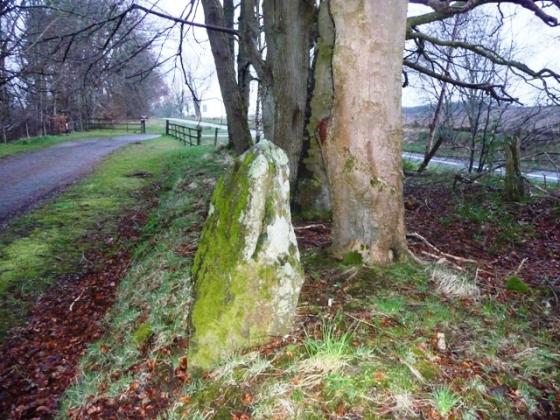
great face in the stone today – nose on left, with a dark eye!
Image credit: stolinskie

great face in the stone today – nose on left, with a dark eye!

Visited 12th June 2011


Visited 12th June 2011


16/02/2013 – Carlin Stone


Looking NW. Note what looks like a thinly carved saltire towards the base of the stone (didn’t notice this on site).

Looking SE.

Lovely quartz band on the stone, like a brushload of icecream.

Carlin Stone and substantial but dwarfed follower.


The Carlin Stone positively ‘glows’ in the February sunshine.


Towards Sheilburn.

Looking north.

This stone was ,reputedly, moved from the Carlin stone, in the background. Not my car, some guy up from the midlands.


17/3/05


17/3/05


Visited: February 24, 2012.
After leaving Backhill of Drachlaw it was a given to cross the field to the north to view Carn Riv, the Carlin Stone. My only excuse for posting is that I’ve added a nice sunny image of the stone for you to enjoy.
Things certainly weren’t as nice as they look. I could barely keep the camera steady as a gale-force wind swept over the field.
This huge stone stands just a field away from the Backhill of Drachlaw circle. Like those stones it has large veins of white quartz running through it, making a thick stripe around the bulk of the rock. Rather than being placed as an outlier to the neighbouring circle it is suggested that the Carlin Stone could itself have been the recumbent of a circle, although the sheer size makes this seem unlikely. There have, however, been Bronze age finds around the stone which would seem to back up the RSC idea.
Before the marsh, out of which it rises, was drained, the Herne Burn, for great part of the year, was a tiny rivulet; now, it scarcely amounts even to this. Its course is through a deep and narrow ravine, forming part of the boundary of the parishes of Turriff and
Inverkeithny, and of the shires of Aberdeen and Banff, — as well as of the district or thanedom of Buchan.
Ascending the ravine, and then holding in a direction ~ almost due south by the compass for about a quarter of a mile, and near the apex of the hill of Drachlaw, we
reach the Caerlin-ring, or, as it is locally termed, the Cairn-riv stone, which marks the boundary of the district at this point. This stone approaches in shape
to a triangular prism—its broadest side being about eight, and each of the other two sides about six feet, and its height upwards of eight feet.
It stands at a short distance from the public road from Turriff to Inverkeithny, on a piece of uncultivated ground on the Backhill of Drachlaw, being one of the stones of a large Druidical circle of about thirty-six yards in diameter.
It is placed in the south side of the circumference. From this point the boundary of the district runs in a southwesterly direction to the Hare-stone, on the farm of Feith-hill, about two miles and a half from Drachlaw.
This stone had also been part of-a Druidical circle, and is now nearly all that remains of it: it projects above ground about three feet. From the Hare-stone of Feithhill, the boundary proceeds in nearly the same southwesterly direction for about a mile, when it reaches the Woof, or Oof-stone, on the hill of Monduff, which indicates not only the limit of the district, but also that of the parishes of Forgue and Inverkeithny, the shires of Banff and Aberdeen, and the estates of Cluny, Gerriesford, and Drumblair, which all meet at this point.
p6 of ‘Buchan’ by John Pratt (1859) ia800906.us.archive.org/24/items/buchan00prat/buchan00prat.pdf
“Carlin” is a corruption of “Cailleach” or witch; The Witches Stone.
Greywether’s comments could well be correct as local legend and rumour has tales of circle(s) being destroyed in the area. Sheilburn has only stone left and the Carlin Stone has it’s remains. The stone at the Hill of Laithers also merits a mention. (Why was Backhill left alone?) Some reckon that the stones are in a wall at the Mill of Laithers. Just recently I found the standing stone at Newton of Fortrie. (July 09)
Coles (PSAS 37) writing of this site in the early 20th century records a conversation with the tenant farmer who stated that there was “in his father’s time, several great stones – none nearly so huge as the Carlin, however – in a Circle, within which was a very low mound or cairn ... At various times ... these blocks ... had been removed, the mound of stones carried away for dykes .... ”
This would add further support to this stone being the recumbent of a largely destroyed RSC.
Pics of the Carlin stone plus Back of Drachlaw stone circle
This book section has a good description of the Carlin Stone and an excellent drawing of the stone from the year 1903. Other context of the page features various megaliths in northeast Scotland.
A huge stone, 8 feet high and 9 feet long is thought to be the last remnant of a long destroyed circle. It is thought that this site was one of a series encircling the Hill of Drachlaw.