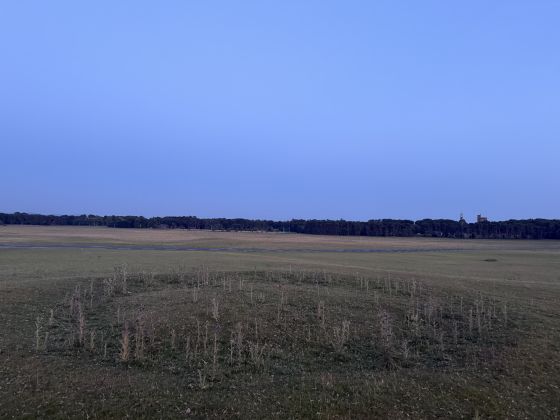
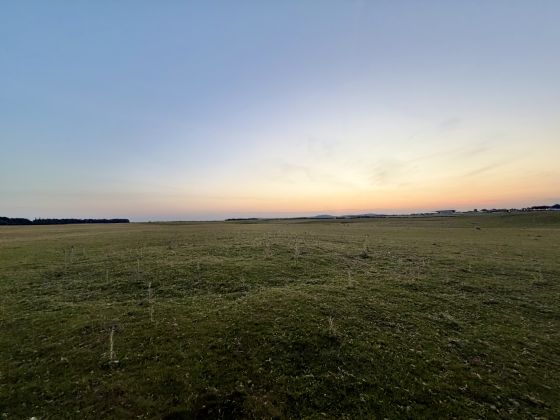
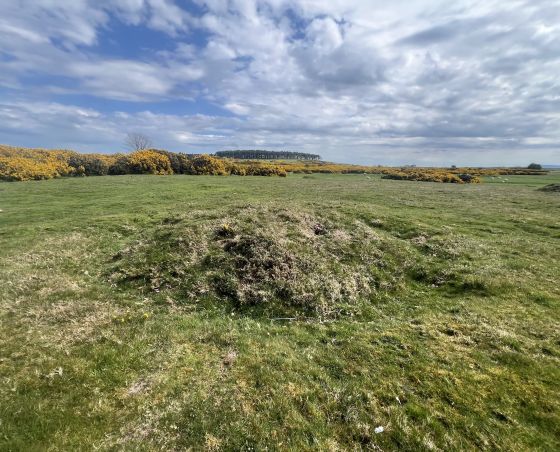
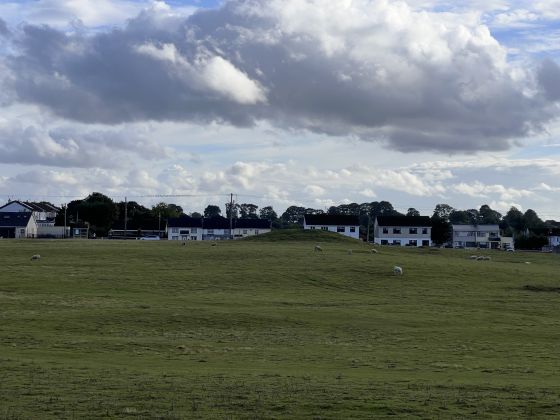
Punchestown early September.
Image credit: ryaner

Punchestown early September.

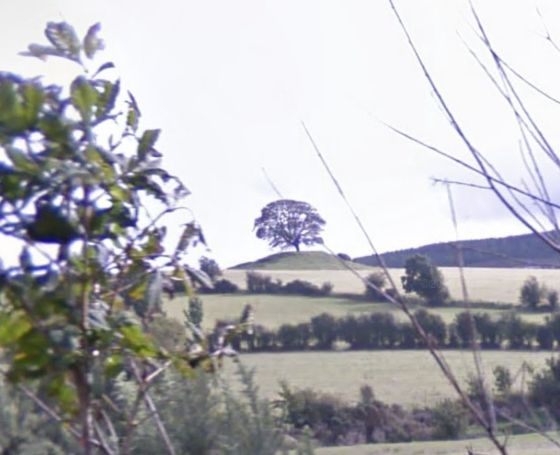
Looking south-east towards the Wicklow hills.

It looks quite slim from this angle.

Punchestown standing stone, 7 metres tall.


Late evening, January 08. Access to the tallest standing stone in Ireland is now next to impossible, unless you have a large stick to beat the brambles back.


With the hills in background


Punchestown stone and the full moon, 14th January 2006. This was taken with a 300mm lens and is a single exposure.


Punchestown Standing Stone
At the north-west corner of the field there is a service entrance to Punchestown racecourse. The gate is sometimes open but if it isn’t there is a hurdlable wall. Over this and back into the corner, the fence into the pasture field that holds the stone is easily surmountable. The hedging and fencing that line the road are impossible. (If you’re not into leaping the medium-difficult wall you can walk up to the actual racecourse entrance a couple of hundred yards up the road and come back to this point. The racecourse allows dog-walkers and strollers and is a popular amenity for the denizens of Naas up the road)
There is a footworn track from the field corner to the stone so people are still determined to visit despite the obstacles. The stone itself is magnificent, the views north blocked but those south-east towards the Wicklow mountains fine. An old info sign has been trashed and thrown into the battered enclosure, the cement that holds the stone up after it was re-ercted in 1934 visible but not too obtrusive.
Visited 25.5.11
Like the Craddockstown West standing stone, this stone is very difficult to access.
I parked near the Racecourse entrance (the main entrance – not the official’s entrance)
and walked back down the road.
It is quite difficult to see the stone over the high hedgerow and I found it impossible to get into the field where the stone stands. Firstly I had to wade through waist high nettles; then go down a bramble filled ditch and up the other side through more nettles/brambles. I was then confronted by a barbed wire fence.
Although I think I could have got over the fence, it would have meant jumping from the top of the fence into the ditch on the way back – a drop of about 10ft.
I settled for a view from the fence.
Close but so far away……………………………

The largest of the eight Long Stones in the County Kildare is the one at Punchestown, which is 19 1/2 feet in height above ground, and 11 feet in circumference ; like all the others, it is of granite. One the opposite side of the Wool-pack Road, within view, and a quarter of a mile to the west of it, on the Cradockstown townland, is another granite monolith.
The only tradition the peasantry have about them is that they were hurled from the Hill of Allen, seven miles off, by the giant Finn Mac Coole; one account says it was due to a trial of strength between Finn and a companion; and the smaller boulder they call “the Gossoon’s Stone”; the other accounts says that they were “fired” by Finn in this direction, as his wife was at Punchestown at the time!
The great lean on the Punchestown stone was caused by an attempt, it is said, of one of the Viscounts Allen to remove it to his mansion at Punchestown, for which purpose he yoked fourteen couples of plough-oxen by chains to the boulder, and tried to drag it from the ground – an attempt which fortunately failed. Of Punchestown House not one stone now stands on another, though an old farmer named Comfrey, of Cradockstown (strong and hearty in 1900), remembers to have seen the walls standing; they were eventually levelled, and the materials sold for building purposes.
It’s not explicit that the house and its family disappeared because of the stone-tampering. But perhaps it’s implied?
From the Journal of the County Kildare Archaeological Society 1906, in an article by ‘Omurethi’ entitled ‘Notes on Punchestown and Cradockstown’.
The accompanying photo
archive.org/stream/journalcountyki00socigoog#page/n64
shows the stone leaning massively (with a rather brave soul standing underneath it) so it’s obviously been straightened considerably since. There’s a photo of the Craddockstown stone too.