|
 Log in |
Register Log in |
Register
|

|
|

Gwern-y-CleppaChambered Cairn
|
||||||||||||||||||||||||


 0 discussions


 Show map (inline Google Map)
|
|
|
Images (click to view fullsize) |
 Add an image Add an image |
|
Fieldnotes |
Add fieldnotes |
|
We visited Gwern-y-Cleppa on 30th March 2013. We began by taking the X16 bus from Newport Bus Station to the stop just by the entrance to the Cleppa Park industrial estate. As previously mentioned, just after the track crosses the motorway there is an obvious gap in the fence on the left hand side. However, we found the "gap" had been filled with several strands of barbed wire, which we squeezed through with some difficulty. An easier route to the stones, which we discovered only after visiting them, is to ignore the gap in the fence, continue up the track, and then climb a gate to gain entry into the first field. After climbing the gate, there is a farm track that skirts the edge of the first field and leads to an open gate into the second field. The stones are then just a short walk downhill. |
 Posted by dubmill
2nd April 2013ce |

|
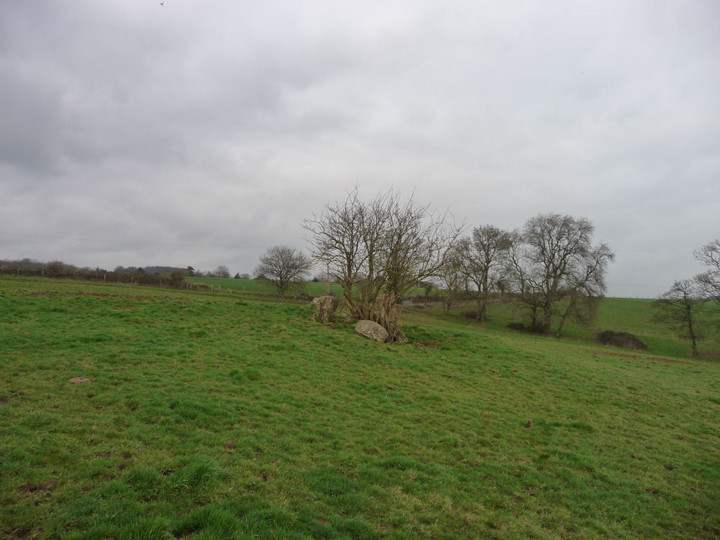
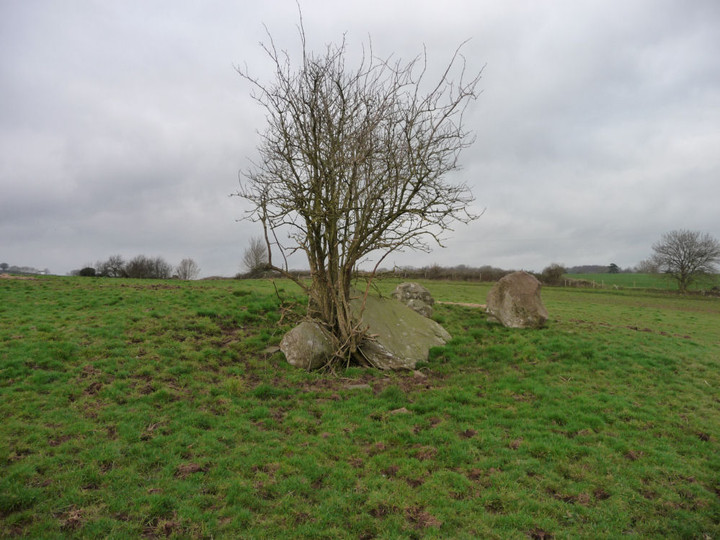
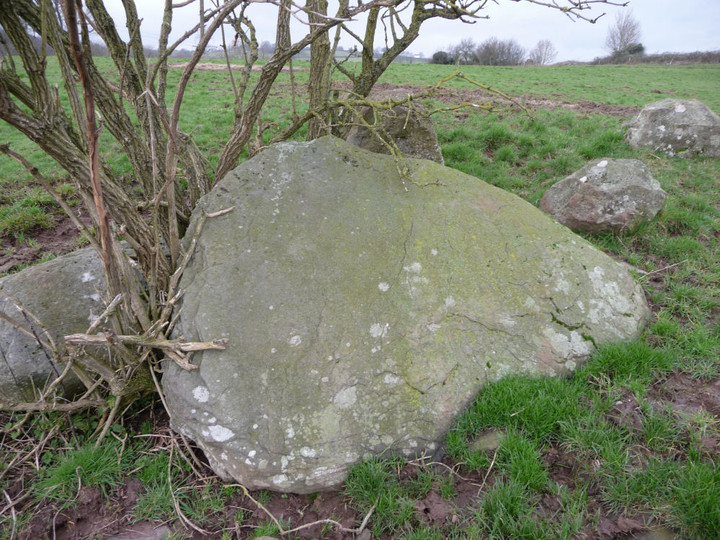
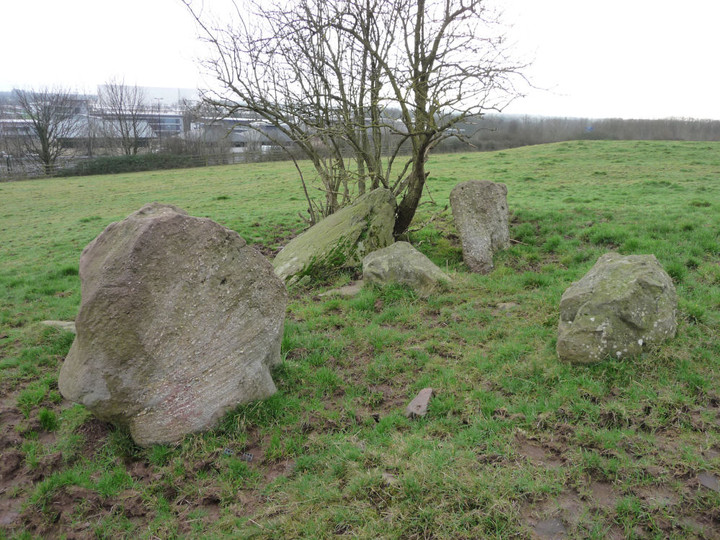
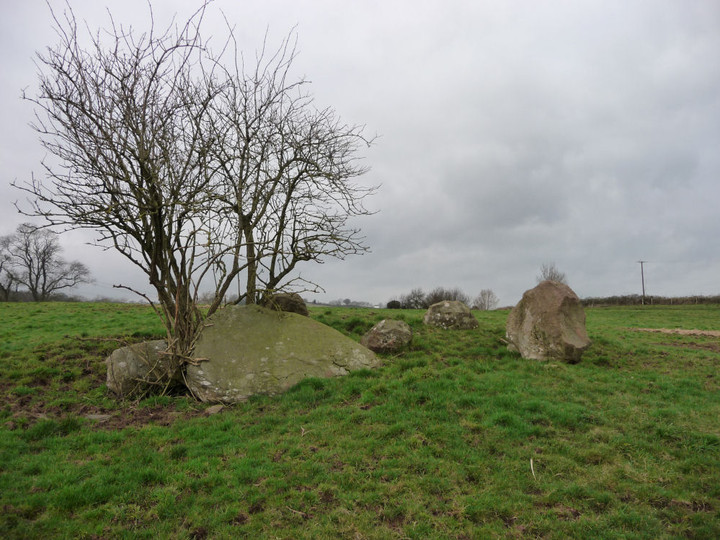
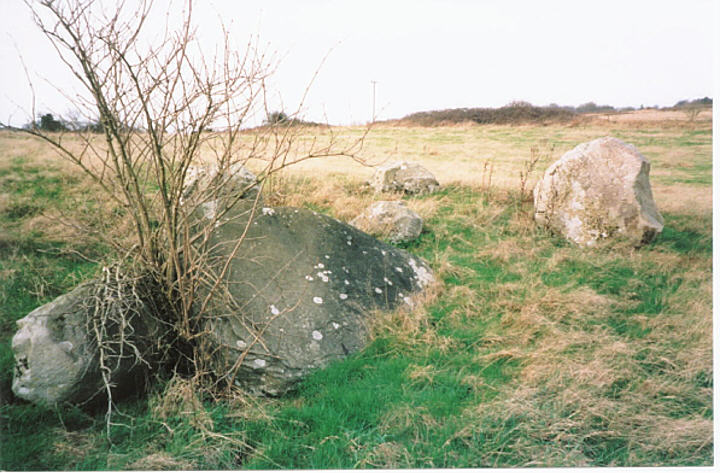
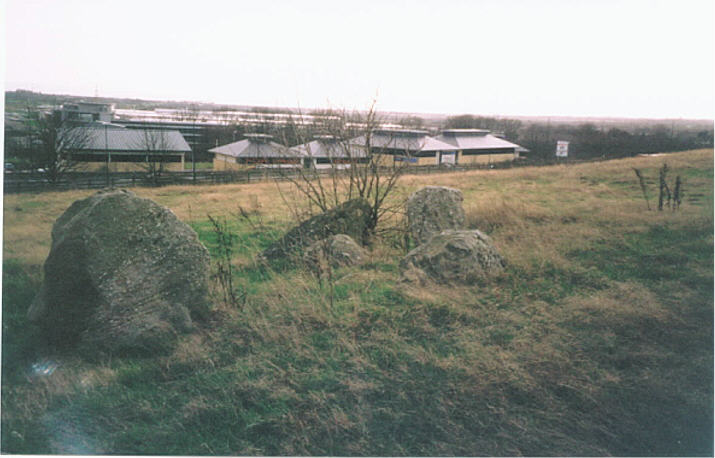
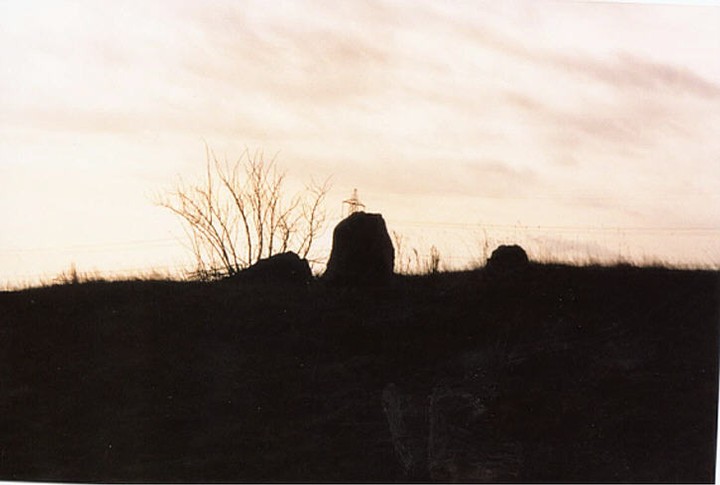
Along with the other Gwent chambered tombs (Gaer Llwyd, Heston Brake and Thornwell), this had been on my radar for a good while, but I've never made it here, despite Gladman's compelling exhortations. So on my way back from Herefordshire (7.1.2013) I decide that it's about time I broke the train journey and had a look for this. Various Newport-Cardiff buses run past Cleppa Park industrial estate, so it's easy enough to get here. It's a grey, overcast day, dry at present but with the threat of more rain hanging in the air. I take the bridge over the motorway mentioned in other notes, then the track. The stones are visible soon enough and access is fairly straightforward, apart from the fact that the almost persistent rain over the last couple of weeks has turned an already muddy field into something resembling a good day on the Somme, so I'm a bit splattered by the time I squelch across to the stones themselves. There is a decent amount left of this tomb, including a dismounted but substantial capstone and four orthostats of a pebbly conglomerate, one of which lies pinned under the capstone itself, as well as some smaller stones. There is also the faint trace of a mound, a ghost of a ghost, but still there. A self-seeded bush, getting more like a tree as the years pass, has burst its way forth between the cap and its crushed supporter. In the long run, I don't think this is a great state of affairs, so if anyone happens to be passing with a saw ... Sadly, the place lacks atmosphere for me today. It's a Monday and the traffic on the M4 below the tomb is unceasing. The muddiness doesn't encourage much sitting about either. The siting of the tomb would be very smart, looking down to the mighty Hafren/Severn making its way to the Bristol Channel, but the motorway and the sprawling industrial estate beyond have robbed the monument of even that joy, to a large degree. I can't help but feel that this place, one of only a precariously surviving handful of such ancient tombs in this part of Wales, has been - and continues to be - done a disservice by the surroundings. So although the visit doesn't charge me with the energy and enthusiasm of many of the more remote places this obsession takes me to, I would join in Gladman's pleas to come here and see what there is (preferably with a saw). I take my leave, feeling rather saddened. Instead of the route over the motorway, I elect to find a footpath that the map shows running along the western edge of the field. This involves a steepish descent from the tomb to a little stream, crossed by a sturdy footbridge. Unfortunately, once over the bridge, the mud of earlier pales into insignificance compared with the bog under the trees. It's a nasty, mucky business this, but eventually I emerge onto the hillside opposite, with the concrete of the motorway blocking all views south. An underpass provides the way out (so this might be a useful approach for anyone who doesn't like the vertiginous feel of crossing motorway footbridges), back onto the main road and a bus ride back to Newport. |
 Posted by thesweetcheat
27th January 2013ce Edited 27th January 2013ce |
|
Visited 28.11.10 I pass this site twice a day, driving back and fore to work. Every day driving home I quickly glance up and see the stones through the seasons, in all kinds of weather and in kinds of lighting – it is surprising how different they can appear. I had planned to make a proper visit for a long time and at last, today was the day! I chose a Sunday as I thought it would be easier to park in the industrial site car park and to my delight the place was deserted (I suppose the artic weather conditions helped!) Walking up the farm track to the left of the car park you soon cross over the motorway and immediately afterwards there is a gap in the fence to the left. (At this point a Land Rover came down the track and I thought 'here we go' but they just drove on) Through the gap in the fence and a brisk walk through the knee height snow across the field heading towards the trees. The chamber is visible from this point. You then have to clamber over a barbed wire fence, through the trees and up to the stones. This may sound like a bit of a hike but it is only a 10 minute walk from the car park. This is the first time I have (I think) visited a site in the snow and it is surprising how much difference it makes. To coin a phrase the snow lay 'deep and crisp and even' and it was a lovely sight to see the dark stones sticking out above the white snow. I counted 6 large stones and several sticking out of the grass/snow. The traffic from the quieter than usual M4 whizzed past nearby but it did not detract from the moment. The sky was blue, the snow was glistening in the sunlight and I had the place to myself – wonderful. It wasn't too long before the cold set in (it was well below zero) and I gave each stone a pat before bidding my farewells. As I was returning across the field about 20 cows came running across – they obviously have better hearing than me as soon after a tractor arrived with a huge bale of hay. At this point I darted back into the trees to retrace my steps – I don't think the farmer saw me? I returned home so glad that I decided to go out for a couple of hours despite the snow. It really does give a different feeling to a site. One I would highly recommend. |
Posted by CARL 1st December 2010ce |
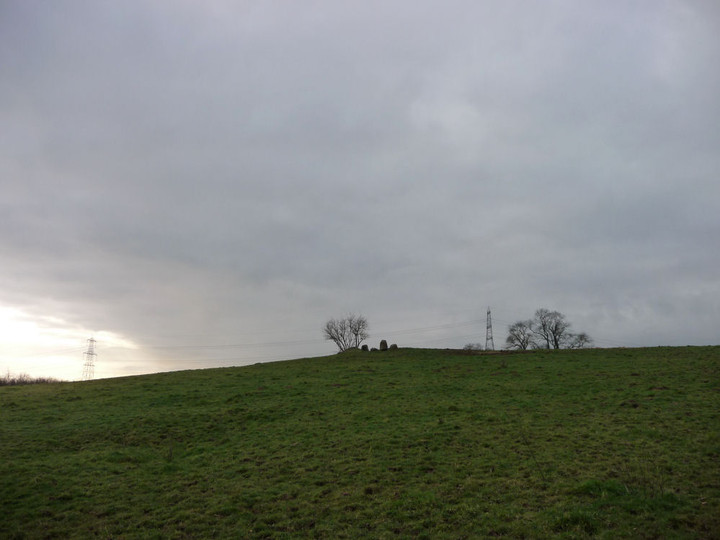
| Gwern-Y-Cleppa is easily seen from the M4 when travelling from Newport to Cardiff (can't be seen in the opposite direction). Just after Junction 28 there is a footbridge over the motorway, just after going under the bridge you will see the back of a large road sign on your right (giving info for motorists heading towards Newport). As you come alongside the sign, look to your right and there it is. Be careful not to crash though!!! |
Posted by CARL 9th March 2010ce |
|
Gwern-y-Cleppa is one of those sites that gives rise to conflicting, contradictory emotions within the traveller. A fine, old longbarrow, with substantial chamber stones still in situ, sitting upon a South Walian hillside. Who could ask for more? Indeed. Trouble is, this said hillside is yards away from Junction 28 of the M4, overlooking a Newport industrial estate. The noise of traffic queuing upon the slipway waiting to attend the Wales/Australia Rugby International is, er, somewhat distracting, similar to the experience of a visit to Mayburgh Henge, it might be said. But then you wouldn't dream of missing a trip there because of the proximity of the M6, would you? Exactly. This is why I finally take the plunge (pun not intended, but this being South Wales it'll do) and park up in the Cleppa Park industrial estate in the teeming rain, feeling a little - OK, very - out of place in my waterproofs.... [by the way, thanks to Hamish for the canny directions]. Following the rough farm track across the aforementioned M4, a Welsh pony looks up from its lunch as if to enquire 'English? Thought so..' before resuming munching grass. Hmm - is this a good idea? The (very) short answer is... Yes. Across the bridge a field of ploughed mud (apparently the Welsh are proud of their ability to 'grow' mud, judging by the tourist adverts) appears to my left, with a barbed wire fence at its far boundary. However I'd advise carrying on a little further before leaving the track and heading towards a ruined building upon the hillside. Here the barbed wire can currently be stepped over with relative ease, so allowing access to the long barrow. It's a good, if not a great site, and I was certainly grateful for its continued survival against all the odds, if also sad for the loss of the landscape it once surveyed. Such is progress, such is economic reality. The tomb itself has othostats comprised of some kind of conglomerate and is graced with several hardy trees. A couple of (empty) vodka bottles - presumably not of Neolithic origin - were unwelcome additions, but note the past tense here. Hanging out in the rain, drinking my coffee and eating sausage rolls, the sheer bizzareness of the moment strikes home... Gwern-y-Cleppa is like the old spinster who won't sell up to the unscrupilous property dealer, striking a defiant stance against the descent into the apparent banality of everyday existance. Yeah, almost as if the old, denuded mound seems to say to the passing cars 'I've seen it all, so bring it on!' Come to Gwern-y-Cleppa if you get the chance. This impoverished, battered long barrow is a survivor and deserves our support! |
 Posted by GLADMAN
8th December 2009ce Edited 8th December 2009ce |
|
This fine old barrow is near Newport and can actually be seen as you pass junction 28 on the right. If you come off at junction 28 take the A48 towards Cardiff,at the next roundabout turn right to Cleppa Park estate.As you enter the estate there is a roundabout,go straght ahead on the left is a lane.Find somewhere here to park and walk up the lane.After you cross the motorway there is a gap in the fence on the left.Go down the field through the trees and up the hill where you will see the stones.Well worth the effort. |
 Posted by hamish
16th March 2004ce |
Miscellaneous |
Add miscellaneous |
|
Iolo Morganwg (aka Edward Williams) "found" an old manuscript that said there was an eisteddfod here in the time of King Edward the third. But actually Mr Williams was a very imaginative man and spent a lot of time "discovering" old druidic Welsh manuscripts and poems, so it is probably a complete and utter fib. http://books.google.co.uk/books?id=6jREAAAAIAAJ&pg=RA1-PA491 |
 Posted by Rhiannon
31st January 2008ce Edited 15th February 2008ce |
Links |
Add a link |
The Scrapbook of William Henry Greene"The Cromlech at Gwern-y Cleppa near Newport, Mon." Sketch by William Henry Greene 12 May 1893 Online at 'Newport Past', along with his many other local sketches, courtesy of Pontypool Museum and sponsor Steve Thomas. |
Posted by Rhiannon 23rd December 2005ce Edited 23rd December 2005ce |
 Top of page