Showing 1-50 of 1,262 posts. Most recent first | Next 50 
Oh Carrowkeel... word fails me, but I guess I should try and describe something of what it meant to visit this astonishing prehistoric ritual complex. For me Carrowkeel is quite simply the finest of the major Irish megalithic cemeteries. Sure, it lacks the connoisseur's art of the Bru na Boinne tombs and Loughcrew - and is of somewhat rougher construction, it has to be said - and Carrowmore is simply mind-boggling in extent. But for a 'mountain-head' like me, Carrowkeel really does have it all, the tombs perched upon the Bricklieve Mountains (Breac Shliabh, or 'speckled mountains') overlooking the gorgeous Loch Arrow and possessing a magnificent vista towards the one and only Knocknarea.
Leave the main N4 Sligo road at Castlebaldwin and follow the 'historical trail' (a bit of a misnomer, obviously, since this is a journey into prehistory) roughly southwards, with the cairn-topped Kesh Corran rearing up to your right. The road surface becomes progressively 'rougher', as if to reflect the surrounding landscape, with high limestone cliff faces curiously reminiscent of Northern England, until a sign proclaims that the final kilometer to the cairns is indeed passable by car. Hmm. Perhaps it's something to do with me being a somewhat cynical Anglo Saxon/Celt/and-whatever-else-hybrid, but we decide to walk nonetheless, fearing a touch o' the Blarney stone. Wisely as it transpires, too, although the Aussie kangarooing (ho! ho!) past us in his hire car would probably have disagreed whilst exclaiming 'where's the cairns, dude!'. Last seen careering downhill towards Loch Arrow...... he at least gave us a laugh and, with large cairns seemingly crowning every ridge, may well have stopped me freaking out altogether with a little light relief. No worries, dude.
The very rough approach track terminates at a turning-area-cum-car-park (ha!) from where a short climb brings us to the first monument. To state that the prosaically named 'Cairn G' is a 'good way to begin' is putting it very mildly indeed, the well preserved cairn covering a magnificent cruciform chamber, its solid roof slabs supported upon eight (I think) orthostats. There's more however, for the chambered tomb possesses a 'Newgrange-style' letter-box which apparently allows the setting summer solstice sun to penetrate the chamber on 21st June. This is obviously the reverse of the world famous arrangement at Newgrange, so elevating this tomb into the premier league of Irish passage graves in the process. Oh to be here when that happens!
The next cairn uphill (Cairn H) has sadly collapsed into the chamber, although I can attest it is still possible to crawl down the passageway. Well, a Gladman's gotta do what a Gladman's gotta do, as they say. Cairn K, however, crowns the summit of the northern Bricklieves and is a real beauty, the cruciform chamber within exceedingly well preserved and reached by a long, low entrance passage akin to the great Orcadian tombs. The three pentagonal side chambers are exquiste, the corbelled roof likewise. And if I'm not very much mistaken.... the passage is aligned upon Maeve's Cairn surmounting distant Knocknarea! It's all too much, it really is. No, seriously, because as well as a large cist to the east of the tomb, the ruined 'Cairn L' to the west, and a nearby settlement (no doubt the home of the people who used these tombs?), cairns seem to crown every horizon. As old Irish comedian Frank Carson used to say.... 'And there's more'. Much, much more at Carrowkeel.
Sadly I must leave and who knows, I may never return? But no matter. Carrowkeel will always have me in thrall.
|
|
|
The magnificent court tomb of Shalwy lies just a couple of hundred yards up the valley from its companion site Croaghbeg, dense vegetation ensuring it remains hidden from all but the most inquisitive - not to mention well informed - passer-by....
http://www.themodernantiquarian.com/site/5377/croaghbeg.html
It is arguably an even more impressive example of the type, being sited upon a small knoll and possessing an additional 'triangular' lintel stone and better defined court. The vibe and sense of place are just as exquisite, the build quality just as good as its near neighbour. These tombs were made to last, you could say. They've certainly stood the test of time.
Note, however, that an approach from Croaghbeg, although short, involves negotiating several barbed-wire fences and very rough, soggy ground. In fact, in retrospect, I would suggest that returning to the road from Croaghbeg and then approaching Shalwy direct would be a less arduous undertaking.
Despite initial appearances from the road above, these two court tombs do not grant personal audiences lightly. Hey, but isn't that always the way with classy ladies?
|
It's hard to credit that such ancient structures as Croaghbeg - and its near neighbour Shalwy - can remain in such a state of glorious abandonment in this, the 21st Century! If ever there were a pair of hidden megalithic gems, 'tis these two beauties.
Even armed with one of the recently introduced Irish 1:50K maps, finding the courts tombs is much easier said than done, until two locals on the coastal road confirm the steep northern turn-off does indeed lead towards Gortnagalliagh. Sure enough, after parking near a junction with a rough farm track, I notice two apparent heaps of stone in the deep valley below to my right. Further afield, W.B. Yeats' Benbulben rises beyond the tiny island of Inishduff within Donegal Bay. It is a sensational vista, it really is, and I believe I can make out Knocknarea.
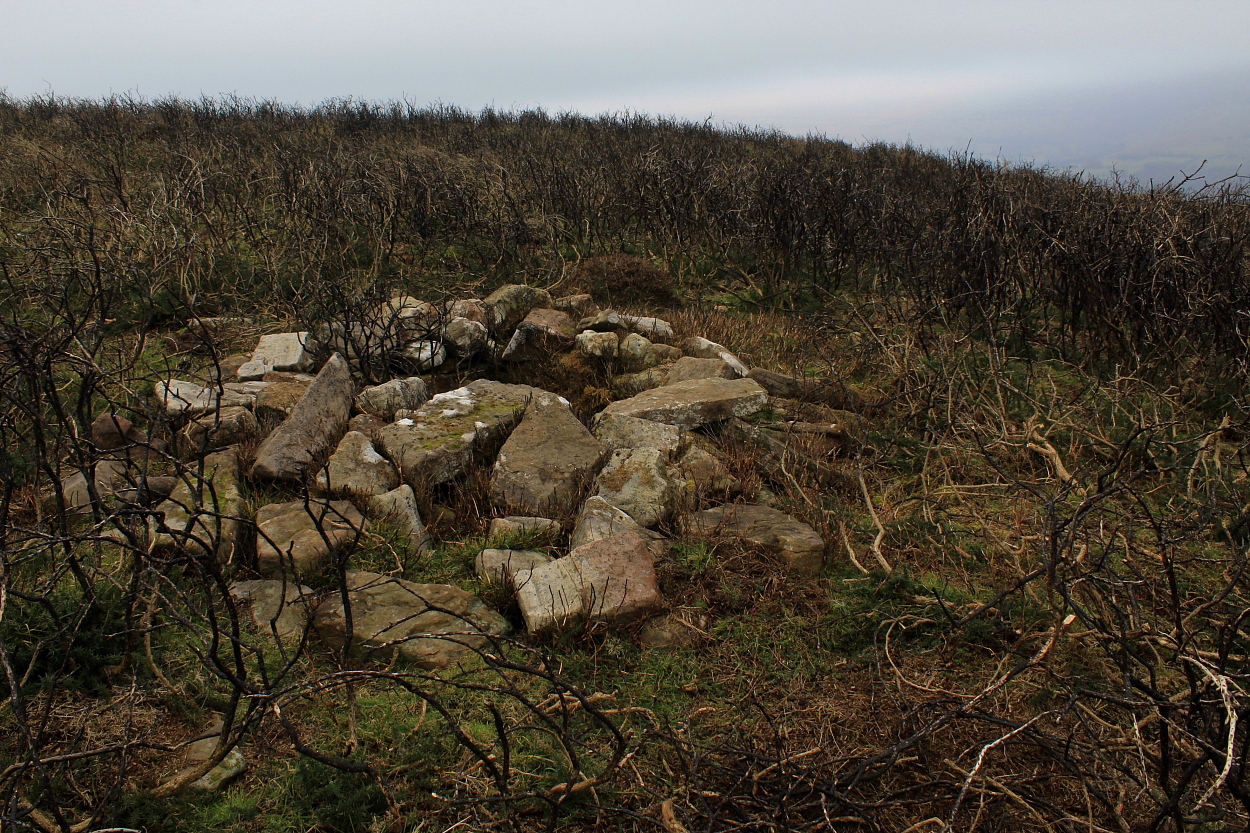
Actually visiting the tombs is also no easy matter, progress down the steep valley side hindered not only by barbed-wire fences (the locals weren't at all perturbed by our visit, it has to be said) and the rough ground underfoot, but by 6ft plus fern rendered soaking wet by a sudden heavy shower. Good job the 'Gladmum' and I elected to wear full waterproofs, then. Seeing the tomb up close and personal for the first time after emerging from the fern cover is something special, almost as if it's actually located within a clearing in the primeval forest or something. Seemingly only missing its capstones, the structure is very well preserved, being solidly constructed of large stones. Having said that, the court itself appears a little poorly defined, although an apparent capstone-less dolmen structure within the court area is a nice additional touch.
A visit to Croaghbeg is a somewhat surreal experience, as if the traveller is granted several hours upon some Lost World plateau where time has stood still. There are no turnstiles, signposts, kissing gates or information boards here, and certainly no tourists to break the spell. Hell, there's nothing at all to interrupt a perfect experience. Except the draw of Croaghbeg's companion tomb, Shalwy, a little up the valley. http://www.themodernantiquarian.com/site/3033/shalwy.html
So why not indeed?
|
Of all prehistoric structures it is perhaps the portal tomb which is consistently the most aesthetically pleasing to the modern eye. Whether originally covered by a mound or not(?), the haunting, bare profile of a dolmen/cromlech is guaranteed to set the thought processes a' flowing.... there are squat, powerful ones (e.g. Lligwy), the overwhelmingly massive (e.g. Browne's Hill), the elegant and impossibly fragile (e.g. Pentre Ifan), the downright bonkers (Trethevy Quoit), the cute little ones (Chun Quoit, Maen-y-Bardd) and the classic 'Flintstones' form (Devil's Den). Quite where the Kilclooney More portal fits in to these categories, I don't know. To be honest I think it's in a category of its own. Really, it is that good.
Sure, I'd seen the pictures and this dolmen was the primary reason for the trip to Donegal - although the many court tombs had a little to do with it, I suppose. But little can prepare the visitor for the elegant form, the streamlined contours... and the sheer, well, sensuous femininity of this wonderful structure.
The visit starts in a less than inspiring manner as I park at the 'Dolmen Centre' (oh dear) beside an impossibly yellow church (double-plus oh dear). Hmm. Trying a bit too hard, me-thinks? Anyway, crossing a bridge beside the latter monstrosity, accompanied by a very annoying hound which wants me to play ball, a path leads onto open moorland, the dolmen eventually appearing upon the horizon. Tourists, with their trademark inane assertions, abound, doing little to dispel my distinctly 'underwhelmed' state of mind. 'This had better be good'... Needless to say it is. Very.
The capstone soars upon well proportioned orthostats as if seemingly made of balsa and liable to float away into space any second, the whole sculpture so incredibly well balanced it takes the breath away. Surely this capstone was always meant to be seen? Further inspection reveals a near 360 degree sweep of mountains upon the horizon and a smaller chamber - seemingly the real thing and not a folly - behind the main event. Hmm, were both after all covered by a single cairn? More questions than answers, a particularly knowledgeable American tourist then going on to torpedo another of my cherished stereotypes. Are you listening to me, boy?
I leave this wonderful site for the nearby ruined court tomb.....
http://www.themodernantiquarian.com/site/5332/kilclooney_more.html
.....thinking that, quite possibly, this is the finest dolmen in these Isles.
|
|
|
|
|
|
|
|
 
|

|
|
|
|
|
|
|
|
|

|
|
 
|

|

|
|
|
|
|
|
|
|
|
|
|

|
|
Showing 1-50 of 1,262 posts. Most recent first | Next 50 
A long time Cope fan from Essex who discovered 'the Great Outdoors' at about the same time M'lud Yatesbury put out Jehovahkill..... some time back, then. Got into the 'stones' - and generally all prehistoric stuff - through stumbling [sometimes literally] into them when out and about on the Welsh hills... usually in the pouring rain ..... and thinking, 'you know, perhaps the Drude's actually onto something with all those crazy sleeve notes?' Perhaps... so it was the ancient mountain-top cairns you must cite as the origin of a prolonged case of 'Gladmania', for better or worse. I hope it's the latter....
I've travelled extensively around Britain and Ireland ever since in an ongoing attempt to try and determine - at first hand - the relationship these magical, hauntingly evocative places have with the human psyche. Why do they possess such a fascination for some, yet are dismissed as 'piles of old stones' by others? Why are TMA-ers like myself not satisfied with the proverbial 'beach holiday in Benidorm?' It would appear the reasons are multiplex, but I would cite stunning scenery, close encounters with wildlife, the appreciation of exquisite forms of sculpture and the sheer joie de vivre of experiencing nature head on - whilst attempting to understand our own fleeting role in the tapestry of time - as ample reward for those willing to brave a little discomfort. Hey, you even have to exercise the grey matter a little and can write about it afterwards.
The onset of dodgy knees - it happens to us all in the end - has meant you're just as likely to find me hanging out within a 'circle than upon a summit cairn these days. But I still have my moments....... having said that, I make no special claim for my contributions. My images are scans of prints (pending a long resisted, but inevitable move into digital) and I'm certainly no more than a very amateur, albeit enthusiastic, field archaeologist. So please forgive (and kindly correct) the occasional error and I'll do my best to avoid any lapse into trendy 'New Ageism', which I believe not only be-littles the immense physical achievements of our ancestors, but also mis-represents the manner in which they related to their surroundings in a metaphysical sense, too. Suffice to say if I can add a little to the enormous efforts of everyone else, help celebrate these marvellous places throughout these marvellous islands of ours and hopefully make myself a better human being in the process... that'll do for me.
So cheers... to Mr Cope for being his inspirational, confrontational self, showing that field archaeology can be FUN! - hey, who'd have thought it? ...to my sister for being the living incarnation of Mam Cymru, using her female 'macro' vision to help me see the detail throughout an ongoing re-exploration of the South Walian uplands... to my own mam for insisting 'young men should have adventures'.... my Dad for inspiring a profound love of high places with tales of climbing Snowdon 'in Jack's old shoes'... and to Aubrey for simply being 'The Man'. You know who I'm talking about!
Some of Gladman's other 'inspirations' include:
George Orwell, Charles Darwin, Michael Collins, Karen Matheson, Will Shakespeare, Winston Churchill, Martin Gore, Richard Dawkins, William Wilberforce, Shane MacGowan, Sophie Scholl, (the one and only) W A Mozart, Manic Street Preachers, Pat Jennings, King Harold II (what a difference half an hour or so would have made!), Gromit, Hugh Dowding/Keith Park and 'The Few', Marc Almond, Stan Laurel and Oliver Hardy, Kurt Gerstein, Harvey Milk, John Le Mesurier (perhaps the coolest man ever?), Ralf Hutter and Florian Schneider, Jeremy Brett, Scooby and Shaggy..... and ...last but not least, Belfast musician Jake Burns for hollering the line 'Question everything you're told!' into my teenage ears. Sound advice, indeed, my friend.
The call is unspoken, never unheard.
|
|