This site is of disputed antiquity. If you have any information that could help clarify this site's authenticity, please post below or leave a post in the forum.
After visiting ‘Snowdrop Valley’ and enjoying an excellent cream tea in the rather posh tea rooms in Wheddon Cross it was time for a bit of ‘old stoning’ before it got dark.
First up was a site I had wanted to visit for a number of years – the Caratacus Stone.
It was easy enough to find; being near the road and sign posted.
I was just about able to make out the Latin inscription but if I wasn’t specifically looking for it I wouldn’t have known it was there. The stone is about 1 metre tall.
The area around the stone has an obvious gorse problem and I am pleased to report that a large amount of ‘de-gorsing’ is taking place. There were whole swathes of recently cut down gorse piled up, making access a lot easier. If left to nature I guess it wouldn’t take too many years before it would be impossible to see the stone!
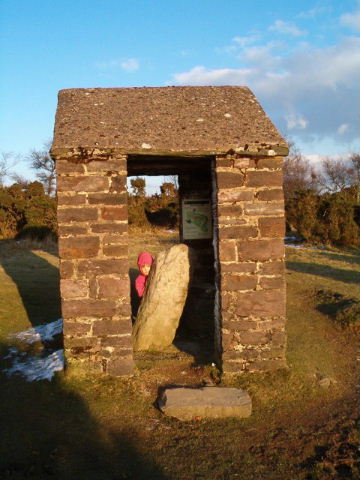
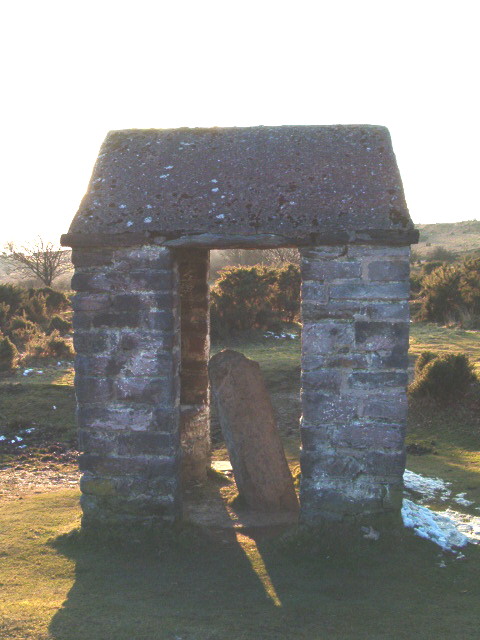
Viewed from the road this looks like a little bus shelter. We had to laugh when we got up close the dear little stone looked so cosy in his little house. The stone has a latin inscription on one side so it looks likely that this stone has been reveared since at least the 5th or 6th centuries. Other sources say it could have been a re-used standing stone from the Bronze age. It stands at the head of a stream. The sign board inside states that the little hut was erected in 1906 for protection.
Many of the stones and most of the barrows are supposed to have treasure buried under them or near them, but it is dangerous to look for it and there are many stories of foiled attempts. The Caractacus Stone, for instance, standing on Winsford Hill, Exmoor, is said to be haunted by a ghostly team and their foolhardy driver who tried to uproot and drag the stone away to get at the treasure it conceals. The stone overturned the waggon and team and crushed the greedy waggoner. On foggy nights they are still to be heard and met.
From the 1965 book of 'Somerset Folklore' by Ruth Tongue (p12) - she heard the story from "A Bossington blacksmith, 1946, and a Hawkridge gardener, 1956."
A winding, up-hill lane conducts us in about two miles to the first genuine piece of moorland - Winsford Hill. Between the finger-post marking the cross-roads and the hedge on the right, and at the side of an old track -- I believe the former highway -- is a rude standing stone of hard slaty rock, known as the Longstone. It leans considerably out of the perpendicular, and has met with rough usage, a portion of the top having been broken off. The height is 3 feet 7 inches, the breadth 14 inches, and the thickness 7 inches. It is inscribed lengthwise with characters, but of what age or date I am unable to decide. That they have been there for many centuries, there can, I think, be no doubt, their worn appearance testifying to many an onslaught of the elements. The aforesaid fracture, the work of a mischievous youth but a few months back, has probably obliterated a part of the second line, and although I was able to find the splintered fragment, and fit it into its place, it availed me not, as the surface had flaked off. I read the inscription thus: CVRAACI FPVS. The first word apprently stands for '(son) of Curatacus,' evidently the Latinized form of some British name. This is the only interpretation I can offer. The local legend says that it marks a deposit of treasure; but it is somewhat strange that there are no traces about the stone indicating that a search has been made.
From 'An exploration of Exmoor and the hill country of West Somerset' by John Lloyd Warden Page (1890).
The surviving Latin text reads 'CARAACI' and 'NEPVS' = 'kinsman of Caratacus', and is thought to refer to a descendant of the famous rebel against the Romans in the 1st century AD.
 Log in |
Register
Log in |
Register


 0 discussions


 Show map (inline Google Map)
 Add an image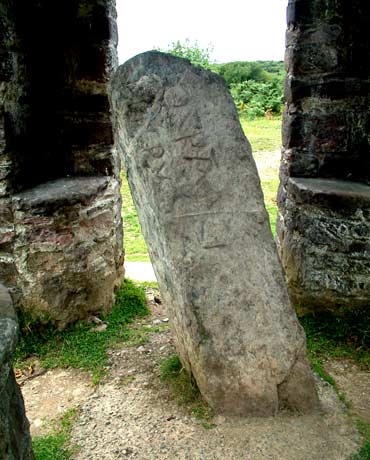

 Posted by Rhiannon
 Posted by baza
 Top of page