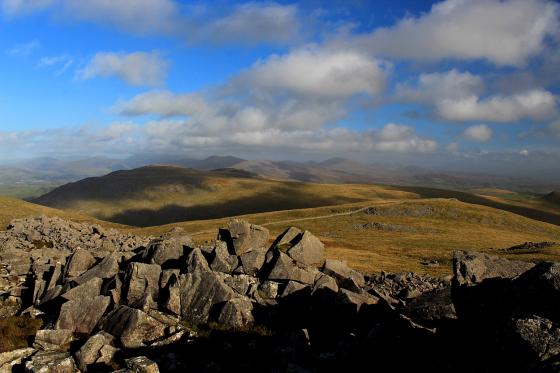
The summit of the ‘fort is crowned by the remains of a massive Bronze Age cairn, seen here. Beyond Gyrn Ddu and its cairns, the skyline Eifionydd lead the eye toward Snowdon herself, centre.
Image credit: Robert Gladstone

The summit of the ‘fort is crowned by the remains of a massive Bronze Age cairn, seen here. Beyond Gyrn Ddu and its cairns, the skyline Eifionydd lead the eye toward Snowdon herself, centre.

The wondrous Tre’r Ceiri viewed from the southern slopes of Gyrn Ddu to approx northeast. The hillfort crowns the left-hand summit of the triumvirate. The massive cairn upon Mynydd Carnguwch is far background left

Moel Hebog and satellites are top left


The surviving dry stone defences are arguably among the finest of their type in the UK

The superb northern defences looking toward the central summit of Yr Eifl. At 1,850ft it’s a pretty hefty hill – however, the superlative views aside, the prime reason for a Citizen Cairn’d to visit is the magnificent cairn.

Seduced by the light. A ‘postern gate’ to the north from without...

Upon the cairn, looking approx south west..

Looking approx south west: the interior possesses a number of well preserved hut circles. The Lleyn Peninsular stretches beyond, through the haze, featuring numerous other fine hill forts, the magnificent Garn Boduan perhaps primary.

Arguably not the optimum ascent route...

Since this revisit was a spur of the moment decision... and I lacked a map.... the direct ascent from south-east seemed a good idea. A quarter of the way up I’d changed my mind.

Image Credit: Natural Resources Wales


Terrifically splendiferous.


Two walls, some hut circles and a big cairn top right.

Big cairn top left, lots of hut circles, and a pair of staggered entrances.

Sun rise from Tre’r Ceiri 21st March 2017, the sun comes up behind the Moelwyns, next door to Cnicht.

Sun rise from Tre’r Ceiri 21st March 2017

Sun rise, 21st March 2017

Equinox sunlight touches the bronze age cairn upon Tre’r Ceiri.

Equinox sunshine alights upon the wonderous wall of Tre’r Ceiri, whilst down below Bachwen dolmen languishes in the gloom cast by Gyrn Ddu.

A great wall, not thee great wall, just a great wall.

Well preserved....yes, but not enough room to swing a cat.......should the need arise.

I wonder if they suffered from nuisance neighbours.
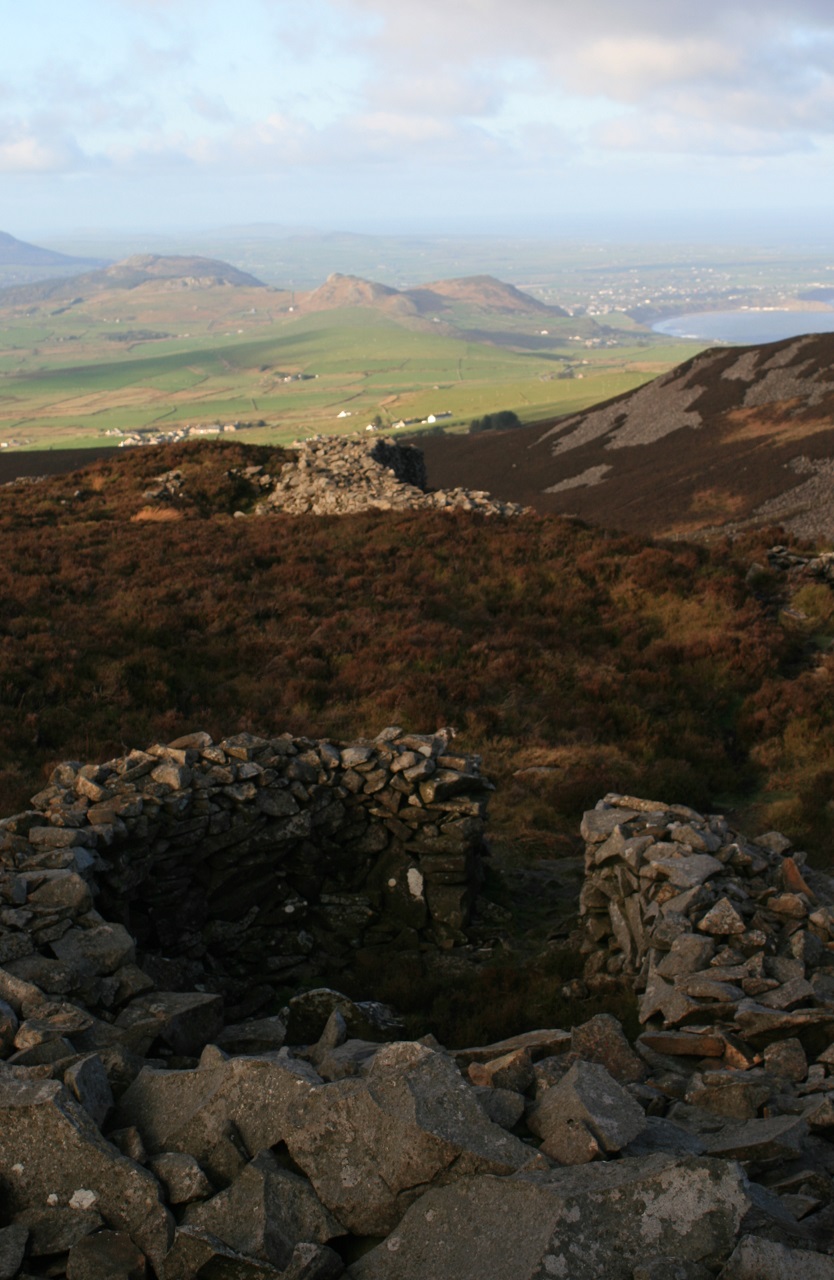
Garn Boduan is the largest hill on the left beyond the green, it too has lots of hut circles, but not as good as this.

The cairn on top of Yr Eifl high above a house at the edge of Tre’r Ceiri.

Looking over the north east wall and the outcrop to splendidly erotic Mynydd Carngwch.

Speechless, almost.

Modern town planners were obviously inspired here.

looks like a a hillfort entrance doesn’t it?
But it’s just another house, a really fine spot this.

Looking through the western entrance to Yr Eifl.

The wondrous Tre’r Ceiri viewed from the great cairn crowning Mynydd Carnguwch.

This wee entrance looked out towards Caernafon. Very dinky. So much stone though.. every view had so much stone... massively quarried mountains with sculpted profiles, scree covered rocky mountain sides and the massive stone walls of Tre’r Ceiri. Heavy man. Very heavy.


More stone than just about anywhere else I’ve ever been to.

An awful lot of stone.

St Aelhaiarn’s Well (see folklore posts), now kept locked.


From the footpath to the southeast.

The southern entrance. Carn Fadrun and Garn Boduan can be seen in the distance.


The frankly jaw-dropping eastern rampart.

Looking towards becairned Mynydd Carnguwch, with the south coast of Lleyn between Pwllheli and Llanbedrog beyond.

The magnificent elevated view of the settlement buildings, presided over by the bulk of Yr Eifl’s tallest peak.

The Bronze Age cairn on the summit, inside the fort.

Looking towards a hazy Yr Wyddfa (right skyline) and Gyrn Ddu.

Looking down on the western entrance, showing how the stonework extends considerably beyond the width of the wall, in order to form a narrow passage.

Imposing western entrance through the inner rampart. The stonework lining the passage extends out from the wall itself.

Entrance through the lower/outer rampart. From here the path climbs fairly steeply to the much more powerfully guarded inner entrance.

The superb high-level view of Tre’r Ceiri with Yr Wyddfa beyond unfolded to alleviate the slog of the climb to the summit of Yr Eifl.
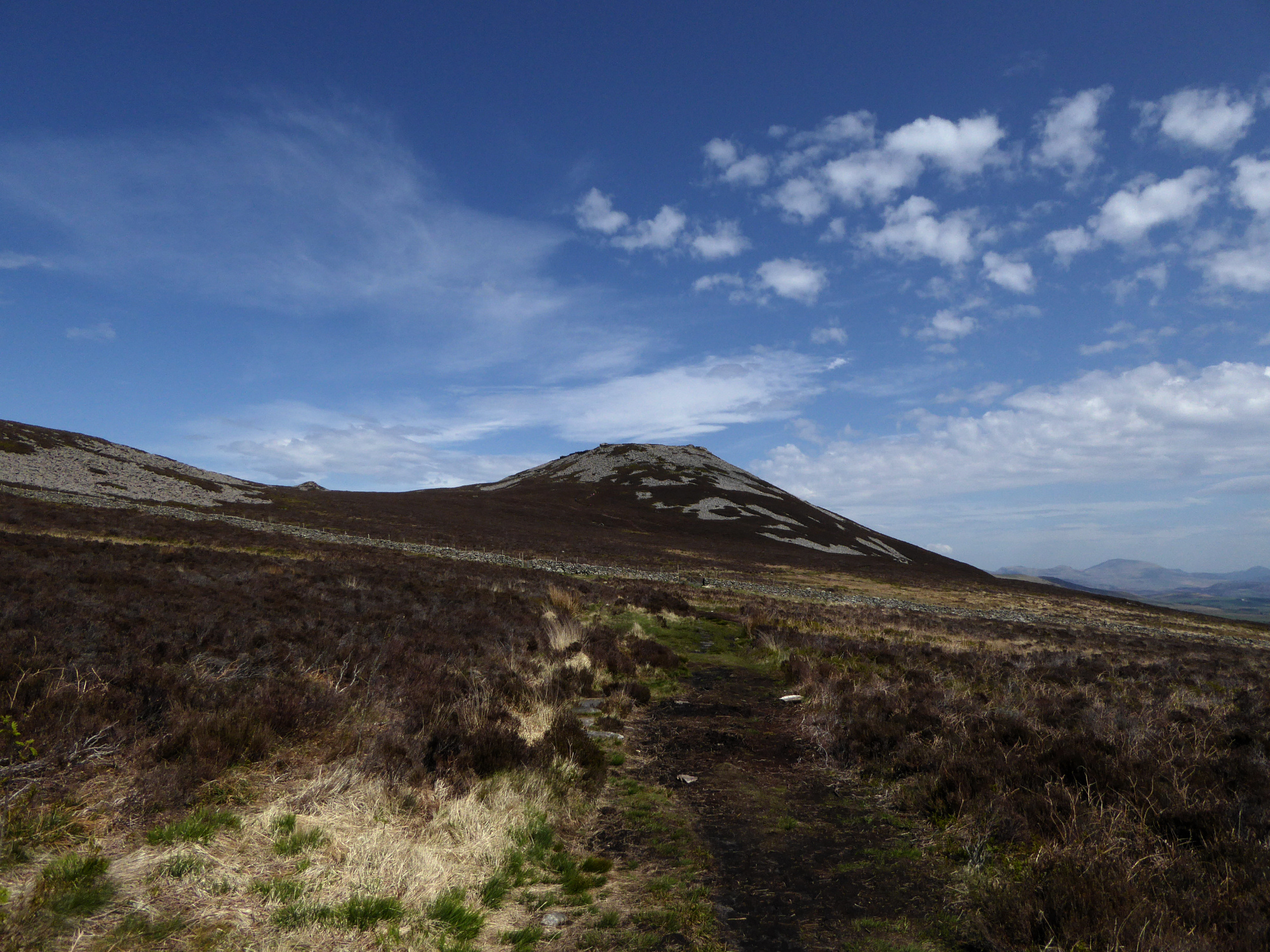
Tre’r Ceiri from the southwest. Moel Hebog can be seen in the distance over on the right.

Quite possibly Wales’ finest hillfort....... but then again, what with Garn Boduan just across the way?

Dark silhouetted Yr Eifl and Tre’r Ceiri rise far right, far higher than the later fortification of Criccieth Castle. From Black Rock Sands. Far left skyline is the also excellent Garn Boduan hillfort above Nefyn.

The Rivals, Tre’r Ceiri on the left.

Yr Eifl on the left and Tre’r Ceiri closer on the right, from Garn Bantyrch

Gyrn Ddu and the Menai Straits........ plus a bit of tumbled ancient rampart.

The hillfort is top centre right skyline, crowning the ‘inner’ peak of Yr Eifl... looking from Carnedd Ugain, Snowdon Massif. The ‘small’ matter of the Nantlle Ridge lies in between, with Bronze Age funerary cairns sited at either end.

Truly one of Britain’s premier hillforts....

The bronze age cairn.


The hill fort straight ahead.
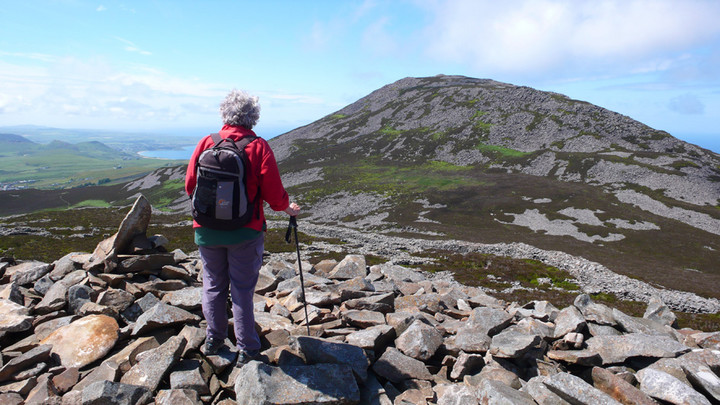
My mam for scale, looking from the Bronze age cairn towards the huts and Yr Eifl beyond, the cairn on Yr Eifl is visible.

Huts. Looking south over Cardigan bay.

Huts looking towards wall and Yr EIfl ( the fork).

The perfect circle.

A smaller entrance on the northwest side of the hill. Anglesey in the distance.

Defensive wall looking west to Yr Eifl.

Detail of wall with mountains beyond.

The incredible view along the coast from the defensive wall to Snowdonia.

The bronze age cairn on top of the fort, evidence the hill had been used at a much earlier time than the Iron age.

Hut groups clearly below, with defensive wall and
Yr Eifl beyond.

Looking South from the wall with Mynydd Carnguwch in the near distance.

More!


Close up of dwelling.


Defensive wall, in some places 15ft high, with walk way.

Todays Main entrance.

two staggered entrances, lower on the left and upper on the right.


The main entrance on the North western side


Looking down from the cairn

The cairn at the top of the hill, the highest point of the hillfort


The north western part of the wall, 7ft thick.

Looking west through the entrance

Structures can be made out on the left side of the ridge...

View from inside the Hillfort looking north towards what may have been a small entrance?


View of the Hillfort from the top of Yr Eifl

Photo from the top of the Hillfort looking west – The end of a perfect day.
Cor my blimey it’s been ten years since I was last here, time passes far too quickly, in the end there may not be time to do everything one wants, so this spring equinox provides me with the drive to get out and see a few hill forts. Leaving the house at 4am, the plan is to get to Tre’r Ceiri before the sun rises. I very nearly made it too, after parking in the wrong layby, and following the wrong path, which then vanishes whilst I’m checking on the suns progress, forcing me to pick a route, any route, and go up, I’m getting too old for this shite, clearly. The sun approved of my star watching position, sat amid big stone scree two thirds of the way up and granted me a quick glimpse of it’s starry magnificence, before it clothed itself in low clouds hanging over the Moelwyns. It was a quickie sunrise, the sun was as it always is at daybreak, the golden glow wrapped the land in beauty and I smiled my sunrise smile, then it was over, it was like the sun knew I had a few things to do today so it let me get on my way, which I did. I knew early on that I was going up the wrong way, nay, the very wrong way, but it didn’t take me by surprise when upon reaching the very top right next to the cairn, it wasn’t just the wrong way up, it is by far the hardest.
But, easy or steep, hard or soft, I had reached the top. It was windy, really very quite windy, but it was sunny and the countryside was looking good, the sun came back out and after a sit upon the cairn, which was lots bigger than I remembered, I set off down the north west wall. Until I came into the hole in the wall, is it an entrance, a secret exit, is it originally original, post Roman, or what, I sat here too, relishing the stones humble gift of wind blocking. Follow the wall south to the big posh entrance, wonder in silence for a minute or three, then dive into the interior of the fort to get lost among the houses.
There’s maybe a dozen places in the whole of Britain where you can see and touch the past in such a satisfying manner as this, I love the closeness of the houses to each other, I love the size of the walls and the perfect corners, surely there must be some restoration at work here, but it doesn’t matter at all, I am far too blown away to dig up such minor trifles. Now over at the east wall north of the entrance where I should have come in. I sit at the battlements, the rocky outcrop that grows out of the wall, from here Mynydd Carngwch has it’s most evocative side to me, it has the desired effect once more, bending myself back into the upright position I walk over to some hut circles packed in right up to the wall. Then after a bit more hutting I’m back at the main west entrance facing Yr Eifl. It is now that I must decide whether or not to put into action part two of my plan, climb up there and have a meet with the big cairn, I’m cold and a bit knackered, hungry, thirsty, but whilst thinking these thoughts my feet decide for me and i’m off, striding across the wilderness like a man with a plan, which I aint.
It has to be said that though Tre’r Ceiri is a brilliant place to be, the place you want to see it from is on top of Yr Eifl, god what an eyeful.
Outstanding.
A walk to the City of the Giants. 25 September 2016
A spur of the moment decision to pop down to North Wales and see Auntie Betty and the family turned into a marvellous weekend of stormy seaside strolls, some good dining (with a few beers) and a Sunday Afternoon walk to the City of the Giants. A few years back when myself, my OH and son were en-route to a wedding at Nant Gwrtheyrn, I’d seen the signpost for the footpath and promised a walk up to Tre’r Ceiri next time we were down. Cousin Gavin had described the place to me and I’d checked it out on Google and Bing Maps. I had since seen the photos on TMA from postman, GLADMAN and thesweetcheat. On Saturday Night last, at dinner in Pwllheli, Gavin suggested a stroll to the City of the Giants on Sunday afternoon. We had spent Saturday watching kite-surfers riding a frothing cauldron and getting airborne at Hell’s Mouth, so I was a little uncertain as to what the weather would bring on Sunday, but a plan was made.
Sunday dawned bright and fair. Gavin and June brought the Gavmobile round to pick us up and we headed off. From Pwllheli you just head out on the A499 towards Caernafon and turn off to the left down a wee narrow street at Llanaelhaearn and head round the foot of the hills between Tre’r Ceiri and Mynydd Carnguwch. There is a great wee pull in spot here.
goo.gl/maps/WtLaa5RKoto
The footpath begins right across the road. A little steep at the start, then up over a stile at the top of the field, a little to the left around the big rocky crag of Caergribin and then it is a fairly level walk across the moorland to the foot of the crag which is the City of the Giant’s perch. I was genuinely floored with amazement as the bright sunlight picked out the faces of the massive stone walls. The flat tops of the mighty defences looked wide enough to drive a car around. My son ran ahead and I watched him dart up the steep entrance while I sweated it out on the heather flanks below. We were less than 30 minutes from the Gavmobile and hadn’t been forcing any kind of hard pace. This is a fairly easy walk and boy does it pay every easy stride back in spadefuls!
I’ll let everyone’s photos of this historical wonder do most of the talking here. There is an awful lot of stone meeting the eye. It is hard to take in the scale of the construction at Tre’r Ceiri. All around are the stoney, scree-strewn peaks of Yr Eifl, Moel-Pen-Llechog and the lower (yet strikingly beautiful) peaks which unfold down the length of the Llyn Peninsula towards Nefyn. But standing straight across from the City of the Giants is the mighty upright cairn of Mynydd Carnguwch, time and again I found my eye was dragged back to look at its profile. The Welsh sun shone all afternoon. We could have stayed all day.
The preservation is exceptional, the walls are a wonder, the simple areas of restoration are easy to spot (with their little drill holes). This is the most amazingly preserved, mightiest, most grandest, finest, panoramically stupefying-est, weirdly intoxicating hillfort I have ever been in. If you are in North Wales and can walk for half an hour or so on fairly easy terrain, get yourself up to Tre’r Ceiri, the City of the Giants. It’s a monster!
Alternative route to Tre’r Ceiri, carry on the road to Llithfaen, in the village take a right as if going to the welsh language school, after a few old cottages on your right you can park on the left, in a nice car park with picnic tables. Facing out of the car park you here take off across to Tre’r Ceiri, it’s a good approach to this fantastic example, keeping left form the bridle way, then cross a stile over a fence and then another over a wall near a farmers trailer and head up to it across the heather.
There’s stunning views from this location. With over 150 huts, and in places 15 foot high walls it’s well worth the walk up. We stayed for two hours and had it to ourselves. You can then come back on yourself and go up Yr Eifl with its ancient cairn, this pre-dates Tre’r Ceiri ( although there is a bronze age cairn on Ceiri-pre-dating the hill fort) the top of the cairn takes up most of the summit but has been disrupted, it’s worth the climb if you have the energy left.
At last, fair enough weather to make an attempt on the fantastic hillfort of Tre’r Ceiri . City of the Giants, What a cool name.
Parking is available on the road to the south, a foopath winds it’s way up giving a good view of Mynnyd Carnguwch .Nearer the top, firstly an information board tells us precious little about the place, and then the little path takes us through the western entrance which is well preserved at a hieght of about 5ft. The Southern wall (which is about 7ft thick all the way round) hangs precariously above jagged rocky cliffs and has a rock outcrop incorperated into it, following the wall to the top of the hill it brings us to Carnedd Tre’r Ceiri a 20m wide cairn which was once like a step pyramid with three tiers. The wall loops around the cairn then takes care of the northern hillside, which also has a covered entrance incorparating six capstones . Inside the fort walls are supposedly the remains of 150 hutcircles. Some are very well preserved more so than the more often visited Holyhead hutcircles if it wasn’t left to nature and had a full time gardener it would be better than Chysauster in Cornwall. Some circle walls and entrances are 6ft tall, and the way the stones fit together is little short of magic, some are huge with natural basins and cupmarks. Back to the northern wall, and the main entrance, going out, the wall (8ft tall) sweeps the pedestrian to the right and down to another wall and entrance, here there is another info board and a virtual path over to cairn topped Yr Eifl which I climbed about two thirds the way up to get a higher up picture.
An absolute wonder this place I couldv’e stayed for hours, it’s long walk up ensures peace and solitude and so much of the city remains.
In the isolated Lleyn peninsula we can find a real ancient Iron Age hillfort connected to the Vortigern legends. Below the superb viewpoints from Yr Eifl (anglicised to ‘the Rivals’, but in Welsh ‘the Fork’) lies one of the most spectacular hillforts, Tre’r Ceiri. On a rocky heather-covered plateau below the eastern peak some 150 huts, that might have supported up tp 500 people, can still be seen clearly.
Locally known as the ‘Town of the Giants’, the walls are still more than 4 metres high in places – no wonder how it received its name.The hight of the walls might very well be caused by its isolation and position 457 metres above sea level, which has prevented all too much stones being looted, as was the case for so very many similar hillforts.
Many of these stones have curious holes in them, varying in size but never large ones. These holes are no mystery, they were drilled to show where the walls had been subject to a conservation project. A ten year long conservation project was carried out on Tre’r Ceiri by Gwynedd Archaeological Trust and Gwynedd Council. The drystone walls were becoming extremely fragile and erosion by the increasing numbers of visitors was causing an alarming amount of damage. The collapses in the walls were causing the masonry to loose its structural integrity. The
collapses were rebuilt in the original building style and the edges of the conserved/rebuilt masonry were marked with small drill holes.

A bit more about St Aelhaiarn’s well, one of the springs below the fort. This is from Lives of the British Saints by Sabine Baring-Gould (1907).
S. Aelhaiarn’s well is an oblong trough of good pure water, by the road side, in which the sick were wont to bathe, and there are seats of stone ranged along the sides for the accommodation of the patients awaiting the “troubling of the waters,” when they might step in, full of confidence, in expectation of a cure.
This “troubling of the waters” is a singular phenomenon. At irregular intervals, and at various points in the basin, the crystal water suddenly wells up, full of sparkling bubbles. Then ensues a lull, and again a swell of water occurs in another part of the tank. This is locally called “the laughing of the water,” and it is said in the place that the water laughs when any one looks at it.
The Well now supplies the village with water. It was walled round and roofed by the Parish Council in 1900, after an outbreak of diphtheria in the village. The entrance is now kept locked.
Baring-Gould’s book also gives the saint’s story from the Itineraries of John Ray (1760). Please indulge me as it is so full of ancient weirdness.
“We were told a legend of one St. Byno , who lived at Clenogvaur, and was wont to foot it four Miles in the Night to Llaynhayrne, and there, on a stone, in the midst of the River, to say his Prayers; whereon they show you still the Prints of his Knees. His Man, out of Curiosity, followed him once to the Place, to see and observe what he did. The Saint coming from his Prayers, and espying a Man, not knowing who it was, prayed, that if he came with a good Intent, he might receive the Good he came for, and might suffer no Damage; but if he had any ill Design, that some Example might be shown upon him; whereupon presently there came forth wild Beasts, and tore him in pieces.
Afterwards, the Saint peceiving it was his own Servant, was very sorry, gathering up his Bones, and praying, he set Bone to Bone, and Limb to Limb, and the Man became whole again, only the part of the Bone under the Eyebrow was wanting; the Saint, to supply that Defect, applied the Iron of his Pike-staff to the Place, and thence, that Village was called Llanvilhayrne.
But for a punishment to his Man (after he had given him Llanvilhayrne) he prayed (and obtained his Prayer) that Clenogvaur Bell might be heard as far as Llanvilhayrne Churchyard, but upon stepping into the Church it was to be heard no longer; this the People hereabout assert with much Confidence, upon their own experience, to be true. The Saint was a South Wales Man, and when he died, the South Wales Men contended with the Clenogvaur Men for his Body, and continued the Contention till Night; next Morning there were two Biers and two Coffins there, and so the South Wales Men carried one away, and the Clenogvaur Men the other.”
The story of the restoration of Aelhaiarn out of his bones, one small bone being missing, is an adaptation of a very ancient myth. It occurs in the Prose Edda of Thor on his journey to Jotunhein. It is found elsewhere. The duplication of the body of Beuno has its counterpart in the triplication of that of Teilo.
Much of this [ruin of the walls] was due to to excavations which were made in the huts some fifty years ago, by people of the neighbourhood. An old woman of Llithfain dreamt that a copper cauldron full of gold was buried in Tre’r Ceiri. This unfortunate dream did more harm to the cytiau of Tre’r Ceiri than many centuries of natural causes of decay.
From an article in Archaeologia Cambrensis, Jan 1904: ‘An Exploration of some of the cytiau in Tre’r Ceiri’ by the Rev. S Baring-Gould and Robert Burnard. It includes some illustrations of their finds.
archive.org/stream/archaeologiacam05powegoog#page/n9/mode/2up
Possibly a bit mean – how much digging would you have done before you got disillusioned? Surely not much. But it does suggest that Treasure would not be seen as an unreasonable thing to find here, and also that dreams are not an unreasonable way of receiving believable information about such Hidden Things.
Just at the foot of the fort is the village of Llanaelhaearn, and its holy well of St Aelhaiarn. Aelhaiarn is one of those Celtic saints with a bizarre life story. He started off as a servant of St Beuno (see Clynnog Fawr). St B liked to commune with God outdoors. Actually he often liked to pray in the middle of rivers. I can appreciate the trance-like state this might induce – perhaps that’s why he liked it. Or perhaps he just thought he could get a bit of peace and quiet in the middle of a river. However, one day his servant followed him. St B was so incensed at being disturbed that he didn’t recognise his friend and rashly muttered that God should teach the man a lesson. Upon that, a pack of wild animals rushed up and tore the poor man to pieces. Beuno must have relented at this point and pulling himself out of the river, ran round collecting up all the bits he could find. Rather cleverly he reassembled them, but just couldn’t find a missing eyebrow. He may have considered a caterpillar, but eventually plumped for the iron tip of his staff. I wonder if the iron nature of the item has any bearing? He then brought the man back to life, and he was known as Aelhaiarn, or ‘iron eyebrow’. Aelhaiarn became a priest and tended the well at the foot of Tre’r Ceiri. The water consequently became renowned for its powers of bodily restoration.
I have based this on the story given by Nigel Pennick in his ‘Celtic Saints’ (1997) but it would be better to find the original ‘Life’.
You can also read a much better (and slightly more complex) version on p228-30 of ‘Select Remains of the Learned John Ray, with his Life’ by William Derham. Published 1760.
which I have found online at google books, and which is from a journey made in 1661.

Local tradition places Vortigern in Nant Gwrtheyrn (the ‘Valley of Vortigern’), a rocky valley leading down from Yr Eifl to the west coast of the Lleyn peninsula. Vortigern was supposed to have once had his headquarters there.
Here we also find his ‘city’: Castel Gwrtheyrn, once so marked on Ordnance Survey maps, but now unlocated. The best candidate for this fortress surely is Tre’r Ceiri, which lies just on the other slope of Yr Eifl, very close to the valley. His grave, Bedd Gwrtheyrn, is also to be found somewhere around here, as there are several locations bearing names familiar to us, such as Carn Fadrun, or the ‘fort of Modrun’ (she was a granddaughter of Vortigern) further south.
Aerial photo of Tre’r Ceiri
Tre’r Ceiri described on the Vortigern Studies website.