Apparently, from Paul Whitewick’s YT channel, video Why I Am No Longer Welcome HERE, a new American landowner is trying to restrict access to this place and is using security personnel. There may be those who have a sudden urge to visit… only using public rights of way, of course. While they exist.

spencer

The Stevenson light at the broch site gleams in the gloaming…
Image credit: Mike Purslow


Moelfre beyond, the ever present. Still trying to suss where the cairn on top of it was viewed from.. the related settlement. It’s visible from Shell Island way and the coast but you lose sight of it as you approach from the west.
Image credit: Mike Purslow


Your first view after closing the farm gate at the minor road-bridleway intersection
Image credit: Mike Purslow

A significant spread of rubble surrounds the stone… most is under gorse but this section on the south side is clear. The cairn, if that is what it is, is an elongated ovoid rather than round. I do wonder if this is a Viking boat burial rather than an earlier cairn.
Image credit: Mike Purslow

Looking down towards the abandoned graveyard. Out of shot to the left is a modern barn which has, on the Balnahard side, a fenced off sizeable relocated cist which was unearthed in the barn’s construction.
Image credit: Mike Purslow

The side of the stone that you will see from the graveyard downhill
Image credit: Mike Purslow
This stone is about 50m uphill from and in full view of the abandoned cemetery and ruined chapel that stand on the high ground between Balnahard and Balnahard Bay. Just follow the fenceline from the graveyard. It has mistakenly been called a stone of penance for the nuns who once lived hereabouts but it is millennia earlier than the date ascribed. I felt that it was on an track to possible sites on the higher ground beyond and on examination of satellite imagery has now revealed a wealth of old rig and furrow that starts about 600ft north of the stone and extends for a wide area on the hidden uplands here and I was therefore right. There is also a dun on the OS East of this area of cultivation. At time of writing I have yet to cross reference with Canmore and give that its correct name and add to this site.
As for the Balnahard area, it is a hard slog along the track from above Kiloran Bay, the nearest place to park: an hour and a half walk each way. If you want to do any more exploration of the archaeology on the hills around then be fit or bring a tent. I hope to return next year – there is so much to see….

The pointed top of modern cairn that sits on Carn na Faire can be seen on the skyline. The Gaelic name for this bay is Port na Righ… ‘Port of the King’. As far as I can establish there are only two other places in Scotland that bear this name, the modern Portree on Skye and a bay at Carradale, East Kintyre. Not an everyday name.
Image credit: Mike Purslow

I found this immediately to the west, alongside the cairn – which is of an unusually large size. I believe this to be the true lookout point which affords shelter, unlike the exposed to the elements top of that cairn, whose Gaelic translation is ‘pile of stones watch point’. A watch point for where? Reckon I have found the answer to that downslope when fieldwalking. As of date of publication of this image fieldnotes and images are yet to be uploaded but local official bodies have already been informed. Perhaps I’ve found hidden in the vegetation the most important prehistoric site on the island… we’ll see…
Image credit: Mike Purslow

The very steep drop off on the E side, Loch Etive beyond
Image credit: Mike Purslow

The view from the W ramparts along Loch Etive, North Connel, and archaeological ‘hot spot’, in the distance, overlooking the Falls of Lora.
Image credit: Mike Purslow

The heavy duty boulders that line the western side’s outer defence.. the ridge beyond, S, the dun’s normal access route in occupation.
Image credit: Mike Purslow

The approach from the west… the bracken already making its presence felt in mid May
Image credit: Mike Purslow

The W side, seen from the shore of Loch Etive
Image credit: Mike Purslow

The highest, tenth, level of the raised beaches here, 130’ above present sea level. Kiloran Bay beyond, and beyond that Uragaig raised beach. Dun Tealtaigh sits to its right.. and, further to the right, the undercut cliff and raised hillock which give Dun Uragaig its shelter from the north winds.. I found it calm there, even on a blowy day.
Image credit: Mike Purslow

The embarkation point is on the east side.. the Ross of Mull and Isles, an easy sail, on the horizon.
The calls of two corncrakes will have to be visualised. As will the midgies.
Image credit: Mike Purslow
A glorious day, filling in time waiting for the Colonsay ferry departure from Oban, with the great Dun Chathach already under our belts. I was only using an old OS49 map and hadn’t referred to Canmore so it wasn’t initially easy to spot.. but once you do you can’t miss it. Just look for the only tree in the field to your left when you take the Achaleven road. It is atop it. In May this wild apple(?) was a delight. A fine sight. And a damn sight more easy to find than all those cairns and sites around North Connel which defeated me, being behind housing. A better map needed for those…


The central cist, part of the northern arc of stones beyond, and, in the distance (not that diminutive – phone cameras, eh?) the four and two stone rows.
Image credit: Mike Purslow

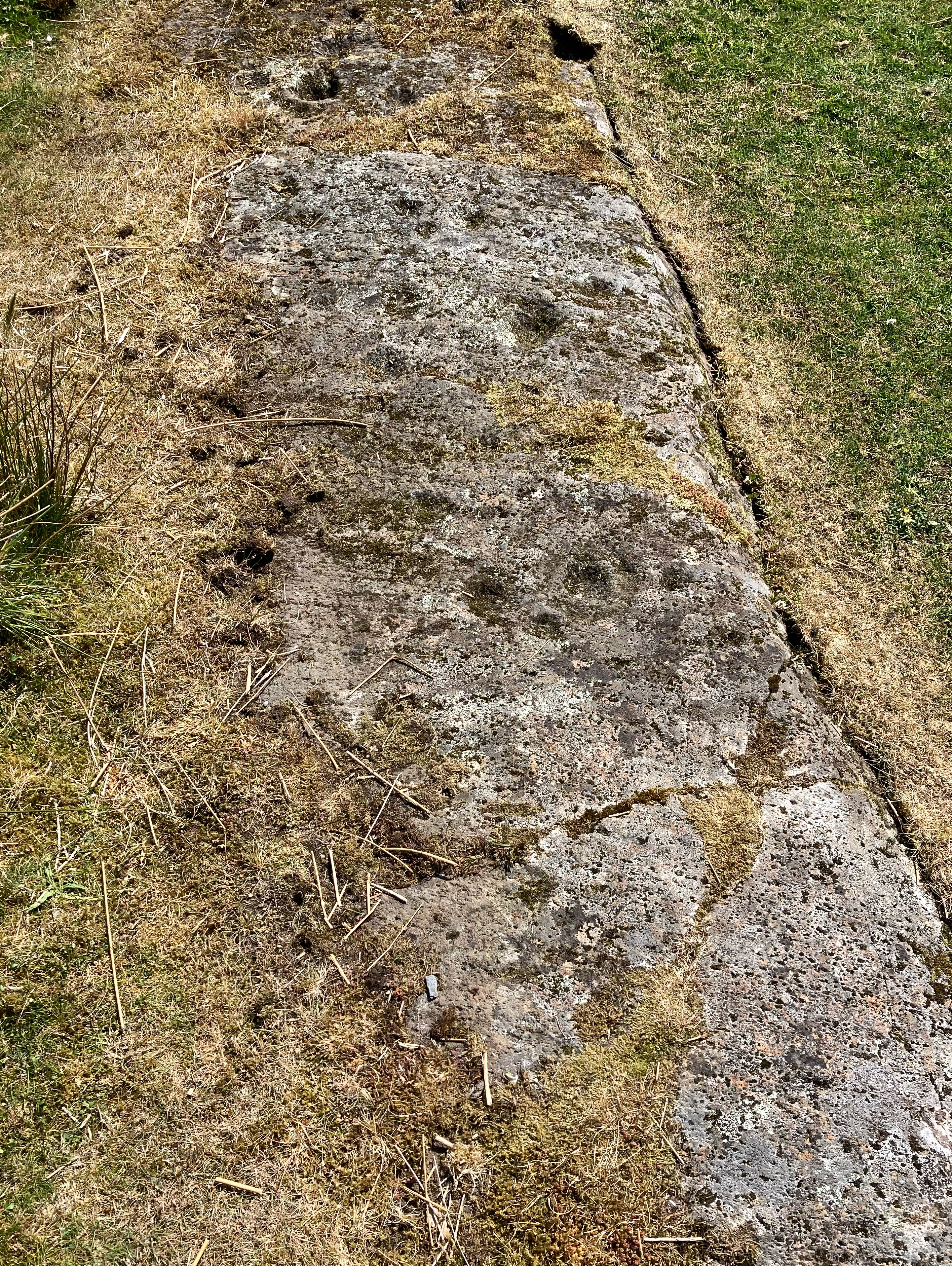
The stone outside the fence… visitors are gradually exposing more of it. I didn’t, of course……..
Image credit: Mike Purslow


Torbhlaren stone with ‘Torbhlaren 2’ prone in mid distance, left. Let’s make them a pair, I say!
Image credit: Mike Purslow

‘Torbhlaren 2’ … packing exposed if you squint at this image. This packing has held the bottom end aloft while tilting the unsupported top end downward so it has nosed into the turf.
Image credit: Mike Purslow

Perhaps this should be called Torbhlaren 2… I saw this distant shape from the gate which gives access to the standing stone, went over and saw packing now exposed by livestock erosion at the prominent end. I’m sure it’s a ‘faller’. At 16’ it’s dwarf the other stone even if securely earthfast when upright. Wish it was…
Image credit: Mike Purslow

Seen from the road to the fort… I didn’t wish to intrude. Cared for in its manicured sylvan surroundings.
Image credit: Mike Purslow

The east side of the cairn on the skyline, top centre.
Image credit: Mike Purslow


Bodach stands on guard. A pilgrimage here for seafarers wishing safe passage to Jura and Southern Ireland beyond. Bless him and he will bless you.
Image credit: Mike Purslow


The cairn is the high point in the centre of the image. Those Paps beyond…
Image credit: Mike Purslow

This, which I think is another probable cairn, overlooks the two cairns on a bluff a hundred yards north, to the east of the road. It would be a skyline feature discernable from the mainland.
Image credit: Mike Purslow

Seen in the tree line clearing from the farm track that leads to the beaches at Cuddyport.
Image credit: Mike Purslow

Another view of the site’s drop off, looking N, defined by the old fence posts. Beyond, in the mid distance, the island’s highest point, and, on the horizon, the Paps of Jura.
Image credit: Mike Purslow

The drop off on the northern side of this very probable cairn defined by a change in bracken height. What sights beyond…
Image credit: Mike Purslow

This site is unrecorded… it is the Achamore Gardens Viewpoint, the gardens highest point, looking out from a conifer shelter belt to the western side of the island, several other sites in view. I noticed a 60’+ wide domed boulder spread which is enmeshed by tree roots and worn down by visitors. There is a distinct, shaped ‘drop off’ on the northern side. I met the island’s Ranger at the gardens – oh, what a sleeping giant of a place is waking here, they’ll be stunning when fully restored after years of neglect – and when I mentioned what I’d found and my conclusion as to what it was she said I was by no means the first to think so. On that basis I’m adding it here as a site. See accompanying photos.
Drive north a short distance from Carragh an Tarbert stone and you will come to a sharp left bend in the road. If you can force yourself to look left towards the Paps of Jura you will see these in the foreground. As with so many of the sites on Gigha if you visit the island later than the start of May you will find them already covered with the annual vegetation.
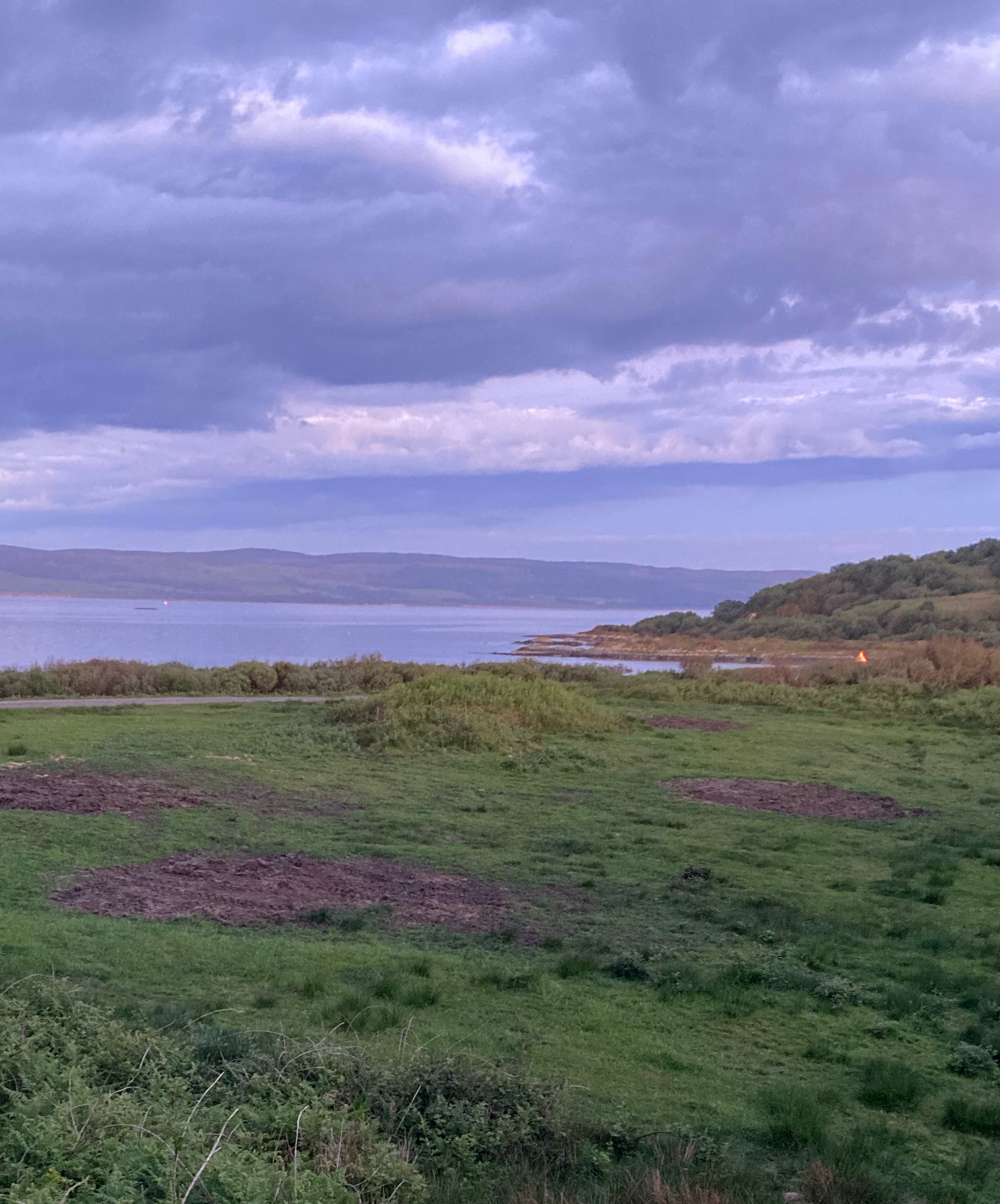
The two cairns with East Tarbert Bay beyond, and beyond that the Sound of Gigha and the Kintyre mainland. A twenty minute ferry trip from Tayinloan to another world: Colonsay in miniature.
Image credit: Mike Purslow
Not hard to spot, this… on the other side of the road from near the entrance drive to the delightful Achamore Gardens, a ‘must see’ if you visit the island. That description can hardly be applied to the dun though. According to Canmore very little remains… a low stretch of what was the north wall and a little bit on the west side. I didn’t wander over and my life doesn’t feel the poorer. Interesting stones at a mound north of it though… perhaps I’ll look next time, touch wood. Yes, this is an island to return to. The sides of the knoll on which the dun sits are thought by the most recent surveyor to have been shaped… I thought so too.