Showing 1-50 of 4,422 posts. Most recent first | Next 50 
Frankly, it's not that easy to know how to follow a visit to the not too distant Bigbury, the mind a veritable cauldron swirling with tales of heroic deeds and defiance against the Roman invader. Go for the smooth 'chill-out' option at Jullieberrie's or Bodsham long barrows, perhaps? However I saw those a few years back, the eye instead settling upon a group of barrows, these of the 'round' variety, situated in chestnut (?) woodland a little east of Godmersham, not far from Ashford. Yeah, that'll do. To be honest I could have chosen a number of others in an arc around Canterbury.... clearly there's a lot more to Prehistoric Kent than I've thought to date.
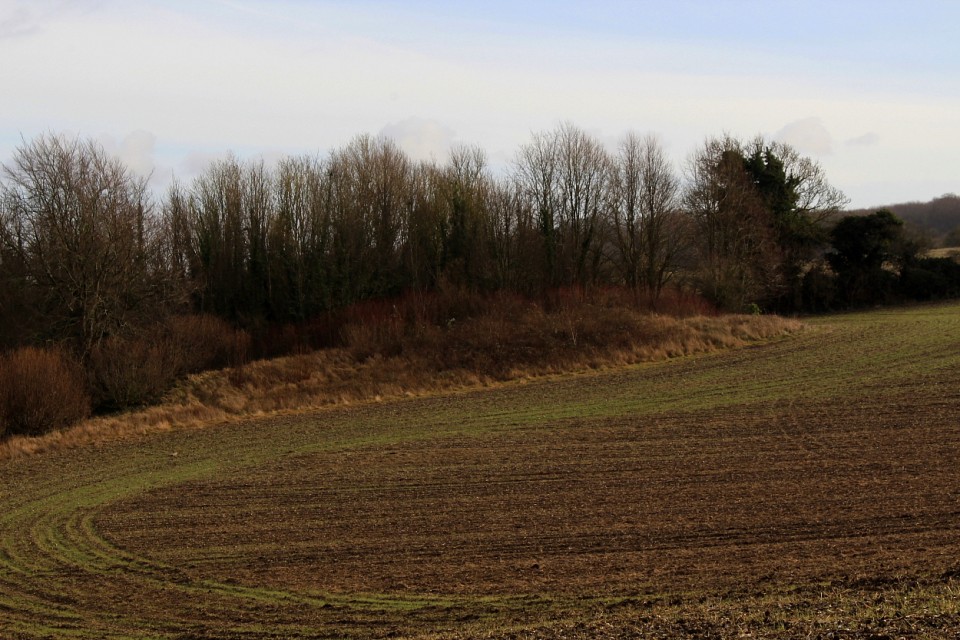
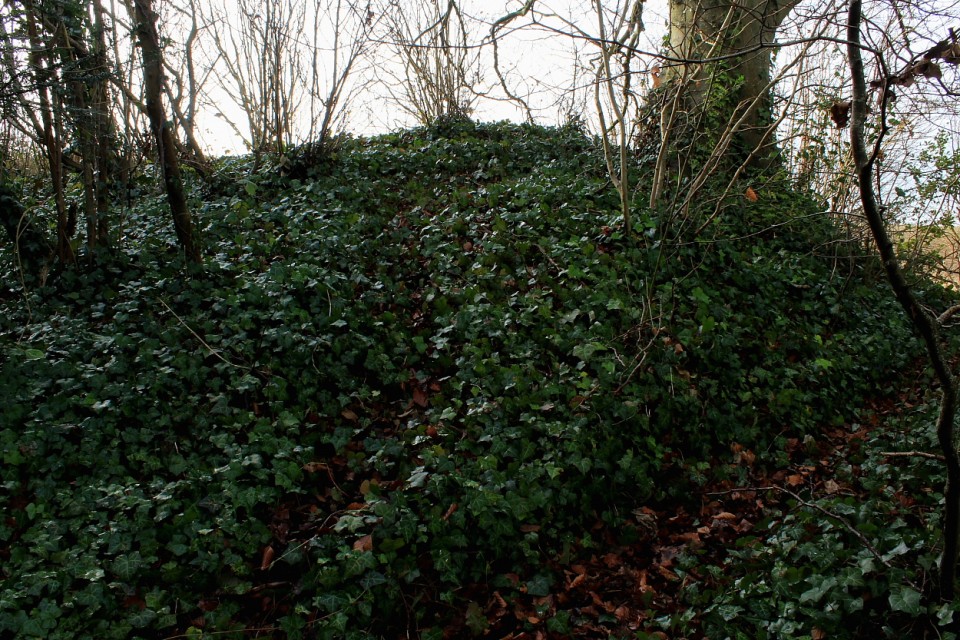
Anyway, leaving the A28 at Godmersham, a minor road sneeks beneath a viaduct and proceeds to snake its way this way and that... as all good country roads should do... eventually arriving at the hamlet of Sole Street. Needless to say, take care... single track leading from a pretty popular pub... need I say more? A little way beyond, 'Penny Pot Lane' heads left (north) to pass through Eggringe Wood. There is a parking area on the right, but carry on to a much larger area and park here. You'll know it's the right one since, looking to the left (south-west) you'll see two large round barrows - not that tall, but of pretty substantial area - within a clearing either side of a forestry track. Somewhat overgrown and unkempt, but hey, what can you do? And at least the trail bikers haven't destroyed them. Yet. According to Pastscape these monuments are:
TR 09665035 : 24.0m in diameter, 1.0m high.
TR 09635041 : 27.0m 1.7m
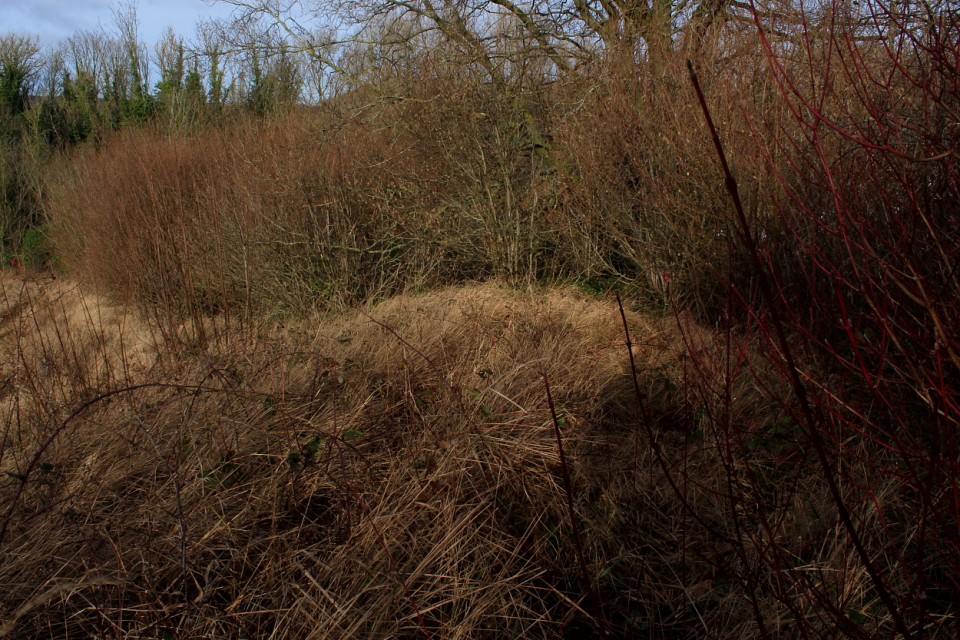
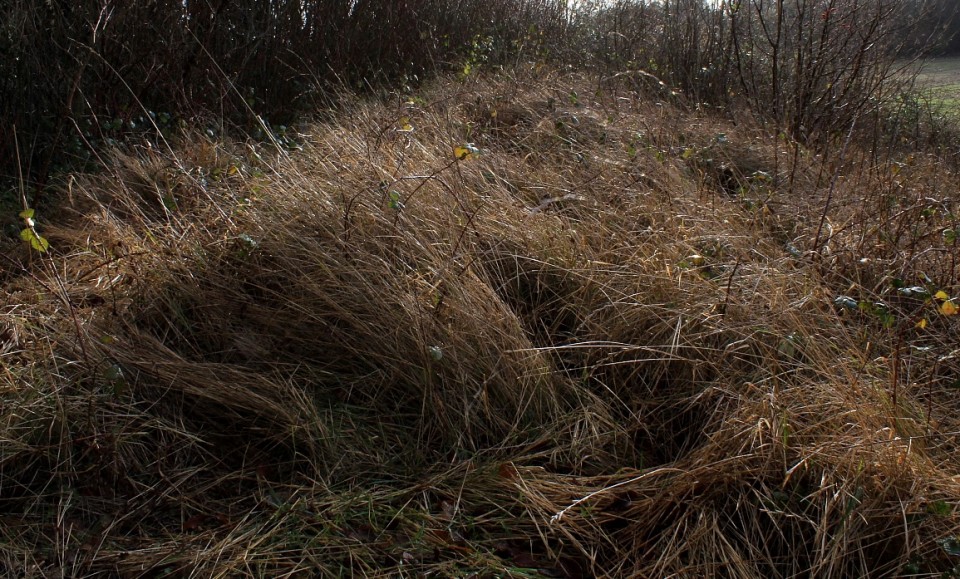
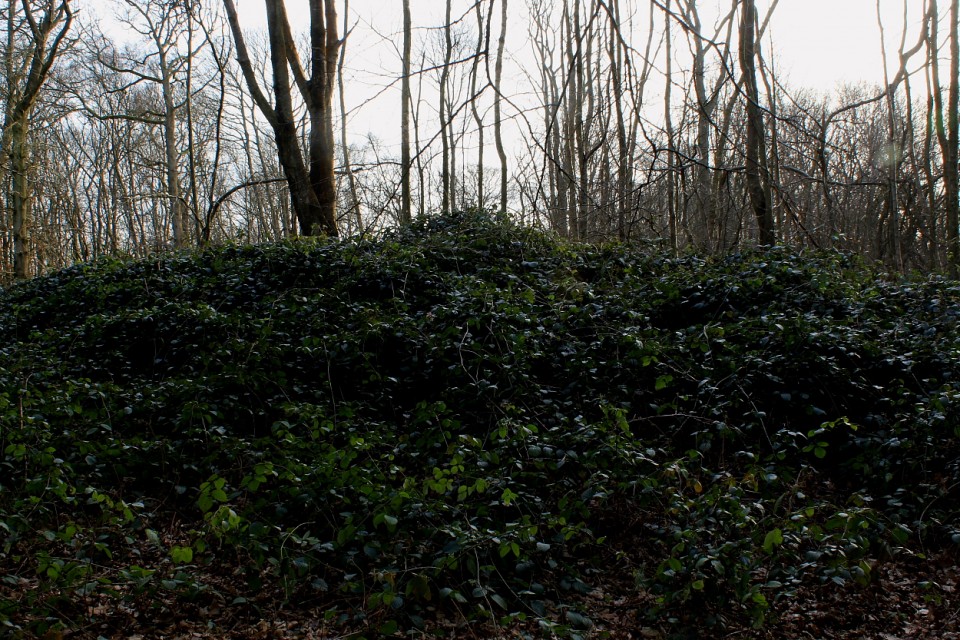
Not bad for starters. However follow the (much smaller) track into the woods to the approx north-east - albeit more akin to a stream during the official 'drought conditions' of May 2012 - and two more, with in my opinion a far superior vibe, can be visited with relative ease. Trending left, follow the track to a crossroads at a clearing. Ignore the left branch and carry on for a little while before veering left. Here, if you're lucky, competent (or whatever) the barrow at TR09965091 (according to Pastscape c27m diameter, 1.0m high) sits in a clearing. Blue bells adorn the damaged mound, birds give it all they've got - quite a bit, it has to be said - and innumerable ants turn a decaying tree stump into a shimmering mass of industry. Nice. So that's where several fierce looking soldiers ants clambering over me live, then? Belieing the not too promising forecast, great white clouds advance across the otherwise pristine blue sky in serried procession. Yeah, this is a spot to lie back and think of England. No, literally. Although if you happen to get carried away by the 'moment'...........
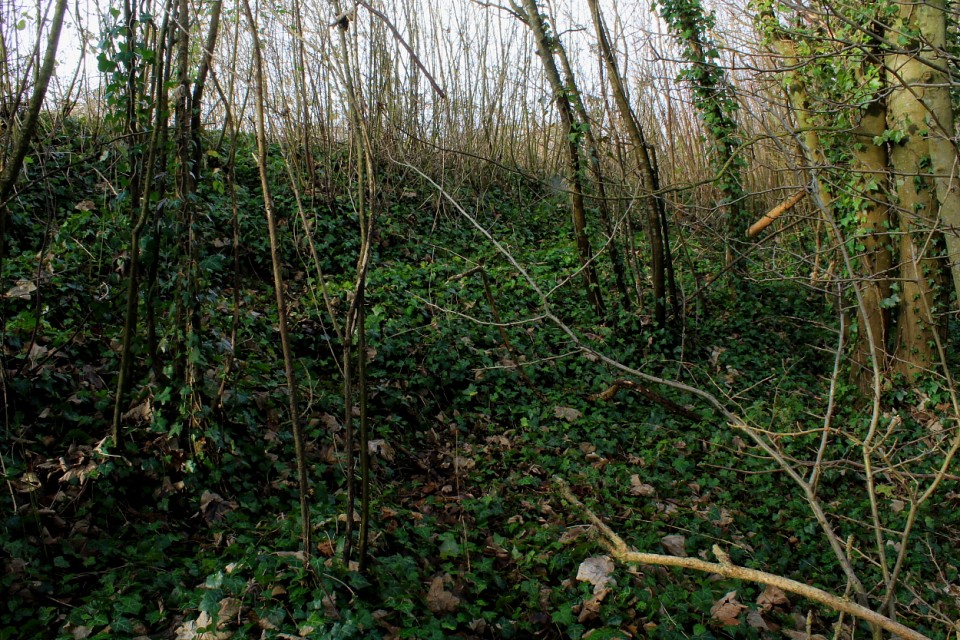
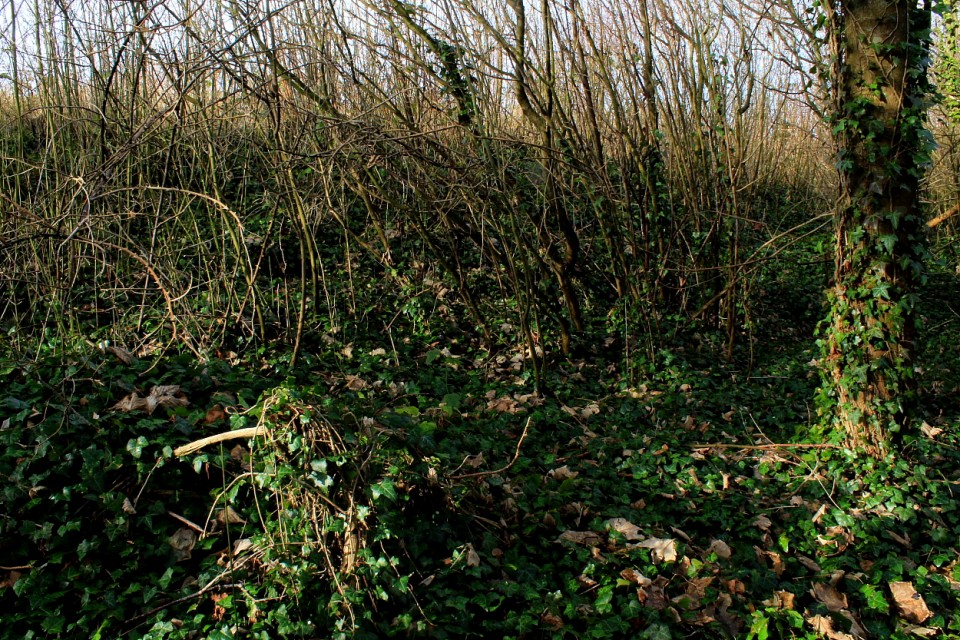
But wait, there's more. Returning whence I came, a short distance beyond the cross-roads... a very indistinct path leads through the trees to my right (west) to the boundary of a field. Here sits another damaged round barrow within another, much more isolated clearing, literally engulfed with blue bells today (Pastscape - TR09795069: 21.0m, by 1.7m). The feathery remains of some species of bird beside a burrow suggest the occupant isn't to be trifled with. So I don't. Sunshine streams through the fringe canopy and, just for a while, everything's all right with the world. It's good to 'recharge', you know? And Eggringe Wood is the ideal spot.
|
Having read in the past - some time or other - that Bigbury had been seriously damaged by gravel digging (you can't make it up), it's consequently taken a while to finally pay a visit to this legendary site. Legendary? Well, yeah. It would appear that most authorities are happy that this is (well, probably) the place where the Cantii 'retired on the woods, where they had a strongly fortified position of great natural strength'... the words of a certain Julius Caesar in 54 BCE, the Vain One having repulsed a mobile assault by the locals near the Great Stour. Needless to say the Cantii stood no chance against the siege techniques of the VII legion during Caesar's abortive invasion of these Isles. The rest, as they say, is history. Or at least the master propagandist's version of it, helping to cement his inexorable rise to ultimate power.
To be honest it is worth coming to Bigbury for that alone.... to stand upon the ramparts and just IMAGINE what it must have been like to see the Romans advance, see your missiles bounce harmlessly off their testudo shield formation.... and realise you would most probably die this day as the siege ramp grew higher. But there is much more to Bigbury than that. Tangible remains, too, giving credence to the fact that Bigbury was probably the most important hillfort (south of the Thames) in Caesar's path. According to yer man, 'they [the Cantii] did nothing unworthy'... which of course may have been a quote designed to inflate his 'achievements'... but I reckon reflects the fatalistic last ditch defence by the local warriors... a defence which may well have contributed to the Romans' eventual retreat back across the Channel for a century. And, in all probability, it happened here. Jeez.
Needless to say I nearly don't make it here at all ... in-car navigation is not my forte. However I eventually locate Harbledown and, crossing the A2, via a bridge, park just beyond upon Bigbury Road. The 'North Downs Way' long distance path cuts through the site from here, pretty substantial earthworks, clad in a beguiling May carpet of blue bells, soon materialising within the woodland. I'm confused, however. Why does the hillside rise steeply to the south, apparently bearing an outward facing rampart? It takes a while.... not to mention much clambering about... to suss that the blue bell adorned ramparts actually represent a north-western annexe.... albeit a pretty powerful one, possibly (according to Dyer) a cattle pound? Some cattle pound! Yeah, the defences of this additional area are substantial, particularly those linking it to the main enclosure upon the western flank. Ascending this bank the penny drops... the OS 1:25K map helps, to be fair... that most of the southern defences of Bigbury, beyond Bigbury Road, are no more. However the northern, towering above the aforementioned annexe, leave no doubt that this was once a major fortress, indeed. But no match for you know who? Damn him and his dodgy haircut to blazes! Although, to be fair, the discovery of a slave chain at Bigbury emphasises that these were extreme, violent - hell, inhuman - times. We need to keep things in perspective.
Fallen trees currently lie stacked upon Bigbury... notices state that this is an official attempt to clear more of the Iron Age ramparts, the back breaking work, I believe, undertaken by volunteers of the Kent Wildlife Trust. Now although regular TMA-ers will know that I'm your archetypal 'tree-hugger', it appears that the mature examples are being spared. Hey, I can live with that. Well done Kent Wildlife Trust. Come to Bigbury and celebrate the defiance of the Britons to the invader. Yeah, sing their praises in the Mead Hall. Or failing that, the Slug and Lettuce.... that'll wind up the punters no end.
|
           
|
           
|
As Mr Cane states, this excellent, deceptively small - yet powerful - hillfort is easy to find.... simply follow the B3180 heading south from the A3052 a little way east of Exeter, the enclosure well sited overlooking the estuary of the beautiful River Exe. Can't miss it (he says). Providing you refrain from following a turn-off to Woodbury and getting hopelessly lost. Stupid is as stupid does...
Anyway. Having (eventually) parked up in the large car park the scale of the defences of this hillfort are immediately apparent. It is also clear (from the information board plan) that the aforementioned B3180 is perhaps not as intrusive as I first thought, utilising the original north and south entrances to traverse the enclosure. How thoughtful. For once. The main body of the fortress is shaped roughly like a back to front capital B... with a squashed top bit beyond the road. There's also a further rampart covering the approach from the north. But enough of this technical jargon!
The southern section of the enclosure, easily accessed from the car park, appears univallate, the massive single bank complemented by a counterscarp beyond a very impressive ditch. Unfortunately ease of access is causing conservation issues here, the bank clearly suffering from the moronic attentions of 'mountain' (ha!) bikers, this despite numerous signs pointing out their endemic idiocy. No excuses, then. I block the passage of one upon the counterscarp and note the immanent lack of expression in his face. In short, Woodbury Castle is a local recreational amenity, albeit one I think (or at least hope) is substantial enough to cope. In common with the wondrous Blackbury Camp not too far to the east, Woodbury is lightly wooded (as you no doubt guessed from the pragmatic name), it being necessary to traverse the roots of some rather splendid trees in order to walk the rampart.
However, for me, the true joy of Woodbury lies across the busy B3180 [take care when crossing, please... it's rather dangerous] in the form of the 'squashed bit of the B' overlooking the estuary. This arc of the defences appears multi-vallate (I think) and is completely overgrown, fallen trees overlying the overwhelming inner bank. It seems very few come here.... the perfect spot for lunch, then.
|
Given the right conditions, this is possibly one of the most enchanting prehistoric enclosures you could ever come across, all things considered. In my opinion, a truly wondrous place indeed.
As Carl notes, Blackbury Camp is by no means large. However I prefer the adjective 'compact' to 'little', for this is no minor engineering work, remaining a very powerful univallate fortress. Pieces of flint protruding through the top soil inform the traveller that the hillfort is not in fact an earthwork, which comes as something of a surprise, I guess. Perhaps this has had a bearing on the excellent state of preservation, flint obviously far more resistant to the wear and tear of the myriad visitors who walk the rampart this morning... and presumably every other Sunday. Yeah, the elderly, young mums with children, annoying people walking dogs, a very attractive young lady in very tight jodhpurs (with a 'wiggle' that suddenly becomes a little too pronounced for the good of my health... jeez - I'll say no more)... the whole community seems to be here today, engendering an aura that is perhaps far more representative of the past than the usual Gladman hillfort visit.
What is far from representative, though, is the triangular outwork protecting what was presumably the original main entrance in the southern flank. Medieval castle-heads will no doubt recognise such 'barbicans' designed to counter surprise assaults upon what was always the weakest point of the enclosure... the way in. However such an arrangement as is to be found at Blackbury is rare at prehistoric sites... in my experience, anyway. There is a twist, too, the 'barbican' defences apparently unfinished - or at least destroyed - to the south. Given the very substantial nature of these additional banks and ditch I find it very unlikely that the constructors suddenly decided 'sod this for a game of soldiers, we're offski'. Perhaps a neighbouring warlord decided it was 'now or never' and made a desperate assault before completion. Dunno. Obviously. But what grim tales has Blackbury to tell?
I mentioned at the start 'given the right conditions'. Guess I should explain. Blackbury Camp is lightly wooded, no doubt at its best when sunlight slants through a thin April canopy to illuminate both the twisted roots colonising the defensive bank and the carpet of blue bells adorning the latter's flank, rising above the great ditch. I am lucky, the overcast conditions of mid morning breaking by lunchtime to achieve just this effect. Yeah, you could well walk around Blackbury's ancient rampart in 10 minutes or less. But I'll wager you'll want a couple of hours.... given the right conditions, of course.
|
  
|
|
Pastscape (Monument No. 201736) has the following to say about this obscure Bronze Age barrow:
'A bowl barrow on Ibberton Hill, 250 metres south of Baker's Folly. The barrow has a mound 1 metre high and 17 metres in diameter. It is now slightly elongated due to erosion caused by a track which clips its eastern edge. A small depression in the centre of the mound suggests partial excvation. Surrounding the mound is a quarry ditch which has become infilled over the years and now survives as a buried feature 2 metres wide. Scheduled.'
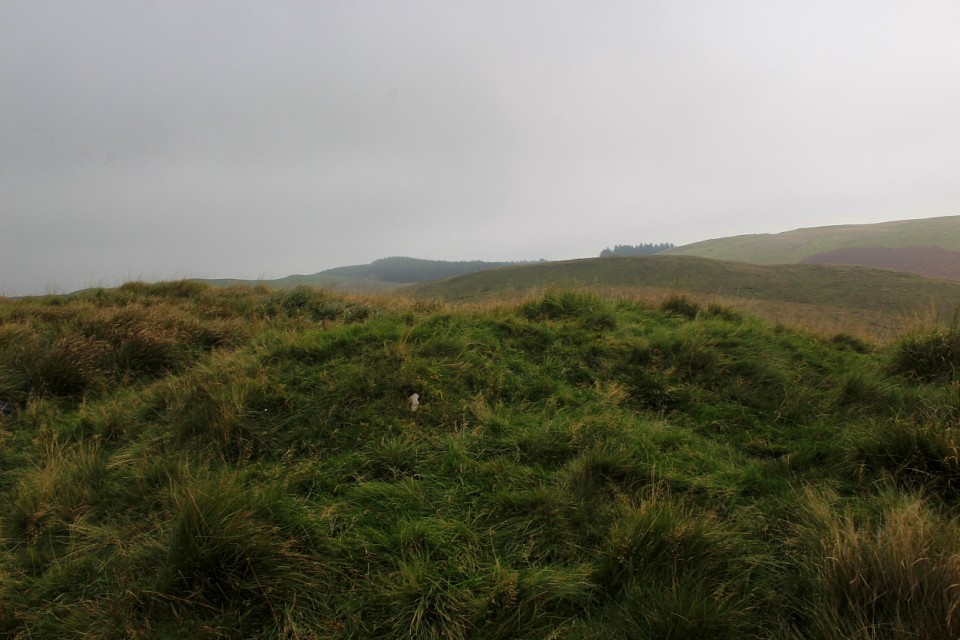
Unfortunately the undergrowth contributed to me not being able to positively identify the monument ... to be honest I might well have been looking in the wrong place altogether. Suffice to say I'll have another go should I again find myself upon this rather fine ridge. It's worth it, the views to the west pretty wondrous, my friends.
|
 
|
Readily seen from the round barrows upon the western flanks of Cold Kitchen Hill - which, incidentally, possesses a frankly superb long barrow to the east - it would've been rude not to have dropped in before heading home. So I did. Although, to be honest, another such monument - near the Court Hill plantation across the way - was beckoning, too. Some other time, perhaps?
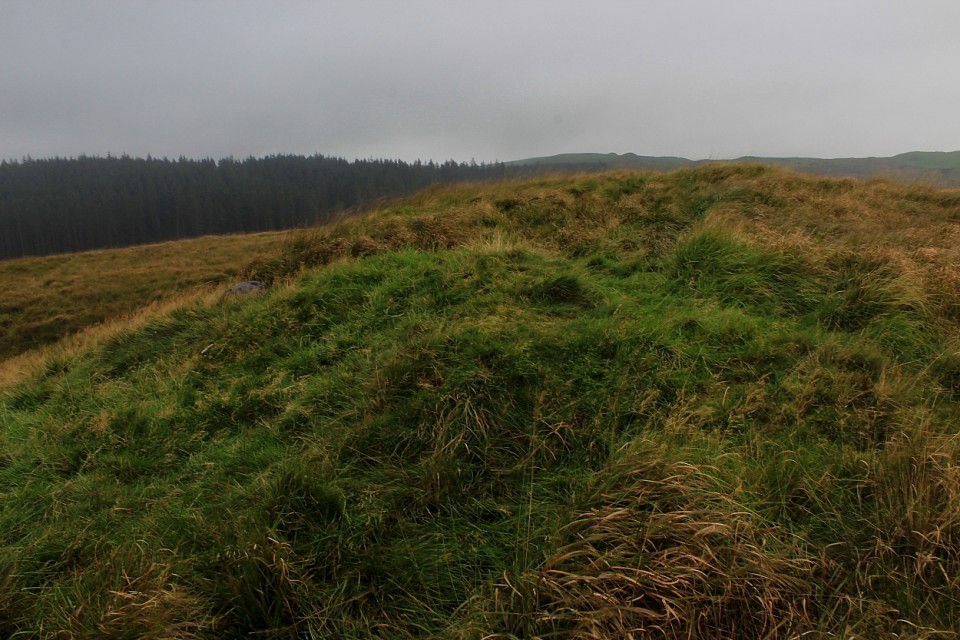
Parking at the spacious entrance to Dairy Farm, I peered under the hedge before sussing that an (unsigned) public footpath actually runs past the site, entering the field from the bend in the minor road a little to the south-east. It's immediately obvious that the view from on high does not deceive.... this is a very substantial round barrow, indeed, set within verdant pastureland. However herein lies the problem... literally, in the form of the bovine occupants of the field. Yeah, sadly - disgracefully - it would appear the southern flank of the monument has been seriously damaged by the clambering actions of said creatures, much of it crumbling away, in fact.
Ascending, carefully, to the flat summit of the mound to investigate further, the sight of several fresh cow pats tell their own story to these incredulous eyes. Hey, I'm well aware cows are able to climb... but, in my not inconsiderable experience, this is unique... the damage so appallingly obvious, yet preventable. Words fail me, they really do. How can the landowner not see this is wrong? I mean, HOW?
What price a simple fence to protect a priceless part of the locality's ancient heritage? This is no mere eroded, grassy bump in the corner of a field. Oh no, this is a fine, seriously upstanding Bronze Age monument, mute testimony to those who worked this land before. I return to the car intent upon asking 'why?', only to see the farmer (I presume) disappearing down the road in his tractor. Perhaps it is as well...
|
      
|
Showing 1-50 of 4,422 posts. Most recent first | Next 50 
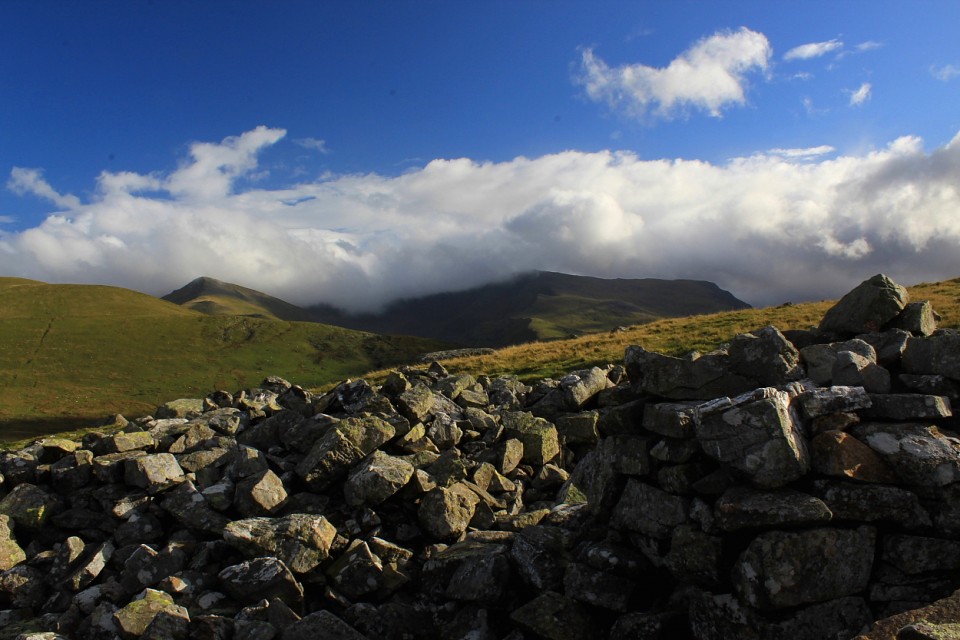
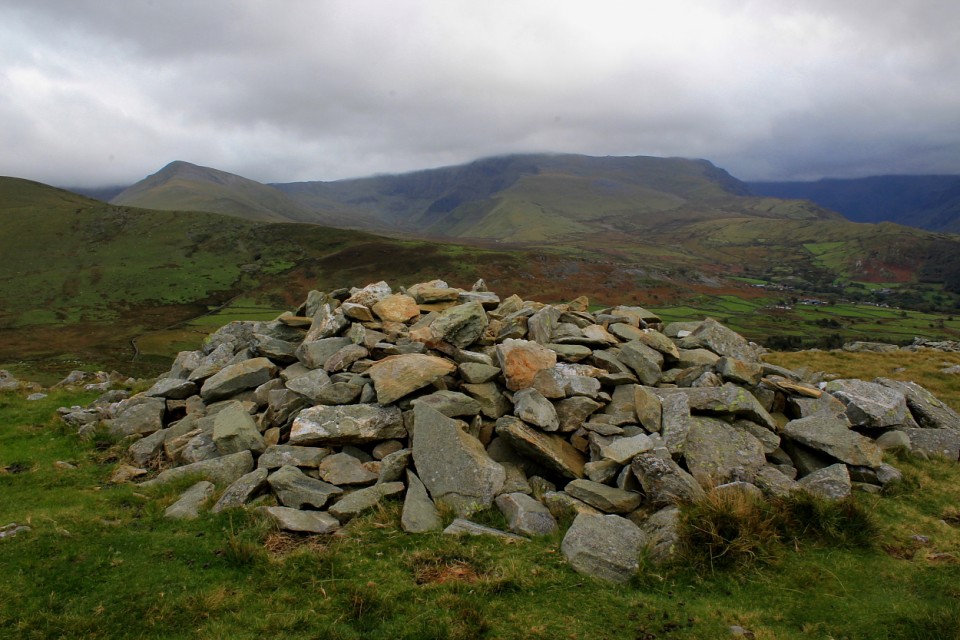
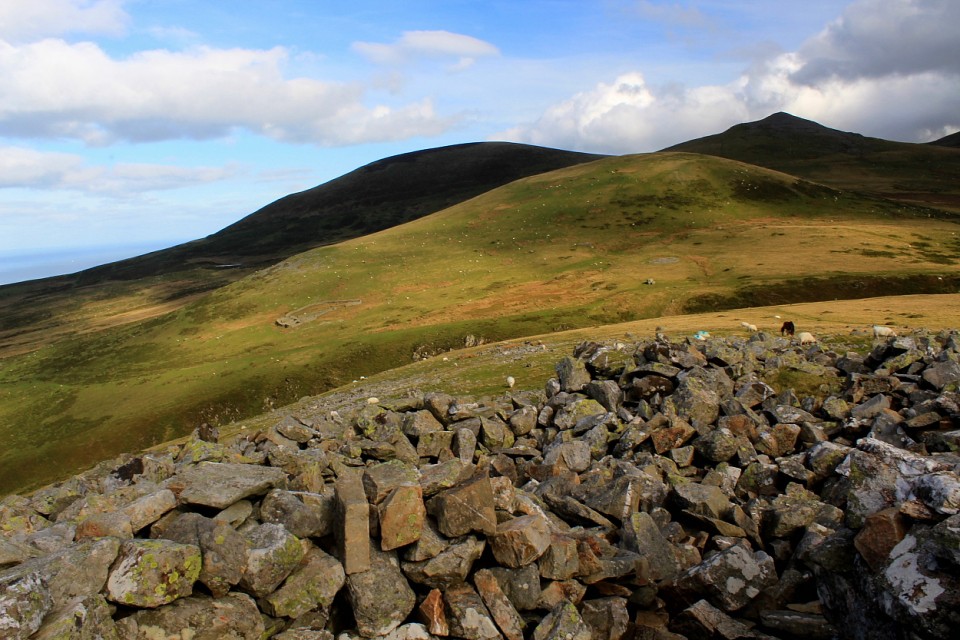
Citizen Cairn'd....... every monument blows me away... but in particular those highland piles of stone. Visiting them, I think, helps ensure those ancient Bronze Age pilgrimages remain relevant, even in this so called 'modern age'. And hell, it makes me feel good, truly alive, on top of the world in the most literal sense... at one with Nature. If this sounds trite, perhaps it is. But nonetheless there are occasions I concur with Elizabeth I's last words... 'All my possessions for a moment of time'.
Suffice to say mine is therefore not an exercise in dryly cataloguing sites for the benefit of future generations - as much as I might try I haven't yet been able to embrace altruism to that extent - but rather an attempt to try and reconcile why I am so incredibly moved by these constructions of stone and/or earth representing a time when everything was, by all accounts, literally a matter of life and death. Yeah, just as an empty house appears to retain echoes of past humanity... the raw emotion that apparently sets us apart as a species... so does the stone circle, the chambered cairn, the long barrow and the mountain top funerary cairn. We may be able to only guess what forms the human interaction may have took - but clearly it mattered. A lot.
I make no special claim for my contributions, particularly since the majority of my earlier images are (variable quality) scans of archive prints.... and my opinions are, well... those of an enthusiastic amateur with a bog-standard education. Consequently I'd recommend visitors to TMA refrain from taking my - or anyone else's - word for anything... go see for yourself and post what you think / experienced. Yeah, make up your own mind. Be inspired, be inspiring, be magnificent (as Ian Dury once said) ... but most of all, my friends, be you! There can be only one.
In a society of computer generated fantasy, however, a word (or two) of caution. Please be aware that reaching some of the more remote upland sites in the British Isles can be potentially dangerous - even life threatening - for the unprepared. Yeah, this is not a drill. Treat the landscape and weather with the respect they deserve and you won't go far wrong. If in doubt, pop a question in the Forum. That's why Mr Cope puts up the readies to run TMA.... Thank you Julian.
So cheers... to Mr Cope for being his inspirational, confrontational self, showing that field archaeology can be FUN! - hey, who'd have thought it? ...to my sister (Mam Cymru) for using her female 'macro' vision to help me see the detail throughout an ongoing re-exploration of the South Walian uplands, albeit upon dodgy ankles etc... to my own mam for insisting 'young men should have adventures'.... and my Dad for unwittingly inspiring a profound love of high places. Oh, and to Aubrey Burl for simply being 'The Man' by blazing that trail.
Some of Gladman's other inspirations include (in no particular order.. except for Darwin):
Charles Darwin (for his peerless humanity... amongst other things...); George Orwell (the strength to change one's mind in light of new evidence); Michael Collins; Winston Churchill (for all his faults); Martin L. Gore; Richard Dawkins (much maligned, yet - by and large - helping to carry the torch of reason during an age of apathetic resignation); Shane MacGowan; Sophie Scholl; W A Mozart; Manic Street Preachers; Pat Jennings; Stuart Adamson; Will Shakespeare; Harry Hill (there's only one way to find out!); Mr Beethoven; Claudia Brucken (so Germans don't have passion?); the (Allied) generation of WW2 for making all this possible; Marc Almond (what does it take to be a man?); Stan Laurel and Oliver Hardy; Christopher Hitchens; Harvey Milk; John Le Mesurier (do you think that's wise, sir?); Ralf Hutter and Florian Schneider.... not to mention anyone who has ever asked 'Why?' - the true legacy of punk. Last but not least, Gaelic beauty Karen Matheson... 'the call is unspoken, never unheard'.
George Orwell - '...during times of universal deceit, telling the truth becomes a revolutionary act'....
Martin L. Gore - 'Like a pawn on the eternal board; Who's never quite sure what he's moved toward; I walk blindly on....'
Truman Capote - 'Failure is the condiment that gives success its flavour'.
Mark Twain - 'Why shouldn't truth be stranger than fiction? Fiction, after all, has to make sense'.
Frank Zappa - 'The mind is like a parachute. It doesn't work if it's not open'.
|
|