Showing 1-20 of 339 fieldnotes. Most recent first | Next 20 
Membury Camp is one of those sites I've 'seen' many - goodness knows how many - times from the M4 services of the same name.... but never got around to visiting. Well, you know how it is? Probably not much there, better places on the 'list' etc.... However I decide to remedy that today, inspired, I guess, by tjj's images back in October. Which is what TMA is all about, is it not?
I approach from the north, so, leaving the M4 at Junction 14, I take the A338 toward Wantage, almost immediately turning left upon the B4000. At Lambourn Woodlands, where the b-road veers sharply right, continue upon a minor road past Fox Farm, parking at the entrance to a farm track on the left. Follow this, past a house, to pick up a public footpath crossing the M4 via - you'll no doubt be pleased to note - a bridge. The stony track continues, passing a prominent wood and with the nissen huts of the former RAF airfield to the left, towards another phalanx of trees concealing the hillfort. The track becomes path and, eventually, affords access to the enclosure. Jeez, it's a big one, Dyer quoting a very impressive 12 hectares, although I'm arguably more impressed by the sheer size of the defensive bank encountered by the traveller. Initially I take the enclosure to be bi-vallate - that is protected by two concentric banks; however Dyer cites the outer as being a counterscarp to the massive ditch. Whatever.... splitting hairs, perhaps.
As with all hillforts, the only real way to appreciate the form and substance of the defences is to walk them.... suffice to say, despite the vegetation being, relatively speaking, not that prohibitive - at least in winter - a circuit takes me over an hour, such is the circumference of this massive earthwork. In fact it is only the distant hum of the M4 which provides an indication of where exactly I am. Are we there yet? No. Are we there yet? Shut-up. Not that this is exactly a hardship, not with Nature having taken over the ramparts to do her thang, occasional pieces of flint lying provocatively upon the bank, as if to say 'for all you know I'm an ancient tool'. But therein lies the problem... I'm no expert. Sigh.
Following lunch, I'm just about to complete my second, and final circuit when the hitherto hidden, entirely unwelcome side of a visit to Membury raises its head. To be fair, I guess she was only doing her job, but I'm suddenly confronted by a 'plummy' middle-aged woman with dogs (I'd seen her about half an hour earlier and thought nothing of it - guess it took some time to summon the bravery to confront me, then... honestly). In short, it appears that I've strayed from the path (I know), that this is very bad (she has no answers to my demands to know why this should be and why the estate wish to forbid me access to my heritage) and that if 'security' catch me I'll be sorry. Oh dear, threats. I assure her I most certainly will not be - sorry that is - that I had no idea walking the ramparts was an issue (there are currently no signs or fences when approaching from the north) and as I've been on site for some three hours, 'security' aren't exactly a formidable unit, are they? I complete my exploration of the defences and have a wander inside the massive enclosure before leaving this exceptional hillfort.
So, there you are. Sadly it seems that here we have another 'high end' landowner who has a problem having a (very) fine example of England's heritage upon his/her land. How damn inconvenient, what? Now there are many ordinary - dare I say 'common' - landowners/ farmers throughout this land who, from experience, I know do not see this as an issue and consequently apply a morally decent attitude to access. Work with the people who want to see your stuff and attitudes invariably improve on both sides, do they not? Yeah, I know. It's plain common sense. Unfortunately such intelligent reasoning, although prevalent somewhere as off the beaten track as the environs of Loch Fyne, for example, does not appear to have caught on yet at Membury. Guess it takes time to filter down....
|
Following a morning's (11/9/11) tough walkabout in the vicinity of the Afon Arban, south of Claerwen (no megaliths, but some things need to be done), the intriguing 'trio' of cairns depicted by our OS friends upon Carn Gafallt finally make it to the top of 'the list'. 'Lucky us', I can almost hear the resident spirits of the ancestors groan. Or is that just a combination of an overactive mind and the admittedly strong wind playing the usual tricks? Yeah, let's go with the latter.
So, no evidence for any 'insubstantial' friends, then, although the adjective could well be employed to describe the mind - for want of a better word - of a muppet farmer who stops his land rover, winds down the window and attempts to stare me down as I make a three point turn near Blaen-y-cwm. What is it with these people? Banjo duels at dawn...... Needless to say us TMA-ers are made of sterner stuff... and I won't back down, particularly since I haven't a clue what I've supposed to have done wrong. But there you are. For the record (Tom Petty comes to mind, by the way) a car can be parked, without causing any obstruction, near a corrugated iron-roofed barn at approx SN940641, a little west(ish) of Talwrn farm. Take the public footpath opposite (north), which veers left, then right to arc through the woodland of Coed Bwlch-glas. A little beyond, the cairns stand, unseen, surmounting the steep hillside above to the left. The official route exits the trees before doubling back along the crest of the ridge to the north-west... assuming an encounter with a moron farmer doesn't encourage the traveller to undertake any deviations, that is.
Whatever route you take to the substantial cairns, however, be sure to schedule an audience if you are in the area.... since the setting of the monuments is class, if not classic. No, I reckon it is the latter, come to think of it. Incidentally Coflein reckons there may actually be five, not three cairns upon this windswept ridge, possibly once connected by a drystone wall, of all things? Apparently some of the cairns are co-joined, although the ravaged interiors and deep heather made this unclear. Well, at least to me. However never let it be said that the ancient occupants of Wales were anything but original. Idiosyncratic, too, particularly the manner in which the summit of Carn Gafallt, rising some way to the north-west, is ignored in favour of linear escarpment edge placement. Yeah, although the highest point was clearly not of specific importance, it is very difficult to believe that the vistas to be had from the site were not. Look to almost every point of the compass (save the north, where the bulk of the hillside obscures, albeit with numerous natural 'mounds' in evidence) and hilltops bearing Bronze Age cairns stand as far as the eye can see..... Y Gamriw to the south (must revisit), Drum Ddu to south-east, Drygarn Fawr and Gorllwyn to south-east... even a stone row upon Rhos-y-Gelynnen to west.
Why, there's even an apparent stone circle upon Allt Goch across the valley. Guess I'll need to come back, then?
|
The 'green desert' of Mid Wales - that wild expanse of high moor stretching north of Llandovery to Pumlumon - has altered somewhat since our Bronze Age forebears erected their hill top cairns in veneration of their dead, the most obvious change, the creation of the massive reservoirs of Cwm Elan and Llyn Brianne.... although forestry is also much in evidence. This recent adaptation of the landscape to support an evolving way of life has not been unflattering to the eye, although, of course, there are other criteria to consider when evaluating the overall impact of the relatively recent actions of humankind. However, from a purely aesthetic viewpoint, my judgement is that these hills, although demanding, offer much to the prehistorically-inclined walker prepared to venture off the 'beaten track'. The highest summits of Drygarn Fawr and Gorllwyn, both crowned by Bronze Age cairns and rising to the north-east of the attractive Irfon pass (north-west of the small hamlet of Abergwesyn) will probably top the list of TMA-ers making an initial sortie into the locality. However note that the ascent of both is problematic due to the more-or-less trackless terrain and subsequent extreme navigational issues prevalent in poor weather. Hence the considerably easier/safer route to the summit barrow of Pen-y-Gurnos could well be a fine, introductory alternative, particularly since it features excellent views of Cwm Doethie, arguably the jewel in the region's crown.
Strong walkers, upon studying the map, may wish to start from the west, near the Youth Hostel of Ty'n-y-cornel, this presenting the option of exploring the enigmatic, prehistoric complex upon Bryn y Gorlan beforehand... not to mention a walk beside the Afon Doethie. However, poor weather having vetoed a proposed attempt upon Pumlumon today (10/9/11), I approach from the north. The isolated chapel of Soar y Mynydd is the key here, accessible by mountain road beyond the north-western 'tentacle' of Llyn Brianne. Ignore the obvious track ascending the hillside to the west (this will bring you back again if you take the circular option and visit Carn Saith-wraig) and instead head to the south-east upon another substantial track above the waters of the Camddwr. Keep your eyes peeled for a sluice gate upon the river and ascend the hillside to the right in the direction of Nant Llwyd farm, this bridleway continuing all the way to the escarpment edge overlooking the Afon Doethie... a wonderful viewpoint. The summit of Pen-y-Gurnos, surmounted by its monument, in turn supporting an OS trig point, can be attained without too much effort by traversing the hillside to the left at this point (to approx south).
The round barrow is by no means an overbearing monument, but nonetheless remains relatively substantial, with traces of kerb a welcome, surviving feature. Needless to say, however, it is the location which takes the proverbial biscuit, endowing the site with, oh, ooodles of vibe, fast moving weather fronts adding that extra authentic 'Welshness' to the experience. Forestry restricts views to the south, but this is of little consequence since the primary focus is - and I would assume always has been - the beautiful gorge carved by the Afon Doethie. Hell, I'd seriously doubt if the natural, abrasive action of flowing water has resulted in more sublime contours in a landscape anywhere else? There is nothing to do except plonk myself upon the ancient barrow and enjoy the silence which pervades this isolated corner of wildest Wales. Not sure if George Borrow ever came here. But if not, he should've. Bryn y Gorlan rises upon the north-western skyline.... but, needless to say, I still haven't the foggiest what went on there. Pen-y-Gurnos is made of simpler 'stuff'. If ever such nebulous material could ever be described as simple.
Two further examples of substantial - if ravaged - Bronze Age cairns lie beyond the ascent track to the approx north-west at Carn Saith-wraig, albeit obscured by high ground. This latter is fenced, although I was able to make my way without excessive problems to connect - following a sojourn at the cairns - with a byway leading east back to Soar y Mynydd (as mentioned earlier). Well worth the additional effort. Yeah, closing the circle is always worthwhile.....
|
As Carl notes, the simplest manner to visit this overgrown, slumbering giant of an enclosure is via the caravan park immediately to the west. However - for me - the promontory / cliff forts which grace this Glamorgan coastline are far and away best approached from water's edge. So, particularly following on from a visit to the unique Sully Island, that is what I must do this Boxing Day afternoon. Romantic fool, that I am.
The initial approach in the car is not especially salubrious..... via the perimeter road to the east of Cardiff International Airport, near Rhoose. However, upon reaching the tiny settlement of Porthceri, the visitor is suddenly transported back to an era where gentlemen emerged, 'glistening', from lakes and ladies had heaving bosoms laced up in their undergarments. Oh, and the peasants did as they were bloody well told, no doubt. Or something like that. Anyway, there is room to park near the church - no cucumber sandwiches on offer, though - from where a public footpath leads down the left hand of private drives to descend, steeply and with much mud, through woodland to a golf course beneath an impressive viaduct. Advance to the foreshore - dodging any bloody golf balls - and follow the coastline around to the right until a little before the point where the cliffs of the promontory tower above; here a path ascends the wooded, lower slopes to the interior of The Bulwarks, following the line of the south-eastern defences in the latter stages.
Upon arrival within the enclosure the immediate impression is that of 'so what?, an interpretation not countermanded by several electrical pylon-wotsits standing in the north-eastern corner. Don't be put off, though.... since the far treeline conceals some pretty substantial tri-vallate earthen banks. The most impressive of these are to the west, terminating at cliff-edge to the south and easily seen by following the footpath to the left towards the caravan park. The northern arc, although much more overgrown and thus less defined, is nonetheless still substantial. As is the eastern/south-eastern flank. Sadly, however, this last section has clearly been treated appallingly, not only having the aforementioned electrical pylons inserted - and being allowed to become completely overgrown - but also acting as a hang-out for local 'yoofs'.... consequently much litter is to be seen, a general feeling of 'who gives a damn?' hanging in the air. Yeah, there is a definite aura of melancholia in evidence here as I force my way through the gorse (and other such prickly, thorny stuff) in the gathering, drizzly gloom. Nevertheless the earthworks, despite such ill treatment, remain as mute testament to this coastline's rich ancient heritage. If only the locals could grasp what they have upon their cliff-top. If only. Speaking of 'cliff tops', that to the south obviously rendered any artificial defences there superfluous.
So, yeah, a visit to The Bulwarks will probably not need to be filed in the TMA 'classic' folder.... needless to say it's not in mine. But an approach from the seashore adds a touch of preceding drama to a viewing of some pretty substantial defences of what was once a major Iron Age site. Now, of course, The Bulwarks is engaged in a new battle for its very survival. The enemy is formidable.... that of apathy and ignorance
|
Wandering down for a quick look whilst visiting the impressive Old Harlow round barrow on New Year's Day....well, it'd be rude not to... I'm sad to relate there is as 'unvibey' a feeling upon this waste ground as you might find behind a block of flats on a council estate in London. To be honest, the clearly relatively recent 'landscaping / contouring' makes the traveller think 'surely not?' at the outset.
Unfortunately it appears that Essex HER agree, an opinion based upon some solid fieldwork, however. To quote SMR 7268:
'Site de-scheduled October 2008 as no longer regarded as a cursus.Field survey and trial trenching was completed in order to evaluate the impact of unauthorised re-contouring groundworks upon it. This archaeological work was undertaken by the Essex County Council Field Archaeology Unit at the request of English Heritage. It consisted of a site walk-over inspection, collection of spot height data and the excavation of trenches across the plotted position of the cropmark and the area to its immediate west. The principal objectives of the work were to establish the presence of the cursus monument and to assess the extent of any damage which may have been caused to it.
The archaeological fieldwork identified the presence of prehistoric and Early Saxon remains,but no trace of the putative cursus. It also established that there had been relatively little deep and extensive truncation of archaeological remains across the majority of the scheduled area, and that the groundworks had largely comprised the removal and the stockpiling of topsoil. However, general compaction, disturbance and rutting caused by the movement of heavy plant were observed on the exposed surface that is likely to have had an adverse impact upon below-ground remains present. It is concluded that the cursus had never been present and that the linear 'cropmark' features evident on aerial photographs, from which it is was identified, are more likely to have been modern-day tracks, footpaths or other wear marks on the field surface.'
So, in all probability not a cursus, then? Curses! However note the stated presence of 'prehistoric' remains..... so something WAS going on here, near the barrow, in ancient times. But what? As usual we clear up one mystery - albeit unsatisfactorily from a TMA point of view - and create another. Right on!
|
Boxing Day morning under a leaden, South Walian sky, with cloud base low enough to prevent fleeing to the hills, is not the most inspiring of times, it has to be said. Only one thing for it, then.... to paraphrase the lovely Cerys Matthews... 'Things are strange, I'm starting to worry. This could be a case of going to Sully'. Well, my mum's always said I'm a bit like Mulder from the X-Files. Not sure if that's a compliment or not, to be honest.
Sully Island is another of those locations which may well take those unfamiliar with the delights of The Glamorgan coastline by surprise, set as it is between the capital city (to the north) and Barry Island (think Gavin and Stacy, if you must) to the west. With due respect to the locals, I'm sure they'd agree scenic beauty wouldn't be the first topic of conversation when mentioning the locality... nevertheless it is here. There is also danger for the unwary in the form of one of the highest tidal ranges in Britain (my thanks to the Mam C's husband - who works nearby - for that nugget of information, duly exposing my general ignorance of local marine matters). To be fair, the prominent signs round about make this crystal clear. People have drowned crossing to Sully Island. Simple as that.
Initially there doesn't seem any chance of me getting more than a distant view of the 'promontory' fort occupying the left hand (eastern) portion of the island, as viewed from the quayside. Yeah, the tide is right in, the island, well.... an island. However the sun pokes from behind the cloud mantle, encouraging me to take a few shots from the beach. Then, wandering down the breakwater - as you do - I have the crazy (and no doubt suicidally dangerous) idea that it might be possible to wade. However, clearly, it would be impossible to venture further without coffee, so a return to the car is required. Several minutes later the decision is academic, a broad causeway of rock now linking island to shore. Jeez. That is fast.
Passing Carl's skeletal boat, I head eastwards along the island, the far (southern) flank of which is being inexorably smashed to oblivion by the Bristol Channel.... fort 'n all. Guess the sea wants Sully Island back, then. Coflein reckons there are three cross-ramparts isolating the far eastern section of the island from the hinterland, although I can only positively identify two. These are quite substantial, relatively speaking, although considerably overgrown with brambles - and, sadly, featuring quite a bit of rubbish. The highest point of the enclosure is crowned by what I take to possibly be the remains of a Bronze Age round barrow. Surprisingly, Coflein (very) tentatively agrees. If we are correct, it is a suitable location for VIP burial, with the natural, craggy defences of the fort falling way sharply to the water, the sea views expansive towards Flat Holm etc. Looking to the south along the disintegrating, southern flank the view is more industrial, with Barry's factory chimneys lying beyond the sound. Yeah, times have changed since people actually occupied this spot. But it still remains an extraordinary place to eat Boxing Day lunch. And that's a fact. No need to get Mulder and Scully onto Sully to solve that one.
Just make sure you keep one eye permanently upon that crazy tide!
|
It's truly sad when unsavoury, extraneous events overshadow a visit to a site. But, hey, these things happen within a flawed society such as ours, do they not? Tell me about it. Quite how we can (rightly) demonise moronic hooligans for rampaging in our city centres when the so called 'higher echelons' (ha!) act like mindless, sub-humans... having a jolly good time hunting a creature to its death for FUN ... is beyond me. It really is. Evil is as evil does, Forrest. It therefore makes my skin crawl to have to share the environs of Coedcae Gaer with such fox hunting degenerates this Christmas Eve afternoon.
There are two saving graces, however. Firstly, the fox doubles back away from the pursuing creatures, paradoxically sat astride beautiful mounts, and casts me a glance as he/she tries to save itself, proceeding to lead them a merry dance in the process. Yeah, a flawed, instinctive executioner when loose in the chicken coop - I doubt if many would blame a farmer blasting the fox with his shotgun on sight - but civilised human beings are supposed to know better than to engage in sheer, retributive blood lust, are we not? QED! I give you the fox hunter! And you can keep 'em the hell away from me upon a public common. Can we stop the cavalry this Christmas? Seems not, my friends. Seems not.
With apologies for the above.... the second saving grace is the unexpected quality of the hillfort of Coedcae Gaer. A little to the north-east of the great urban sprawl that is Bridgend, it's taken me years to find this, so my thanks to the two TMA'ers to proceed me here. The setting is fine, a typical South Walian coastal juxtaposition of industry and sweeping, green hillside, the latter prevalent to the north where the Nant Ciwc has carved the deep valley of Cwm Rhydymilwyr. Phalanxes of wind turbines dominate the summit of Mynydd Maendy to the north-east, the ridge, according to the map, also boasting a 'tumulus'. Another, smaller 'enclosure' sits above Hoel-y-Cyw some way to the west. Far to the south, the Glamorgan coastline is crowned by a myriad promontory 'cliff forts'. Clearly there was a lot going on in ancient times...
So much for the location. The earthworks are pretty good, too. No, they're better than that, the univallate defences rising to an impressive 3m in places, a counterscarp duly emphasising the ditch. Unfortunately a double barbed-wire fence impedes access, and, seeing as the farmer is on site (at least I think it's the farmer, maybe not), I'm forced to have a conversation. Needless to say he's not aware this is a 'hillfort'. But then perhaps that is not so surprising....
|
I first came to South Weald Camp to see the ramparts adorned with the bluebells of Spring... unfortunately, however, I left knowing that I would have to return at some point in order to settle unfinished business. If you've read the miscellaneous post you'll be aware that this Late Iron Age enclosure has not had an easy ride into the 21st Century. Far from it. Now medieval alterations, I can accept.... but a cricket pitch occupying the eastern half of an Essex plateau fort? Do me a favour. People supposedly intelligent enough to play cricket should really know better, should they not? Having said that, though, this Modern Antiquarian should have had the balls to highlight this discrepancy back in April. But, to my shame, I bottled it and went away with the job half done.
Consequently I engineer the return home this New Year's Day - following a morning at Old Harlow's fine round barrow - so as to pass through Brentwood. A little before the town a minor road leaves the A128 to literally bisect South Weald Camp. It is possible to park just south of the enclosure, from whence a rather idiosyncratic stile affords a visit to the western half of the camp. To avail yourself of the eastern half, walk back up the road and make for the cricket club pavilion, G&Ts at the ready. As it happens, today being New Year's Day and all, there is no one around. So I reckon no-one is therefore going to mind me having a quick look at my local heritage. A metal gate to the south gives access to a muddy track following the outside perimeter of the camp. Although badly damaged, the south-eastern arc of the bank is still pretty substantial... the eastern defences more so, although possible medieval amendments should be bourne in mind, I guess. Only to the north is the bank truly trashed, having the indignity of being sandwiched between practice cricket nets. Howzat? Very nearly 'out'. But not quite.
It begins to rain... as forecasted.... and then, to all intents and purposes, monsoon. Which I don't recall being mentioned. But there you are. Nevertheless I can't leave without another visit to the western half of the camp, if only for the sake of continuity. No bluebells on this occasion, the ramparts rising stark within the landscape, trees offering skeletal profiles in Winter raiment. My dodgy 'hillfort-allocation' waterproofs begin to give way under the prolonged onslaught of the rain. But it is of little consequence. I am happy I've now seen the whole picture, as it were.
Yeah, poor South Weald Camp may have been dealt a poor hand by fate, but I reckon it's still well worth an hour or so of anyone's time.
|
'All is quiet on New Year's Day'... so sang that wee Irish fella, Bono... before he began hanging out with politicians, saving the world and indulging in other such important matters. Not to mention wearing silly specs. But I guess his heart's in the right place, a bit like the Bronze Age round barrow at Old Harlow, despite a continual cacophony of noise from the nearby kennels rendering the opening line of U2's seasonal song fanciful, at best.
Last year's ongoing attempt to discover more of my ancient Essex heritage somehow did not include a visit to Harlow... what with the mighty Wallbury just up the road. So what better time to remedy that omission than on the first day of the new year? As with most Essex monuments, the Old Harrow barrow is tucked away from the gaze of the passing motorist, although whether such seclusion mirrors its erectors' original intention is perhaps something we will never know. Was there always a screen of foliage adding a veneer of mystery to the site, the lowland equivalent of the mountain top cairn being set back from the skyline? Or were these great earthern barrows meant to act as a beacon, dominating the landscape?
Upon arrival, my first impression is that the mound is a lot more substantial than I anticipated [hopefully the scale image gives a good indication], both in respect of height and area covered. Several trees have made the ancient soil their home, the radiating branches of one such youngster curiously reminding me of a natural representation of Bryn Cader Faner. The summit is covered by bramble, although not to an excessive extent, the western flanks more or less clear, allowing space to sit and take in the surroundings. A large pond - or small lake - to the east adds a water feature, although a 'work shop' area of some description to the north might be an issue on other days. The aforementioned hounds eventually shut up, the only disturbance then the occasional, friendly local passing by, together with cars in the middle distance. Beyond, upon waste ground to the south-west(ish), air photography had apparently highlighted what was thought to be the course of a cursus, perhaps the least understood of all monuments. I take a look, but see nothing. Perhaps this is not surprising since Essex HER now reckons the linear crop marks probably represent much more recent 'tracks'. More's the pity.....
Access to the Old Harlow Barrow is easy.... once you've sorted somewhere to park, that is. From Junction 7 of the M11 take the A414 towards Harlow. At the fourth roundabout (with school to the right) turn right upon the B183 (Gilden Way) and, beyond another roundabout, the site is within trees a little to the right, beside a public footpath. I carried on a little further and parked down the next left, walking back. Note that there is 'official' access, so no need to climb any fences. Happy New Year!
|
Arenig Fach is always going to remain in the shadow of its big sister across Llyn Celyn, the latter attracting far more visitors, assuming my own experiences - not to mention inclusion within numerous guide books - are reasonably representative. Such is life, I guess. We're never going to overcome the general human tendency to believe that 'biggest is best', to take things (and situations) at face value. And, of course, Arenig Fawr is a fine mountain, crowned by the remains of a Bronze Age cairn and dominating the shoreline of the reservoir, whilst the smaller peak is all but invisible to the passing motorist upon the A4212. All I'm saying is that Arenig Fach is very much worth primary focus as well, providing a much more intimate experience, with no reduction in quality of landscape... just on a somewhat smaller scale. To prove the point, take the (very) minor road traversing The Migneint (literally, 'The Bog') to descend towards the Machno valley... where the mountain suddenly takes Centre Stage, as if this brutal, hostile - not to mention wet! - landscape and the peak are inextricably linked. From this direction it's hard to see how any 'stonehead' would not want to see the Bronze Age cairn upon THAT?
Suffice to say I have wanted to return ever since a short visit way back in 1995. But then you never seem to get around to things, do you? Carnedd Llewelyn may have usurped perfect conditions for a visit the day before, but for some reason I simply must see Carnedd y Bachgen before I return home. Hell, the weather doesn't look that bad today. Does it?
It has to be said that, despite rising to the relatively modest height of 2,260ft, Arenig Fach does not tolerate visitors lightly. A-ha! Perhaps that's why it receives so few, then? The first problem, appropriately enough, occurs right at the start.... where to begin? Unless you are a fan of long distance bog bashing - and fancy following the Afon Serw to approach from the north-west (I'm not) - the only real, practical option that I'm aware of is from the A4212, near the north-western tip of Llyn Celyn. Driving north, I park at the entrance to a concrete track [at approx SH413845] and take a very obscure (unsigned) public footpath opposite a corrugated iron sheepfold, a little north of a prominent waterside boulder, just before power lines cross the road. Advance uphill, with pylons rising above to right and left, cross a lateral footpath and.... basically..... continue roughly uphill to the west, keeping north of Beudy Fron-wen. At (very approximately) SH840413, I chance upon what looks to me a possible trashed, round cairn, or perhaps hut circle? Maybe. Needless to say, what with fence posts piled on top of what looked like the remnants of a cist, the site - if indeed it is a monument - is in a very sorry condition. A small, ruined, drystone structure stands forlornly to my left, a substantial drystone wall impedes progress westwards (there's a gap a little to the south) towards the ridge of Bryn Du. Skirting the high ground to the right, I eventually arrive at the hidden jewel that is Llyn Arenig Fach, just as the sun breaks through the overcast mantle to flood the landscape with light, drab colours suddenly metamorphosised into hues of indescribable intensity. Worth the effort alone, despite the cloud base which is now swirling across the crest of the majestic cliffline which towers above the lake. This crest must now be attained.
The obvious route is to ascend by a fenceline to the left [although the right hand option is probably easier in retrospect], not as easy as it at first appears, the terrain deep heather, concealing many an ankle twisting undulation. Eventually I reach the top and realise how far conditions have deteriorated, particularly in respect of the wind. Pretty bad. However Carnedd y Bachgen calls and I've a fence line as a guide. I follow this to a junction with another, cross over as best I can and head approx westwards to the summit and the Bronze Age cairn. Although clearly heavily robbed - there's an dry-stone shelter at the actual summit, together with an OS trig point - the monument remains impressive, utilising the form of the crag upon which it stands in the same manner as Foel Grach, and to equally great effect. The interior of the cairn is somewhat camouflaged by moss, but nonetheless appears somewhat hollow, albeit with some substantial stones in situ. Yeah, I'm glad I came. Trouble is, Nature appears progressively peeved by the impertinence of my presence......
Sure, the wind is severe, the lowland drizzle transformed into horizontal, lashing rain. But, hey.... this is Wales. So I'm not expecting to be picked up and dumped unceremoniously on my back as I attempt to venture towards the trig! Point taken, mam. Subsequently I decide the best place to be is on my back within the cairn to see if this front will pass and afford me the views I crave. It doesn't and I am therefore denied the vistas, too. It's also somewhat difficult to eat lunch, but I refuse, on point of principle, to use the shelter. Oh no. If you talk the talk, you have to walk the walk. And besides... Carnedd y Bachgen is incredibly, evocatively ethereal today, what with the mist swirling around. Eventually, however, I must begin the descent, shaken and most definitely - definitively, even - stirred. But the waterproofs hold and, after pausing lakeside to reflect upon past times with mum and dad, I reach the car none the worse for wear.
So, yes. Arenig Fach is very much worth the effort. Even in some of the worst conditions Snowdonia can throw at the traveller.... I reckon you can suss why this isolated summit was chosen as 'somewhere special'. Quite simply, it is.
|
As alluded to in previous fieldnotes, it is perhaps somewhat ironic that the great, domed summit plateau of Carnedd Llewelyn is not crowned by a monument more 'worthy' of the position.... particularly bearing in mind the association with the Princes Llewelyn (never been quite sure which was given the honour, if not both?) and the much more substantial cairn gracing Foel Grach, below to the north. But there you are. The Bronze Age peoples of Snowdonia did behave in strange and wondrous ways, did they not? And, of course, the Carnedd Llewelyn cairn has undoubtedly suffered far more erosion from the boots of walkers than the much more obscurely sited Foel Grach monument, not only surmounting the highest peak of Y Carneddau, but also standing at the 'crossroads' of four of the range's main ridges. Yeah, it was a suitable spot, all right.
I reckon most aficionados of the mountain would agree that the most exciting route to the summit is via Pen Yr Ole Wen, the most taxing probably the very long approach from Bont Newydd to the north. Another possibility, however, is a high level circuit of Cwm Eigiau. I arrived by way of the northern arc of this last option this time around, via a very worthwhile diversion to Foel Grach en-route, descending in more or less the same manner.
Carnedd Llewelyn's Bronze Age cairn surveys a brutal landscape of rock. Gone are the grassy, whaleback ridges of the northern Carneddau, the main ridge, connecting the sentinel peak to its neighbour, Carnedd Dafydd, narrow and precipitous in comparison, anticipating Tryfan and Y Glyderau across the Ogwen valley. Ha! This truly is a warrior's grave, a spot suitable for martial heroes hewn out of the metaphorical granite. Hell, for Arthur himself, even. Never mind Llewelyn. All is on a grand scale... save the cairn itself... the towering crags of Ysgolion Duon ('The Black Ladders') visible across Cwm Llafar to the south west, the be-cairned summit of Carnedd Dafydd rising above; the vistas stretching to all points of the compass, none more so than toward a veritable tsunami of cloud pouring over Tryfan to periodically engulf me, sat upon this stone pile, in clammy, opaque vapour. I feel terribly vulnerable (Carnedd Llewelyn is notoriously difficult to navigate from in mist, so please have your compass bearings to hand), yet paradoxically more alive than I've probably ever been, at least in recent memory. The cloud suddenly disperses, as if a drawn up by an unseen, giant hand, leaving a 'Brocken Spectre' of myself in the void above Ffynnon Llyffant. It is a special moment. Yeah, clearly it's not the size, but where you put it that counts. At least in respect of Bronze Age cairns....
Another possible funerary cairn - Tristan's - (again attributed much folklore) lies below, to the south-east, above the source of the Afon Llugwy. There is a further, more certain example gracing the summit of Pen Llithrig Y Wrach, beyond Pen Yr Helgi Du. These monuments lie upon the second half of the Cwm Eigiau skyline route. However I do not have the stamina today - and probably will never have again - so consequently must return the way I have come. In many respects this is a blessing in disguise since I'm thus able to truly chill out (tell me about it... it's freezing) upon this fabulous mountain top for an extended period. Nothing to do but simply use my senses. There is an awful lot to perceive, it has to be said. Little details, like the cairn footprint suggesting an orientation toward Carnedd Dafydd... to pondering the biggest questions of all.
According to author Terry Marsh (as related within his guide 'The Mountains of Wales') there exists in Los Angeles (of all places) a religious sect which believes that Carnedd Llewelyn is one of nineteen 'holy mountains' throughout the world to endow the visitor with 'cosmic energy' enabling him/her to give enlightenment and unselfish service to mankind. Hmm. I'll keep an open mind in that respect.... and would like to find out who they are and on what basis they think that.... but I have to admit a visit to Carnedd Llewelyn is memorable, to say the least. Probably need to work on the altruism, though.
|
Pumlumon... and the Cwmdeuddwr Hills rising above Elan... may well share the distinction of forming Wales' true wilderness, Y Rhinogydd that of possessing, arguably, her roughest, most uncompromising terrain... but I reckon Y Carneddau is the premier mountain group in the land, all things considered. Its summits also play host to Wales' - if not the UK's (?) - most extremely sited Bronze Age cemetery. It is a potent combination, providing all the more reason for the megalithically-minded traveller to pay a visit, in search of that psychological 'essence' which prompted our ancestors to intern their VIP dead in such places. If it is indeed retained somewhere in the modern psyche, where better to unlock the mind?
Perhaps it is no coincidence that, like Pumlumon, Wales' other - and to my mind finest - great upland Bronze Age cemetery, Y Carneddau does not advertise its attributes to the passer by.... the soaring crags, deep rocky cwms, isolated mountain tarns - even Yr Elen, the crown jewel - are all cradled within, hidden from the prying eyes of the casual tourist. Yeah, one has to actually walk the great whaleback ridges to discover what lies between. Consequently it is the brash Glyderau, the incomparable bravado of Tryfan to the fore, and Snowdon (Itself) which grab the attention and the plaudits, Y Carneddau remaining a mysterious, secret land, an unknown quantity to all but those who don the boots. The 'lost world' aura is all too often accentuated by the mist which rolls, unhindered, across the high, domed tops. At times like these it is advisable to keep well away... for route finding becomes a very serious business indeed.
So, what of the ancient cairns which crown a significant number of the Carneddau's high summits? Arguably the finest, albeit restored following excavation, is that upon Drosgl to the north. However the monument which stands upon the brutal, windswept, 3,196ft summit of Foel Grach is perhaps not only the hardest to reach, but also that which - for me - best embodies the primeval 'essence' alluded to earlier, that which maybe invokes the instinctive 'intuition' signifying that here is the perfect location to perhaps enter an altered state of consciousness, to use parts of the brain not normally utilised in order to attempt to perceive something out of the ordinary. Whether this is due to shortness of breath, reduced oxygen levels, sheer fatigue, autosuggestion.... wishful thinking, even... I cannot say? What I can say is that these places affect me. Deeply.
Although approaching something like 2m in height, the great Foel Grach cairn does not dominate its surroundings like other such monuments. The scale of the latter is perhaps too great, the eye drawn across the boulder-strewn summit plateau to the striking Yr Elen across Cwm Caseg to the west.... and towards the Menai Straits, sparkling beyond the be-cairned northern ridge of Y Carneddau to the approx north-east. To the east, the cliff line of Craig y Dulyn conceals a pair of reservoirs at its foot, two of the darkest, most secretive pools of water in all Wales, the valley of the Afon Conwy and the Great Orme crowning the skyline. To the north-west there is an uninterrupted view towards an ancient settlement sited below Gryn Wigau.... the former inhabitants perhaps the people who erected this monument.... although, admittedly, there is another such settlement below to the east at Pant-y-Griafolen? Finally, Carnedd Llewleyn, summit peak of Y Carneddau rises to the south bearing the highest surviving monument in Wales. Jeez, this is some spot. If insight can be forthcoming, 'tis the place alright. Whether the individual can make any sense of what he feels today... is another matter entirely.
Perhaps the most straightforward route to visit the Foel Grach cairn is to start from the small car park north of Llyn Eigiau and follow Cefn Tal-llyn-Eigiau to the col between the peak and Carnedd Llewelyn. A well graded, green track affords a good beginning, the traveller gaining the ridge by way of an obscure path just beyond a ladder stile. Alternatively stick with the green track all the way to Melynllyn, ascending direct to the summit to the right of the lake, although admittedly very steeply. I took the latter option this time, carrying on to Carnedd Llewleyn and returning via Cefn Tal-llyn-Eigiau. It is also possible to descend from Carnedd Llewelyn - incidentally via Tristan's Cairn - to Pen-yr-Helgi-Du and Pen Llithrig-y-Wrach (the latter also crowned by a Bronze Age cairn), so completing the high level circuit of Cwm Eigiau. However at some 11 miles, this is a serious walk indeed. Check the map... there are other options, too.
|
There's an old saying, isn't there? That first impressions count for everything.... however I'm not so sure. Perhaps we shouldn't be so hasty in making final judgements, take a moment or two to appreciate what may well not be readily apparent? Consider The Nantlle Ridge... a linear series of grassy summits set to the south-west of - and very much in the shadow of - the Snowdon Massif, rising over 1,000ft above. Hmm, it would appear at first glance that Nature has allocated very much a supporting role to these modest hills. However this is strictly not the case, connoisseurs of the Snowdonian landscape regularly citing The Nantlle Ridge as second only to the (frankly awesome) Crib Goch arete. What's more, and of great interest to armchair pre-historians and 'hands on' stoneheads alike, is the series of Bronze Age cairns located at the ridge's extremities..... something, of course, that the aforementioned Snowdon no longer possesses. Assuming it ever did, of course. Yeah, let's hear it for the underdog!
The Nantlle Ridge rises to a respectable - although by no means excessive - 2,408ft at Craig Cwm Silyn, the summit crowned by the remains of one of the Bronze Age cairns alluded to above.... there is another upon Garnedd-Goch to the south-west. Paradoxically, however, it is the lowest summit (Y Garn ['The Cairn'], 2,077ft) at the extreme north-eastern apex which was chosen as the site for two of Central Snowdonia's most substantial (remaining) funerary cairns. Clearly placement was everything for the locals, the reasons lost in the mists of time, vapours which are not exactly infrequent nowadays in a far more literal sense. Maybe it was a tad warmer then, venturing up into the hills not such an extreme undertaking in those days? Perhaps. One thing is certain, however... Nature sure hasn't lost its wonder, its ability to take the human psyche to another level. Sheer theatre, created upon the biggest stage of all.
Significantly the true summit of Y Garn (or Carn Mynydd Drws-y-Coed, if you prefer), with exquisite views across Drws-y-Coed to Mynydd Mawr and down to Llyn-y-Dywarchen (the lake incidentally cited in Welsh folklore as once possessing a magical 'floating island' - unfortunately the existing island is very much linked to terra-firma)... amongst other sweeping, mesmeric vistas... was, somehow, not deemed suitable, nowadays surmounted by nothing more than a rather small, modern cairn. 'Jeez.... what did it take to satisfy these people?', this traveller is probably entitled to ponder as he stands, fair foaming at the mouth at the beauty of this landscape? Clearly there were other, more important criteria to be taken into consideration, the pair of ancient cairns instead situated a little to the south, duly denied the views. But also denying a skyline profile to those down below. Hmm... Perhaps that was the whole point? Bronze Age elitism superseding Neolithic all-inclusion?
So, the overwhelming presence of Yr Wyddfa Fawr (Snowdon) to the the north-east excepted, focus for visitors to the Y Garn cairns - then, as now - is firmly to the south.... The Nantlle Ridge itself. It is more than enough, the jagged crags of Mynydd Drws-y-Coed providing a deceptively difficult passage to the graceful arc and domed summit of Trum-y-Ddysgl rising beyond. Both Bronze Age cairns are large, albeit hollowed out to form the unforgivable - but completely predictable - 'storm shelter'. But why here? Follow the ridge to the south and I'm pretty sure all will become clear..... it would appear (to me, at least) that they were simply MEANT to be viewed from the castellated rock formations of Mynydd Drws-y-Coed, the latter a natural proto-temple, perhaps? The moment is worth the effort....risk, even... but please take great care, particularly if the rock is wet. Do not underestimate the danger and ensure every footfall is sure. I carry on to Trum-y-Ddysgl for lunch and gaze across to the be-cairned Moel Hebog, Craig Cwm-Silyn and Mynydd Mawr, amongst other great landscape features. As is often the case when upon such terrain, I feel completely humbled, privileged to be here - insignificant even - yet 100ft tall at the same time! Perhaps this is a predictable reaction to what is often felt to be 'soulless' modern living? Or perhaps this is the way it always was? The way it was simply meant to be. I decide to return the way I came, retrospective views highlighting an immense wall of grey vapour tracking my progress. The cloud finally engulfs me as I stand upon the ancient cairns once more, a claustrophobic, ethereal world where previously the boundaries stretched to infinity. Well, at least as far as the eye could see. The mind races, but the compass bearing is true and Llyn y Gader emerges reassuringly from the gloom, below to the east.
Y Garn and its cairns are most directly reached by taking the Nantlle road from Rhyd Ddu... park roadside a little before Drws-y-Coed Uchaf farm and take the obvious, signed footpath leading up the mountainside to its left. This is very steep, but without technical difficulty. Persevere and the monuments will eventually be found beyond a transverse drystone wall, crossed by a ladder stile. If you decide to carry onto Trum-y-Ddysgl, there is an option to descend to the south and swing round back to Rhyd Ddu through forestry, via Bwlch-y-Ddwy-elor. Or, of course, if you have a car waiting at the other end, to walk the whole ridge and descend to Cwm Silyn. Needless to say a double traverse is a very serious undertaking and best left to the exceedingly fit, young or mad.
|
Although by no means an expert in such matters, I'd nonetheless be very surprised if the high level route crossing the main ridge of Y Berwyn at Bwlch Maen Gwynedd hasn't been in use for millennia... travellers braving such a hostile landscape perhaps reassured by the presence of ancestors interred within numerous round cairns upon the surrounding peaks. Possibly even pausing to give thanks for safe passage at the wondrous Moel ty Uchaf before the final descent to the Dee valley? Or vice versa. Now whether the eastern section of the route was through Cwm Maen Gwynedd itself, or following the crest of the high eastern ridge of Y Berwyn (rising above it to the north) is perhaps a moot point. Needless to say there are many precedents for such high routes which may well have been far more practical back in days of yore.
Mynydd Tawr - the Hill of the Bull - is very nearly the most eastern 2,000ft summit of Y Berwyn (Moel Fferna actually just shades that distinction) and, as such, does not feature on many walking itineraries.... least of all mine for the past 20-odd years. However it has the added attraction (for Stoneheads, that is) of a quite substantial Bronze Age cairn crowning its 2,234ft summit... together with an enigmatic 'mound' to the north east (more on these 'mounds' later). So guess I had to pay a visit sooner or later.
The 'phone box at Tyn-y-fford - minus 'phone, as I recall - to the south of the mountain (at SJ118309 where a car can be carefully parked) is a good starting point for an ascent, locals passing in well used land rovers proving to be a lot more friendly than the dogs in the nearby farm... the latter somewhat noisy blighters, it has to be said. Anyway, follow the dead end road uphill, beyond Maes farm, until a gate gives signed access to a field, forestry visible to the north encompassing the eastern flank of the mountain. The traveller can either follow a byway ascending diagonally to the left, or simply put the head down and climb VERY steeply beside the treeline, directly to the summit. Yeah, brains or brawn. I 'choose' brawn' because I don't read the map properly. Appropriate, perhaps? Incidentally one is inclined to wonder if the byway may have had an ancient origin?
Nourished by the excellent retrospective views, the summit is attained, the cairn proving to be a slight disappointment in comparison with the Pumlumon monuments visited a few days earlier. At approx 1m in height and containing a large 'storm shelter'/ sheep shelter / shooting shelter (dunno which, although this is grouse country) the cairn is not the finest of monuments, but nevertheless still covers a fair old area. The views - northwards toward the Clwydian Hills, southwards to the beautiful Tanat valley and the rolling hills of Mid Wales and, in particular, westwards along the twisting ridge beyond Foel Wen and Tomle to the main summits of Y Berwyn - are more than worth the asking price of the ascent in their own right.
I head to the west, then, pausing at the excellent crags of Cerrig Geneugiaid for a while to savour the unbridled wildness of the landscape. Although a fenceline guides the way (handy if caught in mist) the going is tough, thanks to very poor drainage and trademark Berwyn heather. Foel Wen possesses another enigmatic 'mound' of unknown origin, 2,431ft Tomle, a small quartzite summit cairn and at least one, additional 'mound'. Whether these are clearance or not I guess only excavation may determine. Must admit that the grassed-over example near the quartzite cairn looks too substantial to these eyes, but perhaps that's wishful thinking in light of the ancient route hypothesis. What is certain, however, is another large, round cairn on the shoulder of Cadair Berwyn beyond the bwlch. Not to mention another crowning Cadair Bronwen to the north-west..... and several more a'top Cadair Berwyn and Moel Sych, the flanks of which dominate the whole western scene. The standing stone marking the path across the bwlch is apparently a boundary stone. But of Bronze Age origin?
So there you... the walk arguably raises a lot more questions than it provides answers. But it is nonetheless an integral piece of the Bronze Age jigsaw of Y Berwyn. And it's also bloody enjoyable at whatever cerebral level you care to mention. Late evening sun illuminates the Mynydd Tawr cairn as I squeeze every last moment from time before the final descent. Too late to find a camp-site for the night, I settle for the Arans' Bwlch y Groes as the night's stop-over ... with my beady, cormorant eye upon a possible visit to Craig-yr-Aderyn tomorrow.
|
Carn Fawr represents the last site visit of my day... and, furthermore, could well be the most isolated cairn upon the whole of the Pumlumon massif. You can take it as a given, then, that the vibe and 'sense of place' here makes the receptive traveller feel 'on top of the world'. In a manner of speaking, of course, since this cairn is actually located just below the 2,000ft contour. But truly that is of little relevance here.
According to Coflein [see misc post] there are actually the remains of two further Bronze Age cairns upon this craggy hilltop overlooking Cwm Hengwm, the upper reaches of which are, incidentally, cited by experienced climbing author Dave Ing as the 'wildest cwm in all Wales'. I have to admit, however, that the potent combination of Carn Fawr's impressive dimensions and the manner in which it relates to the landscape renders the memory defective in this instance. Yeah, there can be only one. Carn Fawr not only lives up to its prosaic name... 'Big Cairn'... but additionally has no trouble at all picking the lock of the door to the human psyche labelled 'folk memory, cairns, pertaining to fascination of'. In short, it just looks 'right', you know?
It is therefore sad to relate that Carn Fawr - the large one, that is (the baton is passed to other TMA members to add detail of the others) - has, despite initial appearances, not survived the passage of time as well as its two great neighbours upon Cwmbiga, having a somewhat hollow core. Nonetheless there is a lot of stone within this great stone pile, although, having said that, it is the location which really makes this a 'must visit' for the Citizen Cairn'd on walkabout upon Pumlumon. Situated just a little to the north of the source of the Hafren (Severn) and with Carn Hyddgen, rising across Cwm Hengwm, just one of numerous similarly blessed hills nearby, this is a spot to truly lose yourself for a while. Just make sure it's only in a metaphorical sense, please! Map, compass and the usual kit are, needless to say, essential. But I've said it anyway.
If approaching from Carnfachbugeilyn... Carn Fawr is actually visible from the former looking to the approx west. Follow the fence line to the approx south-west before striking off downhill to your right. If you lose sight of the cairn, carry on until the fence line swings sharply to your left (south)... the monument is now below to your right (approx north).
Finally, thanks to Derfel for posting the images which prove local knowledge cannot really be surpassed.
|
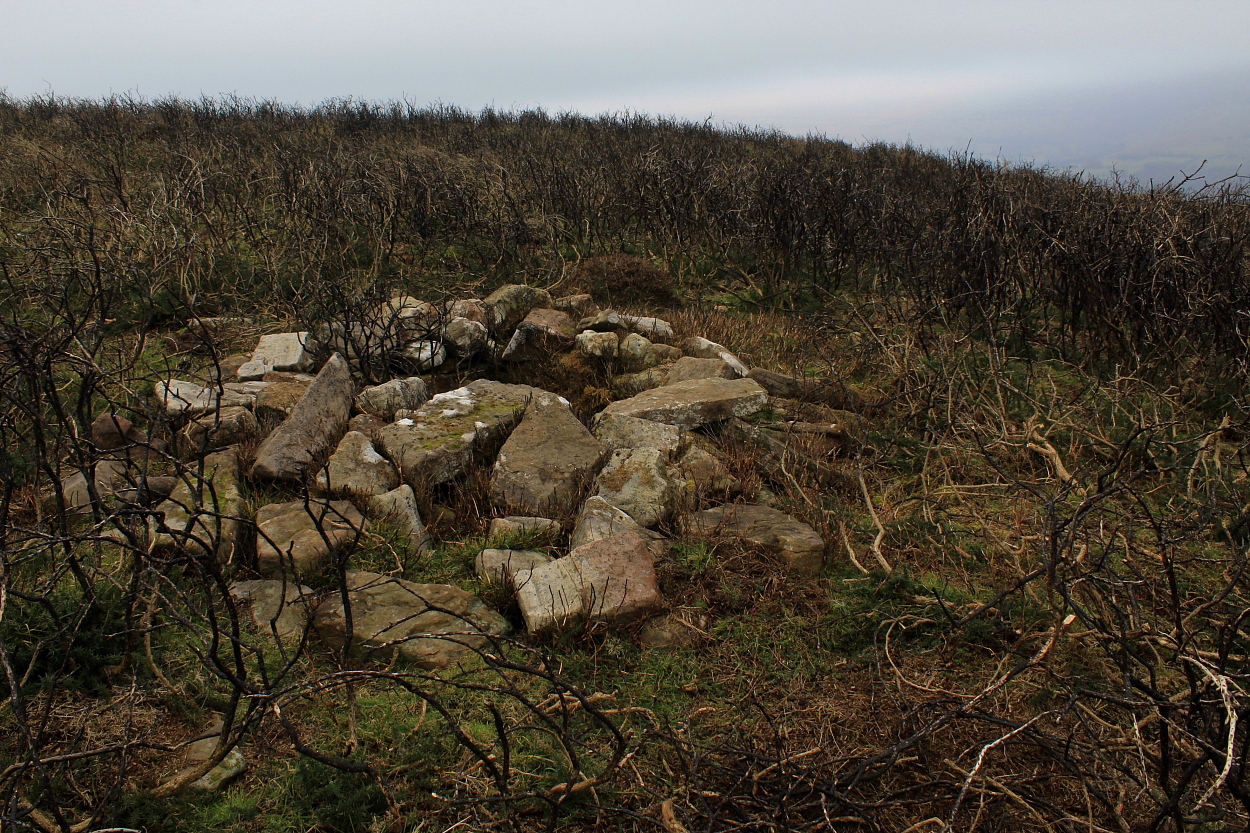
Standing to the approx north west of.... and visible from.... the two great cairns crowning Pumlumon Cwmbiga, the trashed monument of Carnfachbugeilyn ['small cairn of the Bugeilyn', the lake visible below to the north] is always going to be an anti-climax. Nevertheless a visit is still worthwhile, if only for the superb northward views to Foel Fadian (also bearing a monument - actually monuments... one Bronze Age, the other to the late Wynford Vaughan-Thomas, the celebrated correspondent and walker) and Southern Snowdonia, not to mention the aforementioned Cwmbiga cairns crowning the retrospective horizon like a pair of (more than) ample... well, you know what.
As mentioned, the cairn is seriously disturbed - hey, so would you be if you had been messed around to such an extent - although still retaining a reasonable enough volume of material to be classed 'relatively substantial', particularly so if it had been located anywhere else than upon the wondrous Pumlumon. A boundary marker stone stands nearby.
Perhaps the salient point, though, is that the cairn lies on the route from Pumlumon Cwmbiga to the much more impressive Carn Fawr, visible to the approx west..... bonus site, then.
|
Traditionally one of the 'Three Mountains of Wales', Pumlumon possesses little of the overwhelming physical grandeur of either Cadair Idris or Snowdon, its celebrated companions in the triumvirate. No soaring, razor sharp aretes, a paucity of naked rock... in fact little architectural splendour to raise the pulse and encourage the punter to don boots. No, Pumlumon's charms are a lot more subtle, more ethereal - dare I say metaphysical? - and require a lot of effort from prospective suitors, like the woman who, despite lacking the classical aesthetic attributes, nonetheless holds the attention of every man in the room.... without them being able to grasp why. I guess it could be described as 'allure', this mass of soggy, Mid Walian high ground seemingly exerting a magnetism over human kind - the local Bronze Age inhabitants being the prime example - which transcends the manner in which we view the everyday world. How else would it have managed to be in the 'top three', so to speak?
I'm glad to say that there is pretty obvious, not to say fundamental explanation as to why this should be ... the poor drainage which was so lamented by travellers of yore is paradoxically Pumlumon's crowning asset, accounting for the massif sourcing no less than THREE major rivers in the Hafren (that is, the Severn), Wye and Rheidol. Incredible. If ever a mountain could be termed 'Mother of Rivers', surely Pumlumon has first bagsy? What's more, in my opinion it should also be acknowledged as Wales' - if not the UK's? - greatest upland Bronze Age cemetery, even surpassing Snowdonia's Y Carneddau. Yeah, virtually every summit is crowned by an ancient cairn, a number of which are very substantial indeed. I know of no other upland area with such a concentration of these monuments within a relatively small locale. [Suffice to say... if there is, lemme at it!]. So... what are the odds that Pumlumon's two superlative attributes are connected.... and it was selected to be the ritual capital of the 'Citizens Cairn'd' because it was viewed as literally representing the very font of life back in the Bronze Age? Doesn't sound at all far fetched to me.
'Pumlumon' translates as 'Five Stacks', no doubt a reference to the sum of massive cairns which are shared between the summit peak (Pen Pumlumon-Fawr) and its neighbour, Pen Pumlumon-Arwystli. There are many more examples, however, (arguably) the two finest located at the eastern extremity of the main ridge, upon Pumlumon Cwmbiga. The southern of this pair is clearly the larger [see misc post], although both would appear to have had their upper sections rebuilt in times unknown. I can live with that since, for the most part, structural integrity would appear to have been maintained, the monuments unsullied by the shameful 'walker's storm shelter'. I can also live with the two quartzite 'nipples' which further enhance the cairns' representation of a pair of fulsome breasts from a distance. Although recent (not featuring on my 1995 image) it is, I think, a nice touch. Or is it just me? The panorama surveyed by the cairns is expansive to the north, with Cadair Idris and the hills of Southern Snowdonia resplendent in serried rank under a pristine blue sky. The sadly trashed Bronze Age cairn of Carnfachbugeilyn [my next objective] rises to the north-west beyond the remains of another cairn of uncertain origin, whilst to the approx south-west the main Pumlumon ridge leads towards the major summits of the range beyond Blaenhafren, source of the river. Looking to the east, a phalanx of wind turbines crowns a hillside beyond the Hafren Forest, through which I made my approach to this wondrous spot today.
A minor road from Staylittle, a small settlement at the northern tip of Llyn Clywedog, passes a number of 'tumuli' - love that word - to pass Cwmbiga farm. Roadside parking is available here, a well maintained forestry track following the right hand bank of the Afon Biga into the back of beyond. Eventually this encounters the headwall of the cwm, veering sharply to the left before a cascading stream. Ascend to the right of the stream as best you can to reach a parallel, higher track. In retrospect it is advisable to trend right here for a hundred yards or so before continuing on the ascent line... in order to avoid both some very rough terrain resulting from forestry operations and several deep, transverse gulleys. Soon the northernmost Cwmbiga cairn should be visible on the horizon. Persevere and let a fenceline be your final guide....
Don't forget to pay a visit to Blaenhafren and stand in bemused wonderment at the enormity of what it represents, the twin cairns crowning the eastern skyline as if they just HAD to be there. Choose a fine day - any other kind would be risking literally everything upon a landscape as brutal as Pumlumon - and ponder that a massive suspension bridge or two are needed to span the output of this murky pool when it reaches the Bristol Channel. To be honest my poor brain couldn't cope with that at the time. Need to get metaphysical and build a cairn or two if I ever return, methinks.
|
Y Myndd Du (or The Black Mountain, to use the vernacular... this is South Wales, after all!) is a wonderfully distorted triangle of high ground bordered on the north by the fertile Tywi Valley, to the east by the fledgling Afon Tawe, and falling away to the west in a series of hilltops of ever decreasing height crowned by some impressive Bronze Age cairns. A number of stone circles are to be found sheltering beneath the great northern escarpment, not forgetting Maen Mawr, still guarding its flock overlooking the aforementioned Tawe. Yeah, Pythagoras probably wouldn't have been best pleased with Y Mynydd Du's wonky natural geometry. But lovers of wild country infused with enigmatic, tangible remains of past humanity will no doubt possess a different viewpoint.
Hey, hang on though. What of the conveniently forgotten southern flank? Well, aside from the impressive Saith Maen stone row to the south-east, I've always adopted the Paul Daniels' stance... 'you'll like it, but not a lot'. However that was before the Sweetcheat posted a miscellaneous item regarding a 'recently discovered stone circle' upon Llorfa. Surely not? So... not that I'm overly cynical or anything - perish the thought - I simply had to go and have a look. And? In short, there's definitely another stone circle to add to the area's already impressive catalogue. However I would tentatively suggest there may well be a whole lot more, too. A southern companion to the Nant Tarw complex to the north, perhaps?
The approach, as you might expect by the much belated 'recent' discovery, is by no means a stroll. The gradient may be easy enough, but the going underfoot is anything but. Just so as you are forewarned regarding footwear, you understand? So, take the 'Palleg Road' north out of Gurnos (near Ystradgynlais) and, upon passing the cemetery and obligatory golf course, take the right hand fork to the isolated farm of Pen Yr Hoel. Parking is a problem, as evidenced by the numerous signs... however I chanced across the landowner who was quite happy with my arrangement upon the verge a little before the farm. I'd advise against carrying on down the track across the dodgy cattle grid. Tried this and had to reverse all the way back... not a strong point of the Gladman driving technique.
Public rights of way head north and westwards from the farm... however since it was clear the Gwys Fawr had to be crossed sooner or later, I take the latter and am immediately glad for the Gortex boots. There is no bridge and it was not possible to cross the slippery rocks without going for an unintentional paddle. Once across... shaken, the water a little more 'stirred'.... the path follows the river's course north for a while before veering to the north-west. There's a reason for this, of course, but needless to say I lose the line and finish up to my left thigh in the bog. Nice. However boots and gaiters once again limit the effects to manageable levels, so on we go. Follow the dilapidated drystone wall to the right, past sheepfolds, until the deep gulley carved by the Gwys Fach is attained and easily crossed. Head uphill to the left and the first monument reached is the cairn. Not the best of the genre, granted (not by a long chalk), but not bad for starters. The stone circle lies, unseen, a little way further uphill. The first thing that struck me was that it was so obviously a stone circle, albeit featuring the trademark diminutive orthostats of the South Walian uplands. Hey, even I could see that. Could it have been previously confused with the cairn, then? To be honest you would need to be a bit of a muppet since there is not a hint of cairn material within the circumference that I could see. Coflein agrees, adding that there are 'at least 16' earthfast stones in the ring, although to be honest any attempt at arithmetic would be somewhat pedantic... only excavation could answer that, I think. Let's get Tony Robinson and the gang up here....
The circle is never going to blow away those expecting a profile akin to a Scorhill or the like. This is no Carn Llechart. However, for me, the siting of this monument is way in advance of either. The serrated top of Cribarth rises to the east, guiding the gaze in a wide arc to the left, along the long escarpment of Fan Hir (the long ridge... a-ha!) to the Bronze Age cairn-crowned main summits of Fan Brycheiniog and Picws Du. The landscape possesses none of the 'softer' elements of the lower slopes of the Brecon Beacons or The Black Mountains further to the east. No, the vibe is one of austere beauty, devoid of pretension, brutal, even? The vista to the south and the coast is more expansive, with more obvious detail. I prefer the north.....
Venturing a little further up the ridge from the circle, a seemingly natural erratic leads me to what to these eyes looks very much like a stone row. Sceptical, as always, I check out the footings of the stones and conclude that some - in particular the smaller - look very much as if they have been artificially placed upon this hilltop. Wait, there's more. Beyond, and to the left of this 'stone row', lies a large, prostrate slab of stone covering what appears to be a hollow beneath. Again, it looks to me to have been consciously shaped and placed here.... I can't see any other naturally occurring slabs nearby. Having said that I'm no expert on geology, so these observations are obviously tentative at best. I've posted images under the Llorfa cairn site to allow members to comment if they so wish. Better still, go and have a look at first hand: http://www.themodernantiquarian.com/site/8146/llorfa.html
I return via the eastern bank of the Gwys Fach, fording the parent water course, appropriately enough, at the ford shown on the map at approx 784138. As earlier in the day, this is by no means easy. But when you've a sneaking suspicion there is a lot more to the area than previously thought, it is a small price to pay, is it not? Incidentally there are a couple of additional 'possible' ancient cairns nearby. Coflein reckons the southern is probably clearance... however the landscape context, with much surface rock, makes this far from certain in my view.
|
Many visitors come to this corner of Essex to enjoy the 'great' mansion that is Audley End. Hey, even I came here on a coach trip as a kid, although the miniature railway in the grounds made the more lasting impression upon the little philistine mind back then, as far as I can recall.... it's still there. Little did I know that I'd return - some 30 years later - to see an (arguably) far more interesting edifice crowning high ground to the west.
The first thing to point out is that this substantial hillfort is set within strictly private grounds.... the 'Strictly Private' signs fronting the entrance driveway do kind of, er, make that crystal, as we say in these parts. It is also cloaked in a mantle of woodland so nothing is apparent to the passer-by. However the map shows some sort of building located within the enclosure, so I decide to go see whether the occupiers are willing to allow the Essex public access to one of our prehistoric treasures upon request. Is it really so much to ask, and what of the moral duty to celebrate, to share our mutual heritage? As it transpires, no-one is in.... hey ho..... so, having already taken a look at the impressive univallate defences upon the eastern arc on the way in, I return along the arguably more impressive western defences. As mentioned, the crest of the powerful bank is crowned, for the most part, by trees, their spindly roots inter-twinning to create complex structures that might be viewed as somewhat unsettling in any other context, perhaps recalling the imbedded arachnophobia inherent in the majority of our species? Here, however, Nature has created yet another artistic masterpiece contradicting its utilitarian roots, so to speak. Yeah, it looks 'right' and the trees are able to cling to life thanks to their own tenacity, not to mention ingenuity. Everyone's a winner, in fact.
Sunlight plays its part in any visit to an afforested hillfort.... helps to impart a vibe within the human brain which simply does not exist upon an overcast day. Highlight and shadow lends definition to the ancient defences, Ring Hill being no exception. Sadly, however, I am conscious I'm trespassing, having failed to receive permission. A sensitive soul, I guess. However I've gained enough insight into this hillfort to ascertain that it is a special place indeed. Hey, spread the word. Note that I've placed Essex HER's summary of the site as a miscellaneous post....
Back at the car I'm given the most 'evil eye' by a passing ignoramus in a pick-up truck. He receives the same in return, with interest, and thankfully doesn't press the matter further. Yeah, this macho bullshit really is so tiresome. Now whether he was connected with Ring Hill or not, I have no idea... but courtesy costs nothing, does it not? So please be aware this is not an easy site to visit access-wise. But I'm very glad I did, and that's a fact. I would be very interested if any member manages to catch the occupiers at home.
|
Cholesbury Camp is another fine Buckinghamshire Iron Age enclosure... technically a 'plateau fort', as opposed to 'hillfort'... which has unfortunately been damaged by the building of a malignant church and village hall in the southern quadrant. Happily, however, the malevolent atmosphere I found at the similarly defaced, and not too distant, West Wycombe Hill is absent here. Quite the contrary, the surviving three quarters of the ancient ramparts being a joy to behold this bright morning, sunlight interacting with the fine beech trees to send a myriad shadows snaking across the ditch which separates the mainly bi-vallate defences (there would appear to be an additional bank and ditch to west and south-east, if I not mistaken?).... not to mention everywhere else, for that matter. Nice. Yeah, although the initial south-eastern arc is heavy overgrown with vegetation, the remainder of the enceinte is as aesthetically pleasing to the eye today as perhaps it is possible for any ancient fortification to be? Or to have a right to be.
The constantly changing light, and therefore colour, has my artistic consciousness - such as it is - reeling as I try to capture something of the wonder laid out before me upon the digital SLR for posterity. However as I try to do so, the archetypal 'Tim, Nice-But-Dim' - walking with his children, as one does - stops and eyes me curiously. Suspiciously, even... 'what are you photographing?' he enquires. To his credit, and before I can deliver a devastatingly acerbic 'Morrissey-esque' retort, he answers his own question. 'Ah, the hillfort. I see. Jolly good'. Lucky he did so, actually, since I doubt if the aforementioned former Smiths front man would have approved of my rather feeble prospective witticism. Such is the positive vibe at Cholesbury today that everything is right with the world for a while. Can't even think of a sarcastic comment to defend myself with...
The 'fort is easily located within the environs of the chocolate box village. Simply head for the Village Hall - making sure you keep an eye out for the many cyclists who flock to the area at weekends (or so it would appear) - and advance up the church driveway situated to its left, from where paths access the ramparts. The interior of the enclosure is now the site of equestrian activity. But I can deal with that. Hey, I can deal with any thing at Cholesbury.
|
Showing 1-20 of 339 fieldnotes. Most recent first | Next 20  |
Citizen Cairn'd....... every monument blows me away... but in particular those highland piles of stone. Visiting them, I think, helps ensure those ancient Bronze Age pilgrimages remain relevant, even in this so called 'modern age'. And hell, it makes me feel good, truly alive, on top of the world in the most literal sense... at one with Nature. If this sounds trite, perhaps it is. But nonetheless there are occasions I concur with Elizabeth I's last words... 'All my possessions for a moment of time'.
Suffice to say mine is therefore not an exercise in dryly cataloguing sites for the benefit of future generations - as much as I might try I haven't yet been able to embrace altruism to that extent - but rather an attempt to try and reconcile why I am so incredibly moved by these constructions of stone and/or earth representing a time when everything was, by all accounts, literally a matter of life and death. Yeah, just as an empty house appears to retain echoes of past humanity... the raw emotion that apparently sets us apart as a species... so does the stone circle, the chambered cairn, the long barrow and the mountain top funerary cairn. We may be able to only guess what forms the human interaction may have took - but clearly it mattered. A lot.
I make no special claim for my contributions, particularly since the majority of my earlier images are (variable quality) scans of archive prints.... and my opinions are, well... those of an enthusiastic amateur with a bog-standard education. Consequently I'd recommend visitors to TMA refrain from taking my - or anyone else's - word for anything... go see for yourself and post what you think / experienced. Yeah, make up your own mind. Be inspired, be inspiring, be magnificent (as Ian Dury once said) ... but most of all, my friends, be you! There can be only one.
In a society of computer generated fantasy, however, a word (or two) of caution. Please be aware that reaching some of the more remote upland sites in the British Isles can be potentially dangerous - even life threatening - for the unprepared. Yeah, this is not a drill. Treat the landscape and weather with the respect they deserve and you won't go far wrong. If in doubt, pop a question in the Forum. That's why Mr Cope puts up the readies to run TMA.... Thank you Julian.
So cheers... to Mr Cope for being his inspirational, confrontational self, showing that field archaeology can be FUN! - hey, who'd have thought it? ...to my sister (Mam Cymru) for using her female 'macro' vision to help me see the detail throughout an ongoing re-exploration of the South Walian uplands, albeit upon dodgy ankles etc... to my own mam for insisting 'young men should have adventures'.... and my Dad for unwittingly inspiring a profound love of high places. Oh, and to Aubrey Burl for simply being 'The Man' by blazing that trail.
Some of Gladman's other inspirations include (in no particular order.. except for Darwin):
Charles Darwin (for his peerless humanity... amongst other things...); George Orwell (the strength to change one's mind in light of new evidence); Michael Collins; Winston Churchill (for all his faults); Martin L. Gore; Richard Dawkins (much maligned, yet - by and large - helping to carry the torch of reason during an age of apathetic resignation); Shane MacGowan; Sophie Scholl; W A Mozart; Manic Street Preachers; Pat Jennings; Stuart Adamson; Will Shakespeare; Harry Hill (there's only one way to find out!); Mr Beethoven; Claudia Brucken (so Germans don't have passion?); the (Allied) generation of WW2 for making all this possible; Marc Almond (what does it take to be a man?); Stan Laurel and Oliver Hardy; Christopher Hitchens; Harvey Milk; John Le Mesurier (do you think that's wise, sir?); Ralf Hutter and Florian Schneider.... not to mention anyone who has ever asked 'Why?' - the true legacy of punk. Last but not least, Gaelic beauty Karen Matheson... 'the call is unspoken, never unheard'.
George Orwell - '...during times of universal deceit, telling the truth becomes a revolutionary act'....
Martin L. Gore - 'Like a pawn on the eternal board; Who's never quite sure what he's moved toward; I walk blindly on....'
|