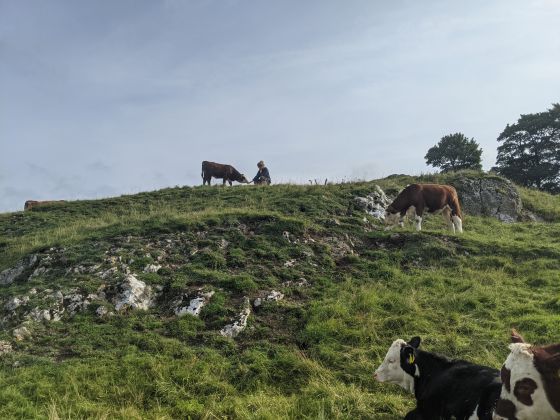
The smallest barrow on the hill


the largest of four barrows on the hill

This mound is marked on the OS map as a tumulus
sorry isn’t it

Three bronze age barrows the one on the left has been comandeered in recent times

Added in 3 images of the large stone slab with numerous simple cup marks.
Resides in Potteries Museum and Art Gallery (PMAG), Hanley, Stoke on Trent
Awful lighting... 1 dim light at 90 degrees to the cup marks! – needs some decent side lighting, or the stone erected vertically, to appreciate the cup marks.
Been repeatedly used, marked upon, as feint cup depressions visible as well as the more obvious ones.
A small lane heads south off the A52 to the little village of Wooton, after passing Weaver farm a small car park appears on the right , a footpath goes to the trig point 371m high .
This is the last Peak hill before descending onto the Staffordshire plain (though outside the national park)
The first barrow is on the crest of the hill above about 1 metre tall, from here we can see the biggest barrow and the built upon barrow and further on the smallest barrow with the hilltop trig point .The biggest barrow has the obligatory scooped interoir and a fenced off tree ,the stranger of the group has no grass covering and a concrete floor on it despite it’s modern appearance it really is a bronze age barrow.
Farther on is the smallest barrow about 3ft tall then it’s down and up a small valley to the trig point and a great view marred slightly by three big quarries.
On the way back to the car it started raining and twenty feet from the car I realised I’d lost my carkeys half an hour retracing my steps precisely with my fingers crossed and whoo-hoo success ,quick tip allways fasten your pocket zip
A slab bearing 24 cup marks was found in a stile nearby and was speculated to have been broken off a larger panel.
Another sandstone boulder with a single cup mark was found in one of the surrounding walls.
Both in Stoke-on-Trent’s museum.