Image credit: Chris Bickerton


The Priddy henges are just beyond the trees.


Half of the Ashen Hill barrows.

Nature adds a splash of colour.

Eight barrows covered in golden grass


Looking west along line of barrows


Climbing from Nine Barrows lane.
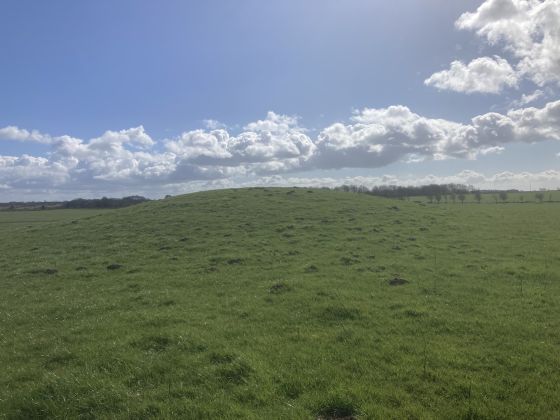
I parked on the B3135 opposite Harptree lodge then walked back up to the gate opposite the southern henge. Hopping the gate and walking across the field the barrows cut a very impressive silhouette against the skyline. I head to the far right hand barrow first, back home i’d drive a hundred miles to see a barrow like this, there’s eight of them here, well seventeen or eighteen actually but......
I stand atop the western barrow and look along the line of barrows, six are in a line but the far eastern two are off line and curving the line to the south. I make my way along the line going round this one up the next and round that one. It’s worth noting about now the view to the south, almost paradoxically to North Hill and it’s group of nine barrows, prosaically named Priddy Nine barrows, that one must have taken a while.
Ashen Hill barrows are every bit as cool and impressive as Priddy Nine barrows, I just wanted to say that, I don’t know weather it means anything to anyone but I’d heard of Priddy nine barrows but not of Ashen hill barrows, and I should have.
Having said that I gird my loins and stride of to the nine barrows.
Visited 7.9.13
After looking for any signs of the damage to Priddy Circles I crossed the road and jumped over the metal field gate opposite.
From the gate you can see the remains of 8 Barrows along the brow of the hill.
They appear to be of various size and condition.
I didn’t have time to walk to the top and look back to see if you can get a better view of the Priddy Circles? Perhaps the trees would be in the way?
This is a place I would like to return to one day when I have more time and as well as getting a closer look at the Ash Hill Barrows continue walking south and take in Priddy Nine Barrows on North Hill as well.
Boxing Day 2004
Fantastic day for walking, not a cloud in the sky. The line of barrows stood out as we climbed the hill from Nine Barrows Lane their numbers increasing as you ascend the hill. At the top end there is what looks like a dug into barrow until you get close and realise it is just the earth that has been thrown out of a long ditch. I would guess this to have been created by miners looking for traces of lead (there is a large lead mine to the east in the valley)
As for the ditch the other side of the barrows, I am not sure. A gap has been left to allow the route of the path from the Priddy Circles to the Nine Barrows to pass and in my expierience it is unususal for miners to dig one long even trench.
I have never come across so many barrows in a small area, this must have been an impotrtant site. With the four henges so close by as well, I can see I will have to do a bit of studying.
[visited 28/11/04] I’m loathe to include this as a seperate site from priddy nine barrows (PNB), but as it is seperate on other websites and an extra eight or nine barrows would make PNB very badly misnamed... However, these should almost certainly be counted as the same cemetary, being less than 10 minutes walk from PNB and highly inter-visible. But maybe then the idea of a barrow cemetary is fundamentally flawed when you are talking about barrows. Where do you draw the limits?
Moving on, this is a nice linear cluster, acting almost as a counterpoint to PNB who’s line lies slightly further to the east. They are all in relatively good order and a fair size for todays barrows. One thing that did puzzle me were the ditches either side of the barrow line expecially as the Northern ditch had large stones within it. Whether this is a mendip thing I’m not sure, there is a solitary large barrow at 545492, with 300 metre long ditches either side of it. The ditches look newer than bronze age however...
Access is a 100 yards down a track then 200 yards across a muddy muddy field.
All these eight barrows were investigated by the Reverend John Skinner in 1815, and all barrows produced one or more cremations. Some of these contained Early Bronze age urns and were covered with stone slabs (similar to Lansdown barrows cemetery). Three barrows had bronze daggers, one in a wooden sheaf. One barrow contained a rich burial which included beads and other objects of amber (maybe faience) and a miniature incense cup. There are a further two, much larger barrows, located north of the main cemetery.
Taken from;
British Barrows (A Matter of Life and Death) by Ann Woodward.