
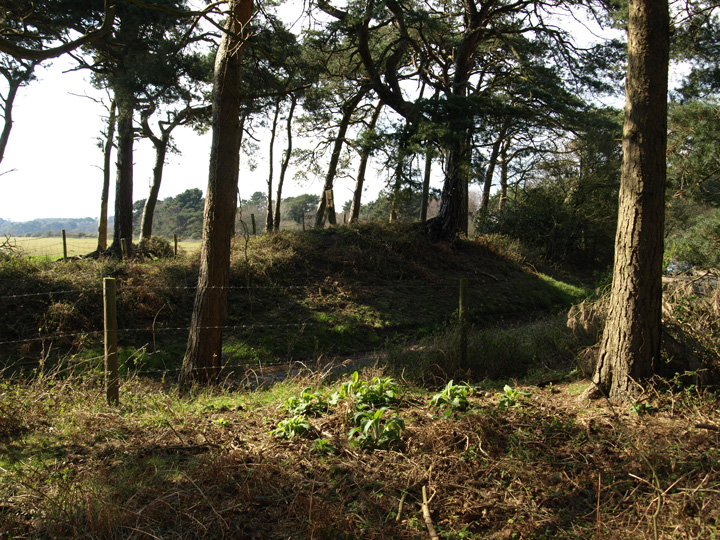
The main barrow from the south.
Image credit: Mike Rowland 04/05/2008.

The main barrow from the south.

A small low barrow north west of the main barrow.
This large bowl barrow is now completely surrounded by a modern housing estate. It is in relatively poor condition and is covered in large pine and cedar trees, it is surrounded by rhoddodendron bushes on its southern and eastern sides. This is probably one of the most accessible barrows anywhere.

Parley Barrow at the corner of two roads on the housing estate that surrounds it.

A gorse covered barrow on the northern edge of Beaulieau heath.


There are three bell barrows and two bowl barrows on this rise on Lulworth heath. Two of the bell barrows seem to be in quite good condition and of medium size. The smaller of the three is hard to see from the road, which is the only way to see them. I could not see the bowl barrows at all. These barrows are on an M.O.D firing range. There are many barrows on these ranges, most of which can’t be seen or accessed, on this visit I could hear automatic gunfire close by.

The three visible barrows from the road.

One of three bell barrows, this is closest to the road.

The most promenent of three bell barrows in this group.
Two unusual large disc type conjoined barrows. These are a rarity anywhere, but espescially in the New Forest. They sit atop a low plateau on the north west side of Setley plain. The northern is the smaller of the two and is overlapped by the larger southern barrow. They are of a similar size to the disc barrows on Oakley Down in Dorset. These barrows have larger mounds in the centre than most disc barrows, M.A.G.I.C. calls them “fancy barrows”. There is a single example south of the pair.

The joining up of the two barrows.

The central mound of the north barrow.

The south side bank and ditches of the north barrow.

The central mound of the barrow from the east.

The inner ditch and outer ring, the northern arc which is in the best condition.

A very low, nearly ploughed out barrow to the left of the tree.

At least five barrows on the skyline of the Dorset Ridgeway, to the south.

Bowl barrow in the middle of the group.

This is the southern most barrow in the cemetery.

The barrow nearest the road, with rainbow.
A rare type of round barrow. According to L.V.Grinsell; ” 93 feet overall diameter. On OWERMOIGNE boundary. The central mound is surrounded by a narrow berm, bank, and outer ditch. The bank and outer ditch are more massive than with the normal tree-clump circle, and may be ancient because the road, which follows the parish boundary, cuts through them, and is presumably later. The barrow is covered with firs.”
Information taken from Dorset Barrows 1959 P.D.N.H.A.S.
This describes accurately what can be seen today, the plastic portaloo is there for some road works a few feet away!

The largest, bell barrow in the group.
The east side from the other side of the road.

The barrow from the northwest with plastic bog.

Two people standing on a round barrow next to the Hardy monument.

Two of the barrows from Blackdown plantation.

Bronkham hill from Blackdown plantation.
This visit I had time to have a proper look at this site. The feature you see when you first get here is an impressively big pair of banks and ditches, known as the double dykes. These are the main defensive feature for the settlement. They run north to south and cut across the narrowest point here.
Behind the banks is a field called Barn field in which there is a large bowl barrow in pretty good condition.
The next feature is Warren hill which is 90 metres in height and has steep sea cliffs on one side. It is a steep climb all the way round this hill, and it is an easily defensible position. On the hill there are several round barrows, the most easy to see was a low bowl type, gorse covered another 2 low ones.

A low round barrow on warren hill.
A medium sized hillfort just inside the New Forest national park. Its in reasonable condition for the most part although it is cut through by a track leading to houses.
This is a univallte hillfort enclosing five acres. The bank is at its highest on the eastern side, as the west side slopes steeply away.
A large bowl barrow on heathland on the edge of the New Forest. This is in good condition with a complete outer bank and ditch. It has a flattish top and appears to have been excavated at some point. Its scheduled monument number is 20293.
The barrow is 25 metres in diameter and just over 2 metres high, the surrounding ditch is nearly 2 metres wide.
About three hundred metres to the west is a small bowl barrow. It is on OS maps, but not marked as a scheduled monument on M.A.G.I.C.

Castle Hill fron the top of a barrow on Vales moor.


A large bowl barrow in Barn field.

The bank of the double dykes from Warren hill.


The western inner rampart.

From the north, all three barrows.

Looking north at the twin and single bowl barrows, Big Wood barrows are in the background.

A single bowl barrow, split from the main group by a road.
Dorset Cursus
There are 7 barrows in this group which is to the north of Sheep down long barrow and south of the Big wood group. The three largest are in the centre and include a rare double bowl barrow with a figure of eight ditch. The cemetary straddles the road to Weymouth and is part of the south Dorset ridgeway group of barrows.

The three largest barrows in the group. The right and centre are a double bowl barrow.
The south Dorset Ridgeway project was launched in Portesham village hall. The three year project aims to protect historic monuments affected by erosion over the last forty years. The cash comes from the heritage lottery fund.
There appear to be about seven barrows in this group according to O.S. / Dorset Barrows / MAGIC. The largest and most prominent is just south of the old roman road to Exeter. It is on a ridge to the north west of Clandon barrow which is fully visible from it. The Dorset ridgeway is to the south of this group and a lot of the barrows on the ridge are visible.
There are four other similar sized barrows in this group, most are covered with trees. One of them is all but obscured. The cleanest one has recently been cleared of trees and has a large excavation cleft in its summit.
One of the group is all but ploughed out and another, to the south of the road is marked as destroyed on all the maps I’ve seen.
I also found two pieces of worked flint on the field margin of this site, one of which was a late neolithic / early bronze age end scraper.

A large bowl barrow next to the roman road from dorchester to exeter (A35).