This is an extended group of barrows of various sizes within and on the edges of woodland. Most of them are in dense, mixed forest and are hard to find, I know, I’ve looked. Some of them may only be accessible when the trees are felled, as with the nearby Rain Barrows.
Parking is easy and the footpaths are good, the forest is about four miles from Dorchester.

formicaant

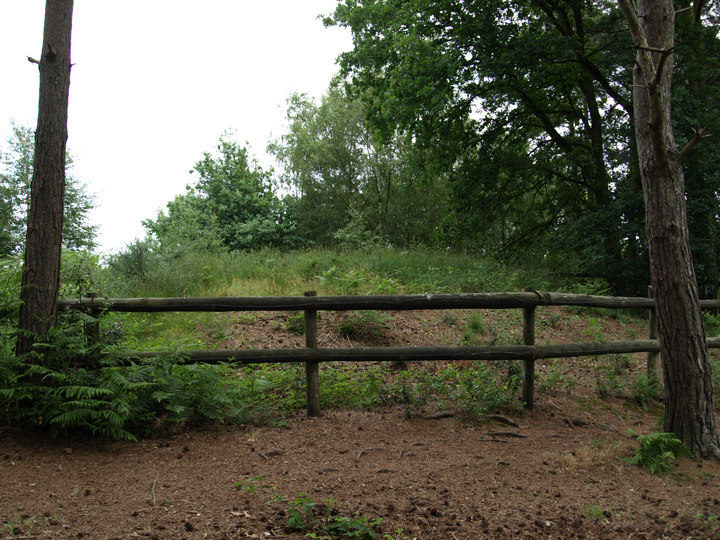
A small bowl barrow, fenced off and covered in vegetation.
Image credit: Mike Rowland 16/06/08
This is a surprising place of peace and quiet, slap in the middle of military firing ranges. It is a nature reserve and when I visited the only sound I could hear was birdsong.
It is a mixed barrow cemetery containing about ten barrows, two of which are bell types. Six bowl barrows are on a low hill called Coombe Beacon. The two bells are on the low part of the heath, both have a visible berm and the northern still has traces of a ditch and bank.
The southern barrow has a small, low bowl barrow attached to the northeast edge.
One very small barrow is now fenced off, presumably to protect it.

Two bell barrows, with a small low bowl barrow attached to the berm of the southern bell barrow.
Image credit: Mike Rowland 16/06/08


A pair of bell barrows on the heath, with the Purbeck hills in the background.
Image credit: Mike Rowland 16/06/08

A small barrow in the middle of a plowed field.
Image credit: Mike Rowland 15/06/2008.

A small bowl barrow covered in foxgloves.
Image credit: Mike Rowland 15/06/2008.
This is a bell barrow on a rise above the excellently named Slap Bottom, the best photo I could get was from a a distance as the barrow is covered in gorse and bracken.

This is a bowl barrow on Cranes / Church moor. M.A.G.I.C says its 13 metres in diameter and 1.3 metres high. I couldn’t get close to it, as the area has ground nesting birds with young at the moment. Apparently the there is a ditch and bank surrounding it, I will try to get closer to the barrow in the winter.

This is a large bowl barrow on the highest point in the Purbecks. It is fairly knocked about, there is a large chunk taken out of the west side of it. Also there are 2 large blocks of Purbeck stone on top of it, they aren’t ancient and have a north/south line and a diagonal scribed across them.These were the base of a windmill, they must weigh several tons each and must have taken some effort to get up the hill.
About a hundred yards north is a small, low barrow with a dry stone wall across it. Opposite the large barrow, across a valley is a celtic field system.
I have now found out that the barrow has been modified in shape when it was used as a windmill base.
There are three barrows in this woodland setting. The easterly one is a large bowl barrow in a low lying area, it is 75 feet in diameter and 9 feet high. The berm is only well preserved on the west side and there is a large excavation scar on its summit.
The next barrow west is a small bowl barrow on the highest point of Canon hill. Presumably for its protection it is fenced off. It looks in reasonable condition it is 10 feet across and 2 1/2 high.
The third barrow I couldn’t find, from the map it appears to be in dense under growth.

The eastern half of the bell barrow.
Image credit: Mike Rowland 09/06/2008.

The western half of the bell barrow.
Image credit: Mike Rowland 09/06/2008.
A small bowl barrow on the highest point of Canon hill.
Image credit: Mike Rowland 09/06/2008.

Swyre head barrow, on the highest point of the Purbecks.
Image credit: Mike Rowland 08/06/2008.

A small, low barrow to the north of Swyre head.
Image credit: Mike Rowland 08/06/2008.

A large scar on the barrow, partly showing the construction.
Image credit: Mike Rowland 08/06/2008.

A medium sized bowl barrow on the West Knighton and Warmwell boundaries. It is 18 metres in diameter and 2 metres high. It was damaged by the military during the second world war, but is not in bad condition. It is set in mixed woodland surrounded by huge holes in the ground from gravel quarrying.
Huck appears to be a corruption of hook – referring to it’s position at the corner of three parish boundaries.


Two large, low round barrows north of the long barrow, which can be seen in the darker grass.
Image credit: Mike Rowland 04/06/2008.
This is a medium sized bowl barrow above the tiny hamlet of Whitcombe. It is 28 metres in diameter and 3 metres high. There is evidence of past excavation on the summit and it is covered in beech trees and scrub. A low bank and fence cross the barrow which marks the parish boundaries of Whitcombe and West Stafford.
To the south, on the skyline can be seen Came wood and at least 4 round barrows.
In the adjacent field I found 4 pieces of worked flint in about 10 minutes, showing this place has been in use for thousands of years.
On a flat site near the hamlet below this monument, a very rich burial was found. Called the Whitcombe Warrior it is of a late Iron Age male buried with a sword in its scabbard, an iron spearhead and various other pieces of iron equipment. The burial was removed intact and is on public display in Dorset County Museum.

The view from the barrow shows Came wood and at least 4 barrows on the hill to the south.
Image credit: Mike Rowland 04/06/2008.

The eastern slope of the barrow.
Image credit: Mike Rowland 04/06/2008.

This bowl barrow is very similar to the nearby Mag’s barrow, several hundred metres to the west. It is in the garden of a large house and appears in good condition. It has a 3 metre wide ditch surrounding it, it is 25 metres across and 2 metres in height.
A bowl barrow in the garden of a very posh house, I took my photo very quickly in case they called the police! The barrow is 25 metres in diameter and 2 metres in height. Apparently it has an intact ditch, I couldn’t see it as the plant cover was too dense.
This and the similar Ralph’s barrow a few hundred metres to the east are lucky survivals in the middle of a housing estate. These barrows are part of a strung out cemetery on the former Parley heath, of which only a small part remains.
The street is very helpfully named after the monument.

The street name is a good clue as to where the barrow is.
Image credit: Mike Rowland 28/05/2008.

The barrow, covered in dense vegetation and trees.
Image credit: Mike Rowland 28/05/2008.

The barrow in the back garden of a house.
Image credit: Mike Rowland 28/05/2008.

Small bowl barrow 300m west of the main barrow.
Image credit: Mike Rowland 28/05/2008.

The northern bowl barrow on Pound Hill.
Image credit: Mike Rowland 12/05/2008.

The southern of the two bowl barrows.
Image credit: Mike Rowland 12/05/2008.
This site is on a hill to the north of the village of Winterbourne Abbas. I saw`and photographed 2 bowl barrows, M.A.G.I.C. shows another bowl and a long barrow neither of which I could see. The long barrow was disputed by L.V.Grinsell when he visited the site, he thought it was twin bowl barrows whose definition had been reduced by ploughing. I wasn’t looking for this today and it may well still exist, I’ll have another look soon.
Both the bowl barrows appeared in reasonable condition and were to the west of the public footpath.
I have concentrated on the barrows on this site of which there are said to be eleven. I managed to find and photograph only two of them on this visit. This is a large site with at least two other sets of earthworks on it one of which is said to be of iron age origin.
Sited above and overlooking Christchurch, Hengistbury head can be see to the south east. I will be adding the earthworks and other barrows in the near future as I will visit again soon.

An overgrown bowl barrow.
Image credit: Mike Rowland 04/05/2008.

A large tree covered bowl barrow on St Catherine’s Hill.
Image credit: Mike Rowland 04/05/2008.
The name of the barrow is thought to be a corruption of “colt-pixie”. These creatures were supposed to lure young ponies to their deaths in the water logged marshy parts of the heath. Another explanation is that the creatures were part horse and called other horses into the barrow.
This is a low bowl barrow on the western half of the heath. It is next to the road which passes north of the heath. The barrow is not in very good condition, it was excavated in the early 1940’s. Its survival is lucky as some barrows were lost during the construction of a second world war airfield.

The north east side of the barrow.
Image credit: Mike Rowland 04/05/2008.

The water logged southern ditch of the barrow.
Image credit: Mike Rowland 04/05/2008.
Pictured here are two large tree covered round barrows. The southern barrow is a large bell type, this is 104 feet in diameter and 7 feet in height. The other barrow is a bowl type to the north east of the bell, it is of similar size to it. The bowl has a distinct ditch surrounding most of its circumference.
There are other smaller barrows on this site which I will visit in the near future.

The west side of the bell barrow.
Image credit: Mike Rowland 04/05/2008.

The north side of the bell barrow.
Image credit: Mike Rowland 04/05/2008.

Large bowl barrow north of the bell barrow.
Image credit: Mike Rowland 04/05/2008.
This is a small barrow cemetery, south of Setley plain. It is dominated by a large banked and ditched bell barrow. There are three smaller barrows marked as surrounding the large one. I could only see one small low round barrow to the north west of the large one.