25/8/07
It’s hard not to stop by here when I’m in the vicinity. Late August is probably not the best time of year though, what with all the summer growth. The track to the main 2 bullauns is worn, but not hugely; somebody visits these powerful stones now and again. These 2 could easily get overgrown and ‘lost’.
Finding the double and the single in the forestry plantation to the east is a challenge. Head high heather blocks you. The fifth one, a double, broken through its larger basin, is moss-covered; there’s also grass coming up through the fracture.
If the little cottage beside this place ever came up for sale…

ryaner

I went clomping through the heather and peat trying to find this, a “circular cairn of granite and some quartz (diam. 9m, H 0.5-1m)” but failed to find it.
The western cairn of a pair said to be 450m apart, follow the track all the way from the cul de sac at S947978. Ask permission at the farmhouse as the track, a right of way, crosses this farmers land. He’s very friendly!
The track follows the treeline for some way then cuts north into a high meadow studded with gleaming quartz. Keep going and the cairn appears around a few bends that lead you east.
The cairn has been robbed out but the rubble that remains shows quite a few flat slabs. It’s roughly circular and about 18 metres in diameter. The views onto Church mountain, Corriebracks, Sugarloaf, over to Keadeen at the south, and south-west into south Wicklow and Carlow are fantastic, probably the best reason for coming here!


Looking north-north-west over the cairn onto Church mountain
Image credit: ryaner
Neolithic Chewing Gum
Student Dig Unearths Ancient Gum
A 5,000-year-old piece of chewing gum has been discovered by an archaeology student from the University of Derby.
Sarah Pickin, 23, found the lump of birch bark tar while on a dig in western Finland.
Neolithic people used the material as an antiseptic to treat gum infections, as well as a glue for repairing pots.
More here: news.bbc.co.uk/2/hi/uk_news/6954562.stm

Looking south over the chamber/passage. The entrance is to the south and could have that same winter solstice sunrise alignment.
Image credit: ryaner

Passage grave ‘K’, “an undifferentiated passage tomb”, looking east with the main Newgrange mound behind. The western kerb and western passage orthostats are well preserved and are said to bear megalithic art.
Image credit: ryaner


Fields should not be this muddy at this time of year (august 07) but that aside, I was well surprised to see that this has its own little fógra. I’d say this is a bowl barrow, but with very little evidence of a ditch. It’s about 10 metres in diameter and rises to about 2 and a half metres high. Most of the views surrounding here are blocked by field boundaries and trees.


Left is Prince William’s Seat and you can see the Great Sugar Loaf peeping over the back of the outcrop
Image credit: ryaner

Cross over from the ‘cairn’ on Prince William’s seat, down the track to a bog and up again to this very peculiar, altar-like outcrop. It stands proud of the surrounding peat to about 4 metres tall. It sits there brooding like some broken-down tank or an exhausted rhinoceros, completely out of place on these wind-swept hills. And yet, where else would it be? The only comparison I can think of is The Cheesewring, with its eroded formations.
There is one stone, the top stone, that seems to have been worked by human hand, with a shallow mini-bullaun. It’s quite an eerie place. My dog got quite antsy while we were here but that may have been because he smelt the local goats. Was this a ‘sacred’ place to the ancients? It affords the same type of views that Prince William’s Seat with its dubious cairn has, though there is very little else of megalithic significance hereabouts.

Howth peninsula across Dublin Bay taken from atop the trig point
Image credit: ryaner

The ‘cairn’, framed by the Little and Great Sugar Loafs
Image credit: ryaner
According to the Ordnance Survey this mountain is named after the visit of Prince William in 1821 with his father, the reprobate George IV.
I started at the car-park at O185168 on the Glencree to Enniskerry road where the Wicklow Way crosses and heads around Knockree. Follow the Wicklow Way until you get above the forestry line and turn left. This track heads off south around the summit of Prince William’s Seat but there’s a right turn after about 200 metres. Take this and head up.
I’m not too sure about this being a cairn. The trig point in cemented onto an outcrop. There are very few signs of cairn rubble, just some large stones of the same conglomerate as the outcrop.
The views from here are spectacular, south and west over to Kippure, Tonduff and Djouce, east to the 2 Sugar Loafs, north-north-east to Howth and north down the Glencullen valley.

The massive capstone struggling to be seen with all the summer’s growth
Image credit: ryaner


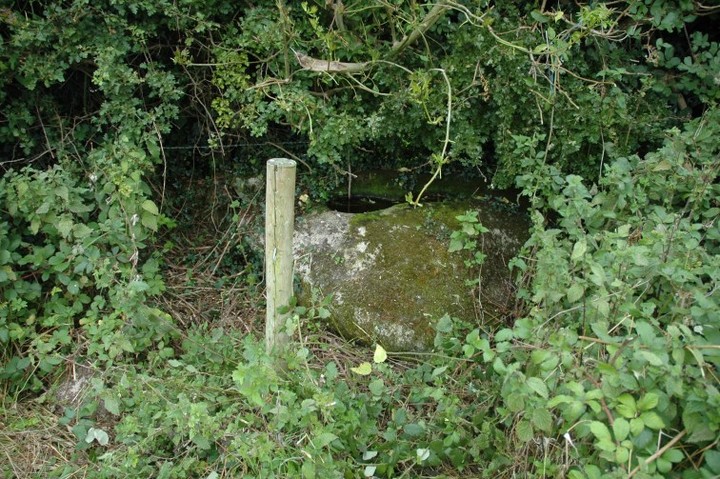
Someone cares as their was evidence of a recent clear up
Image credit: ryaner

A magnificent stone, hidden and neglected in the wall of a large field. The two conjoined bullauns are some of the deepest I’ve seen. Full of water and leaf mulch, I was only able to test their depth by using a stick of about a foot long. This sunk all the way ‘til it disappeared. The Arch. Inventory of Co. Carlow describes the bullauns as ‘conical’, putting one in mind of the nearby stone in Myshall graveyard.


Slievecorragh cairn with seated teddy in foreground, 31/7/07
Image credit: ryaner
Probably the strangest site I’ve visited. There may be a path up to here from Hollywood village but I couldn’t find one (I didn’t look too hard). I parked at the junction at N952035 and headed up the steep way.
This is on the St. Kevin’s Way and that may account for the sculptured chair (with teddy) that I encountered on arrival. St. Kevin’s Chair and St. Kevin’s Bed are features below in Hollywood glen. At first I thought that someone had brought up an ordinary wooden chair in a kind of Flann O’Brien gesture, but no, this is actually a metal chair, sculptured and painted so well that it wasn’t until I touched it that I realised that it was metal. It’s placed on a promonotory below the cairn with fantastic views to the south-west and west. Wacky!
On to the cairn itself. It’s been robbed out. It’s quite large, 25 metres on the longer axis with evidence of multiple cists/burials. There’s a little church-like structure on the west end, constructed with no little skill in what I reckon is an attempt to christianise the site. Near the centre is what I take to be the remains of a central burial with a large capstone. This has been robbed out and thrown back together again.
The all round views from up here are great. Poulaphouca reservoir glistens to the north-east, you can see the ESB power-station on Turlough Hill to the east, Church mountain with its cairn is to the south and the mad expanse of west Wicklow and what seems like all of Kildare, Offaly and Laois are to the west.

Passage grave in the foreground with the unopened cairn behind
Image credit: ryaner

Looking over the capstone and down the passage with Dublin in the distance
Image credit: ryaner
Thanks to the farmer for his friendliness and permission to visit the site.
It’s said to be a four-poster but there are many other stones close to the 4 main ones. I was struck by its situation on a small hillock that’s surrounded by about 8 other hills that are nearly equidistant, except for Carrickbyrne Hill that dominates the SSE skyline.


A bowl barrow. It seems to have been excavated or quarried relatively recently. There is a huge gash in the mound, right down to what looks like a burial pit. This quarrying/excavation seems to have been conducted in the last 10 years. The way the mound has been left leads me to believe that this ‘work’ was done unofficially.
The fosse and bank are clearly visible on the east and south quadrants. The mound would once have been over 3 metres tall. Many beech trees were planted on the mound, some still clinging precariously on to the remains.

The eastern part of the fosse and bank are in quite good condition. It’s hard to make out here but the top of the barrow would have been about 3 and a half metres above the bottom of the trench.
Image credit: ryaner

The barrow has been ‘excavated’ with a huge amount of material removed to expose the burial
Image credit: ryaner

The central pit where the burial may once have been
Image credit: ryaner
A beautiful bullaun stone, dumped into the field boundary and neglected. It looks to have once been earthfast, though that’s hard to call as it’s so overgrown. It’s definitely not in its original position as the basins are all on a slope, with one end of the stone a metre above the other. There are 3 large basins in a diagonal line on the metre and a half square stone. This would be a prize bullaun elsewhere but now rests sadly, ignored at the edge of the field.

Easy to find to the right just inside the gate of the old cemetery in Myshall. Both bullauns were full of detritus, one with stones, a plastic bottle and some broken glass. It seems that the graveyard is reasonable well tended but the weird stone with the holes in it is ignored. Other photos elsewhere don’t show the concrete setting.
Both bullauns are very deep set, about 25 to 30 cms, and almost inverted cones.
