
From ‘The dolmens of Ireland’ volume 2, by William Copeland Borlase (1897), p317
archive.org/stream/dolmensofireland02borl#page/n5/mode/2up
Image credit: WCB

From ‘The dolmens of Ireland’ volume 2, by William Copeland Borlase (1897), p317
archive.org/stream/dolmensofireland02borl#page/n5/mode/2up

From ‘The dolmens of Ireland’ volume 2, by William Copeland Borlase (1897), p316
archive.org/stream/dolmensofireland02borl#page/n5/mode/2up

From William Borlase’s ‘Antiquities, historical and monumental, of the county of Cornwall’ (1695).

From William Borlase’s ‘Antiquities, historical and monumental, of the county of Cornwall’ (1695).
I guess one of these is now missing, as related by Pure Joy in the miscellaneous posts.

From William Borlase’s ‘Antiquities, historical and monumental, of the county of Cornwall’ (1695).

From William Borlase’s ‘Antiquities, historical and monumental, of the county of Cornwall’ (1695).

From William Borlase’s ‘Antiquities, historical and monumental, of the county of Cornwall’ (1695).
It says ‘Two stones erect at Bolleit in St Buryan. about a furlong asunder. explained p. 168‘

From ‘A new and complete history of the county of York’ by Thomas Allen, v4, 1831.
archive.org/stream/anewandcomplete00hollgoog#page/n137/

In the Journal of the Royal Society of Antiquaries of Ireland, 1905.
“In comparatively recent times the central space was used as a race-course, and was a popular place of resort for holiday-folk from Belfast; of late this practice has fallen into disuse.

From v35 of the Journal of the Royal Society of Antiquaries of Ireland, 1905.
archive.org/stream/journalofroyalso35royauoft#page/264/mode/2up

From v35 of the Journal of the Royal Society of Antiquaries of Ireland
archive.org/stream/journalofroyalso35royauoft#page/264/mode/2up
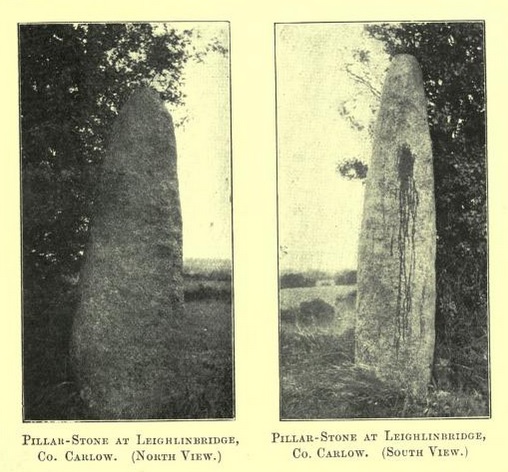
From ‘Notes on a gallaun, or pillar-stone, at Leighlinbridge, County Carlow’ by Sir Edmund T Bewley. In the Journal of the Royal Society of Antiquaries of Ireland v35, 1905.
archive.org/stream/journalofroyalso35royauoft#page/64/mode/2up

What you missed out on, Ryaner. I think it should be reinstated.
From ‘Historical and Topographical Notes Etc...’ by J G White, 1905.
archive.org/stream/bub_gb_6GQNAAAAYAAJ#page/n181/mode/1up
in an article by Courtney Moore.

archive.org/stream/journalofroyalso3451roya#page/190/mode/2up
In the Journal of the Royal Society of Antiquaries of Ireland, 1904.

archive.org/stream/journalofroyalso3451roya#page/158/mode/2up
From ‘The Daff Stone,’ Moneydig, County Derry, by the Late Rev. George R Buick.
In the Journal of the Royal Society of Antiquaries of Ireland (1904).

archive.org/stream/journalofroyalso3451roya#page/158/mode/2up
From ‘The Daff Stone,’ Moneydig, County Derry, by the Late Rev. George R Buick.
In the Journal of the Royal Society of Antiquaries of Ireland (1904).

archive.org/stream/journalofroyalso3451roya#page/104
You can see the usual rags, but what are the objects here I wonder?

from
archive.org/stream/journalofroyalso3451roya#page/104
It’s interesting that there’s a stone on top of the ‘bed’, but this isn’t mentioned in the article.

From
archive.org/stream/journalofroyalso3451roya#page/4/mode/2up
The Journal of the Royal Society of Antiquaries of Ireland, v14 5th series, 1904.

From
archive.org/stream/journalofroyalso3451roya#page/4/mode/2up
The Journal of the Royal Society of Antiquaries of Ireland, v14 5th series, 1904.

From
archive.org/stream/journalofroyalso3451roya#page/4/mode/2up
The Journal of the Royal Society of Antiquaries of Ireland, v14 5th series, 1904.

From
archive.org/stream/journalofroyalso3451roya#page/4/mode/2up
The Journal of the Royal Society of Antiquaries of Ireland, v14 5th series, 1904.

From
archive.org/stream/journalofroyalso3451roya#page/4/mode/2up
The Journal of the Royal Society of Antiquaries of Ireland, v14 5th series, 1904.

From
archive.org/stream/journalofroyalso3451roya#page/4/mode/2up
The Journal of the Royal Society of Antiquaries of Ireland, v14 5th series, 1904.

From this article
archive.org/stream/journalofroyalso3451roya#page/72/mode/2up
in the Journal of the Royal Society of Antiquaries of Ireland (v14 5th series, 1904).

From ‘Memorials of Old Staffordshire’, ed. Rev. W. Beresford (1909). Note the slightly spooky sculpture (mentioned in the contributions below).

From ‘A book of the West’ by Sabine Baring-Gould (v1. 1899). I wonder if that’s the great SB-G himself.

From Sabine Baring-Gould’s ‘Book of the West’ v.1 (1899).
How galling is it that this amazing logan stone is no longer defying gravity? It’s very sad. It was called the Nutcracker. There are more pictures and some information at Legendary Dartmoor
legendarydartmoor.co.uk/nutcrack_rock.htm

From ‘A book of the West’ by S Baring-Gould. Volume 1 (1899).

JLW Page, ‘An exploration of Dartmoor and its antiquities, with some account of its borders.’ (1889).

JLW Page, ‘An exploration of Dartmoor and its antiquities, with some account of its borders.’ (1889).

JLW Page, ‘An exploration of Dartmoor and its antiquities, with some account of its borders.’ (1889).

JLW Page, ‘An exploration of Dartmoor and its antiquities, with some account of its borders.’ (1889).

JLW Page, ‘An exploration of Dartmoor and its antiquities, with some account of its borders.’ (1889).

JLW Page, ‘An exploration of Dartmoor and its antiquities, with some account of its borders.’ (1889).

From ‘Dartmoor and its surroundings’ by B F Cresswell, 1900.

From ‘History of Kent ’ by Henry Francis Abell (1898).

From ‘Short notes on Painswick’ by Uriah J Davis (1881).

One of my favourite places I think. In Edward Bradbury’s ‘All About Derbyshire’ (1884).


From Llewellynn Jewitt’s ‘Contents of Grave-Mounds’ (1870), in which there are other drawings of the excavation.
gutenberg.org/files/52906/52906-h/52906-h.htm

From Llewellynn Jewitt’s ‘Grave mounds and their contents’ (1870)
gutenberg.org/files/52906/52906-h/52906-h.htm

From Llewellyn Jewitt’s ‘Grave mounds and their contents’ (1870)
gutenberg.org/files/52906/52906-h/52906-h.htm

“The drawings of Druid Temple, Clava Cairns – north and south, and the northern cairn of Clava are lithographs from original etchings by Mr Smart; and I take this opportunity of thanking him for the immense trouble he took to illustrate my paper. The excellence of the work speaks for itself. Mr Smart gave me also valuable assistance and suggestions throughout.”
From Scoto-Celtic Studies, by Alex MacBain.
archive.org/stream/scotocelticstudimacb#page/n0/mode/1up

From ‘The megalithic remains of Anglesey’ by E N Baynes. Perhaps that is E N Baynes.
archive.org/stream/cu31924029933011#page/n148/mode/1up

From ‘The megalithic remains of Anglesey’ by EN Baynes, 1911.
archive.org/details/cu31924029933011
Objects presumably for scale!

