
From ‘Ten days’ tour through the isle of Anglesey’ by the Rev. John Skinner (1804).

From ‘Ten days’ tour through the isle of Anglesey’ by the Rev. John Skinner (1804).

From ‘Ten days’ tour through the isle of Anglesey’ by the Rev. John Skinner (1804).

From ‘Ten days’ tour through the isle of Anglesey’ by the Rev. John Skinner (1804).
Can you believe it, the rev actually squeezed in past those wiggly stones at the front and set about diligently measuring the stones inside? What a star.
This remain is one of the most considerable in the island measuring one hundred and thirty four paces in circumference. On walking round it we observed a square opening on the south side which I entered on my hands and knees and found it about ten feet long, four wide and three high, the sides formed of three large flat stones placed edgeways in the ground supporting the roof which consists of only two.

This (I do believe – it must be these, surely?) is what the stones looked like when Somerset vicar John Skinner and his brother turned up in 1802. You can see the other stone actually built into the cottage perhaps? But from his notes they didn’t seem to have noticed the other one: On enquiring for some ancient stones noticed by Mr. Roland at a place called Bryn Gwyn we were directed to one standing near a cottage a quarter of a mile to the [west] of the circus.* It was of a lozenge form measuring above three yards in height and two in width. We observed none of equal dimensions near at hand but in a field at the back of the cottage there were six each about a yard high placed three and three at equal distances so as to form two exact triangles.
*the Castell Bryn Gwyn.
From ‘Ten day’s tour through the isle of Anglesey’.

From ‘On the cromlechs extant in the Isle of Anglesey’ by H Longueville Jones, in the Archaeological Journal v3 (1846).

From ‘On the cromlechs extant in the Isle of Anglesey’ by H Longueville Jones, in the Archaeological Journal v3 (1846).

From ‘On the cromlechs extant in the Isle of Anglesey’ by H Longueville Jones, in the Archaeological Journal v3 (1846).
The next [cromlechs] in size and importance to that on the Marquis of Anglesey’s grounds are those at Presaddfed near Bodedern. Of these too we give a view, by which it will be seen that one of very large size is still erect, while another close to it is partially fallen down; the former offers a shelter of at least 12 ft. square to the former and a party of six or eight labourers, whenever they are overtaken in their work by a sudden shower; the cattle commonly take refuge under it, and it is surrounded by a great number of small stones, affording a strong presumption that here too there was once a carn.

I’ve wanted to post this drawing for so long, because it’s been in my mind for a very long time – one of those things that caught my imagination about archaeology I think. The details about the burial are in one of the miscellaneous posts below. The picture comes courtesy of the scan at the Open Library. The picture was drawn by Worthington G Smith (who was an expert in fungi, too).


These little rolls of birch bark are 10,000 years old. They may have been waiting to be used as firelighters. Or perhaps their resin was to be used as glue to fasten microliths to a bit of mesolithic technology. A lot of them were found at Star Carr. Whatever they were intended for, they are now available for your viewing delight at the British Museum. Mmm.

A bracket fungus from Starr Carr which would have been prepared and used for catching and nurturing a tiny spark to start a fire. It’s 10,000 years old. And now it resides in the British Museum for strange people like me to come and thrill in front of. Marvellous.

How excited was I to see these 10,000 year old hazelnuts from Howick at the British Museum? Actually, to an apparently eccentric and faintly unseemly degree.


My wobbly-handed drawing of the engraving. ‘Serpentiform’ yes, if by that you mean wavy, but anthropomorphic? Kind of, but couldn’t it really be anything? I admit it was hard to see what was going on through the cabinet, it was hard to see what were deliberate scratches and what was chalk crackiness. Now if it had a face, that’s anthropomorphic. All very unusual and interesting, regardless.

The accompanying blurb said: “Rock carving from the Flagstones monument on chalk bedrock. Middle Neolithic, c3300BC.
One of four carved on chalk rockfaces within separate ditch segments of this circular enclosure. This is the largest. The gentle serpentiform line within enclosed rings is cut across an earlier carving. The image can be regarded as anthropomorphic and perhaps a cult symbol linked to life, death and burial.”

This necklace was found by Greenwell in one of the cists. The long beads are jet, and the discs are made of shale. They must have been lying undisturbed, because the Canon says “They had been arranged in successive series of ten round beads, then a long one, then ten round ones again, and so on.”
I wonder if the jet came from Whitby and the shale from Kimmeridge. Even if not, the materials or finished beads must still have travelled some distance?
Also I wonder who the book’s illustrator was – it is packed with excellent engravings.
Also mentioned here
biodiversitylibrary.org/item/110629#page/211/mode/1up
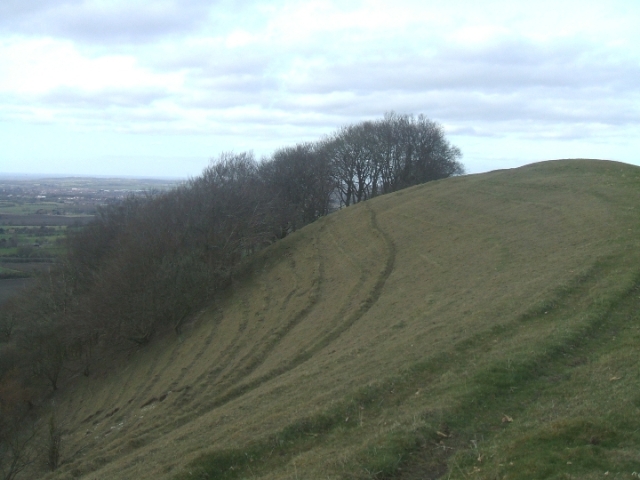
The round barrow right on the edge of the slope.

A distant view of the hill, with wood clinging on for dear life and the round barrow just visible as the pointy bit right in the centre of the photo.

A tiny segment of the view from the round barrow :) If you could see round the corner, that’s where all the weird undulations are.

The long barrow sits where you’d rather think to site it yourself, at the right hand tip of the hill (where the trees start). This gloomy February view taken from the marvellous common below.

Glastonbury Tor from the snowy barrows on Beacon Hill.


The complete article is at cliftonantiquarian.co.uk/CAC_docs/CAC%20Clifton%20Stokeleigh%20and%20Burwalls.pdf
in the Proceedings of The Clifton Antiquarian Club, 1900.
The ‘Bridge’ is of course the famous suspension bridge, just off the plan to the SW.

From ‘Maen Beuno’ by the editor of Archaeologia Cambrensis, in the July 1857 edition. He dryly remarks: “The old stone may remain here for centuries, unless some clumsy waggoner happen to drive up against it in a dark night, when he will probably obtain leave from the parish authorities to remove it.”

This illustration of ‘Parselly Hay’ accompanies the article ‘The Grave Mounds of Derbyshire and their Contents’ by Llewellynn Jewitt, in ‘The Intellectual Observer’ 1868: you can read it on Google Books.

This illustration accompanies the article ‘The Grave Mounds of Derbyshire and their Contents’ by Llewellynn Jewitt, in ‘The Intellectual Observer’ 1868: you can read it on Google Books.


from ‘Memoirs Historical and Topographical of Bristol and it’s Neighbourhood’ [sic], 1821.

I don’t know where this was, or where it is, but it is so unusual that it surely demands inclusion?
There were two stones, one at each end of a central cist (of three) in a cairn, on the Poltalloch estate. As you can see, one of them had linear markings, which the Reverend Mapleton took to be Ogham (though to the untrained eye they don’t look very Oghamish), and the other some shallow carvings in the apparent shape of Bronze Age axes. Someone at the reading of the paper suggested they might be for casting such axes. On another stone were 10 or 11 cupmarks.
The description of the cairn’s whereabouts is a bit vague: In the glen that extends from Loch Awe to the Crinan Canal are several sand and gravel banks rising among the moss, in many of which cairns and cists have been found. One such gravel-bank contains a very interesting cist. It is skirted on the east by moss, and on the west by reclaimed pasture-land, which was loose moss about forty or forty-five years ago [ie c1840]; at that time the bank was trenched for the purpose of planting, and it is now occupied by a small plantation. There are remains of the cairn; but as some houses were built on the spot, it is not easy to ascertain the limits or size of the cairn. The situation of the plantation is in the middle of the flat extent of land between Callton Mor, the residence of Mr. Malcolm*, of Poltalloch, and the village of Kilmartin.
*this being the big house at Poltalloch.
from
Note on a Cist with Engraved Stones on the Poltalloch Estate, County of Argyll
R. J. Mapleton
The Journal of the Ethnological Society of London (1869-1870), Vol. 2, No. 3 (1870), pp. 340-342

A selection of items found in the cave. From the article
Report on the Results Obtained by the Settle Cave Exploration Committee Out of Victoria Cave in 1870.
W. Boyd Dawkins
The Journal of the Anthropological Institute of Great Britain and Ireland, Vol. 1. (1872), pp. 60-70.

“Witches’ Stone” / “Witch’s Stone” mentioned in folklore posts below.

A dubious carving. see miscellaneous post
themodernantiquarian.com/post/55173

A dubious carving – see miscellaneous post
themodernantiquarian.com/post/55173

A dubious carving: see miscellaneous post
themodernantiquarian.com/post/55173

Galley Hill on the left (with barrows, somewhere), Warden Hill on the right, and Drays Ditches would be somewhere in the middle. The Icknield Way passes along the front.

It was far away, I know. I took it from the flat land below the ridge. The knoll is, I think, the small bump at centre top, with an interestingly shaped natural bump further forward called Knocking Hoe (faintly similar at least from this angle and millennium).

The other side of the carved stone (now in the National Museum and Art Gallery, Cardiff).

I visited the National Museum and Art Gallery in Cardiff, and found the carved stone from Bryn Celli Ddu far from its home. The carved lines are quite faint – this drawing is probably not the most precise of copies, but it gives you the idea. It’s quite a big stone and you can walk round it. I don’t remember it being enclosed in a glass case as in Kammer’s picture. But that could be my bad memory.


There are so many lichens on the stones. And when you get looking you realise the stones are themselves quite colourful, quite pink.

from some angles it looks almost impossibly balanced

As you walk round, not only does the appearance of the dolmen change from long and pointy to compact and short, the holes between the stones change too (I thought it was interesting)


