
The east part of the southern wall looking south east.
Image credit: drew/AMJ

The east part of the southern wall looking south east.


The lower wall continues, this looking up to the east wall.


The north wall appears to have fallen over the edge.


A shepherd’s wind shelter on the south west part of the wall.

Beyond the west wall and a hint of another rampart.


South east wall, Beauly Firth in the distance.


Further up, the walls just about become visible, the scenery to the west beautiful.


Looking east, Dun Fumhair in the distance.


The sun in the south west, reasonably warm, that would change.

Large stone might a moved kerb or just dumped, on the north side of the cairn.

The shimmer in the distance is the start of the Beauly Firth.
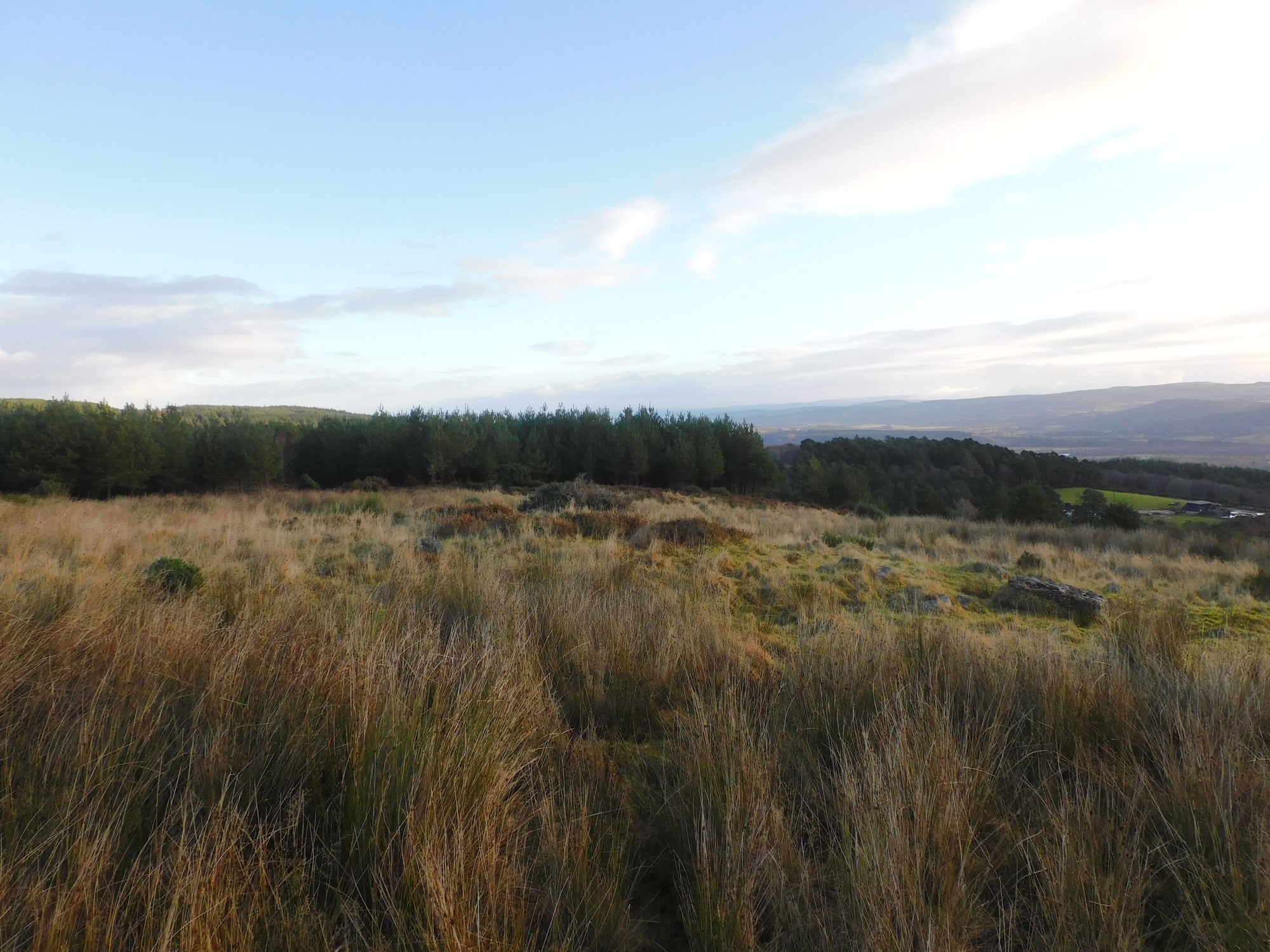

An important site and yet to be recorded with Canmore. The Welton cairn can be seen in the distance.

Large kerbs can be seen looking west, loads of prehistoric sites, Wester Coul, Strone Hill, Pitmudie, Foldend etc etc


Larger kerbs on the south west, makes you wonder if the longest stone once stood.

South part of the cairn with kerbs, Loch Lintrathen in the distance, the slope to its east home to another cairn.

Kerbs just about mark the outline of this soon to be recorded site.

Looking northish, on top of the hill you look down on the Strone East cairn.

The Brankam Cairn looking over to The Carrach, home to another cairn.

The outline of the cairn shapes the top of the unnamed hill between Brankam and Welton.


The top of the cairn appears to be slightly houked, then again it might be animal damage.

The cairn overlooks Dalnaglar Castle which is a few hundred meters north,

Looking north west towards the A93, white van, and Meall Odhur and Meall Dubh the closest peaks.

Some kerbs and Lamh Dearg posing behind the trees to the south west,


The great unwashed to the east, Dalnaglar was far easier to find than the site I’d come from.
Archaeology & History
The isle of Boreray is four miles northeast of Hirta and here once lived, according to legend, a christian hermit. However in the reverend Kenneth Macaulay History of St. Kilda (1764), he told us that the character was actually a druid. Take your pick! The druid lived at Stallir House, adjacent to which, said Macaulay, was
“a large circle of huge stones fixed perpendicularly in the ground, at equal distances from one and other, with one more remarkable regular in the centre which is flat in the top and one would think sacred in a more eminent degree.”
In a later article by F.L.W. Thomas (1867) he also mentioned this ‘stone circle’, though indicated its decline. Additional information on this little known stone is sparse due to its somewhat remote position on one of the uninhabited isles of St. Kilda.