
Slightly smaller – but still impressive. The southwestern barrow.
Image credit: A. Brookes (16.6.2015)

Slightly smaller – but still impressive. The southwestern barrow.

Northeastern barrow from southwestern.

The northeastern barrow. It has a nasty erosion scar, but otherwise is probably the finest clifftop round barrow on the north Cornwall coast.

G/F gives scale to the magnificent northeastern barrow.

The northeastern barrow in its stunning clifftop setting.


The southern extent of the fort drops steeply to Stein Cove.


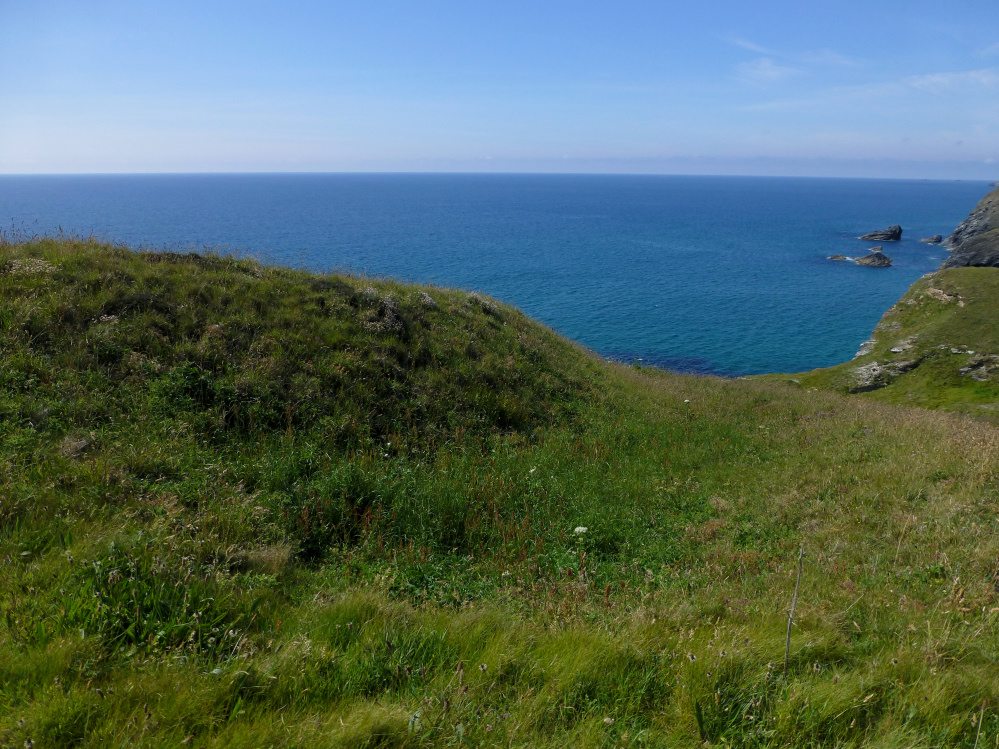


Approaching from the north presents an excellent elevated view of the ramparts. The outstanding round barrow pair at Whipsiderry can be seen on the skyline.

The sea view from the top of the barrow.


There’s a decent barrow hiding under the vegetation.


The fort from the south, the ramparts clearly visible. Park Head fort can be seen beyond.

The overgrown double rampart from the southeast.

Looking over the vertigo-inducing northern side of the fort towards Park Head fort, the next cliff fort north.


The inner rampart, terminating abruptly on a crumbling cliff face.

The outer rampart, which completely hides the inner rampart from this angle.

The fort is on the cliffs far left, covered in dark green vegetation. Bedruthan Steps and the rock stacks attract all the visitors.

The crumbling southern side of the fort. Other visitors give scale to the obvious rampart.

On the south sheer cliffs drop to Mackerel Cove. Looking towards Redcliff Castle and the tourist honeytrap of Bedruthan Steps.

Looking north towards Dinas Head. The Park Head barrow cemetery occupies the nearest cliff top, to the right.


The rock-cut ditch, quite silted up now.

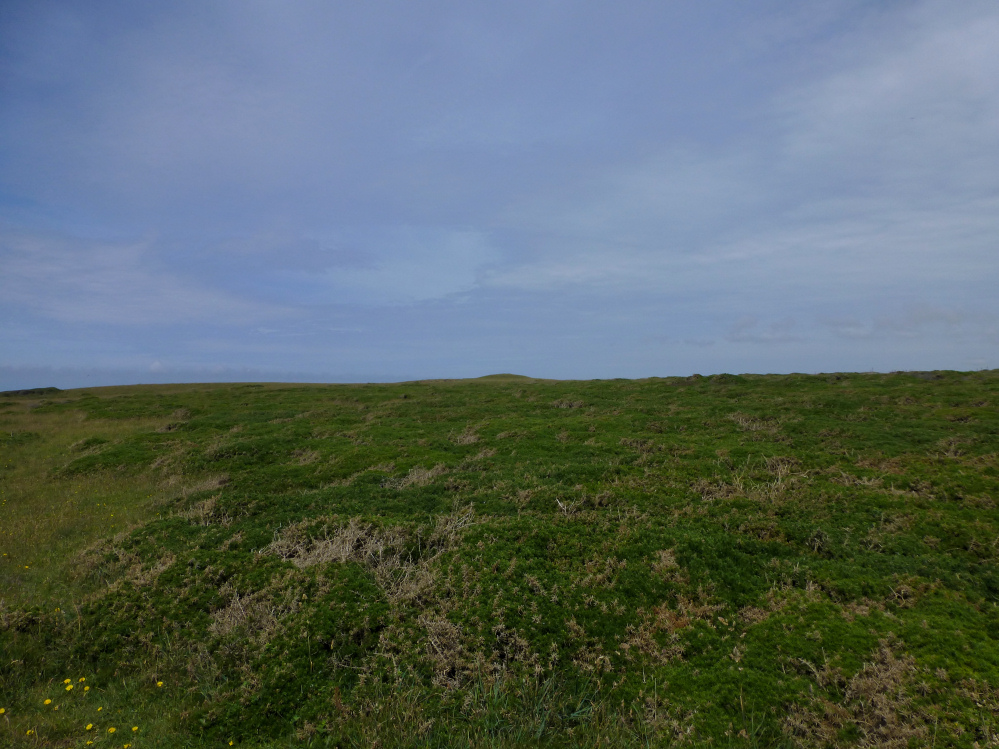
The most prominent barrow from the southeast. There is one more barrow somewhere in the gorsey wilderness in the foreground, but it’s not shown on the OS and we didn’t know it was there.

Looking eastwards across the barrow at SW 8447 7101.

The barrow at SW 8447 7101.

The barrow at SW 8447 7101, the finest in the group at the high point of the headland.

The coastally-challenged barrow at SW 8444 7120, with the better-preserved western barrow visible behind on the right.

The barrow at SW 8444 7120, which would be pretty good if half of it hadn’t fallen over the cliff.


The westernmost barrow in the group (SW 84417130).

The easternmost barrow is set back a long way from the cliff edge.

The easternmost barrow (SW 8461 7126) in the group has a huge diameter (c.30m) but is low, suggesting it’s been lowered and spread by ploughing.

The barrow at SW 8478 7150, with the northernmost barrow directly behind.

The low barrow at SW 84787150.

As well as coastal views, the northern barrow also looks up the valley towards Trevemedar.

The scooped top of the northern barrow at SW 8481 7157.

The northernmost barrow at SW 8481 7157, looking north towards Dinas Head and Trevose Head.
Extensive cemetery of Bronze Age barrows on Park Head, near to an Iron Age cliff fort. In addition Mesolithic flints have been found on the headland.
Details from Cornwall & Scilly HER, north to south:
SW 8481 7157
This is the northernmost of the group of barrows on Park Head; it stands on a cliff edge looking north. It is a bowl barrow 0.9m high and 18m across with sunken top. The barrow is Scheduled and covered by grass.SW 8478 7150
This is the second northernmost of the group of barrows on Park Head; it stands on a slope looking north. It is a bowl barrow 0.6m high. The barrow is Scheduled and is under pasture.SW 8479 7148
This is the third northernmost of the group of barrows on Park Head; it stands on a slope facing north, very close to the barrow 21780.2. It has been almost entirely removed, leaving just a small rim about 12m across (h1). It is covered by grass.SW 8441 7130
This is the westernmost of the group of barrows on Park Head; it stands on a clifftop looking west. It is 1.7m high and 27m across, but has been mutilated by a number of excavations in the sides. The barrow is Scheduled and is under pasture.SW 8461 7126
This is the one of the group of barrows on Park Head; it stands 200m from the cliff tops. This barrow is in arable land but is under pasture; the plough has bitten into the sides somewhat. The remains are 0.6m high and are Scheduled.SW 8444 7120
This is the one of the group of barrows on Park Head; it stands on a clifftop looking south-west. It is 0.7m high and 27m across, but has been mutilated by a number of eroded areas of rabbit holes. Parts of the west side have been lost to the cliff edge; otherwise the barrow is covered by grass and is Scheduled.SW 8447 7101
This is one of the group of barrows on Park Head; it stands 50m from the cliff top. This barrow is in good order, 1.5m high and 18m across. It has been mutilated by a number of small excavations, and was recorded in 1760 as having “just been opened”, although it was apparently intact in 1865. The barrow is Scheduled and now under pasture. The barrow may have been used as a beacon.SW 8454 7084
This is the southernmost of the group of barrows on Park Head; it stands 50m from the cliff top. This barrow was rediscovered by Sheppard in 1978, from the coastal path; it is covered by gorse elsewhere. It was indicated on Thomas’s survey sheet and may have been used as a beacon in the early C19.

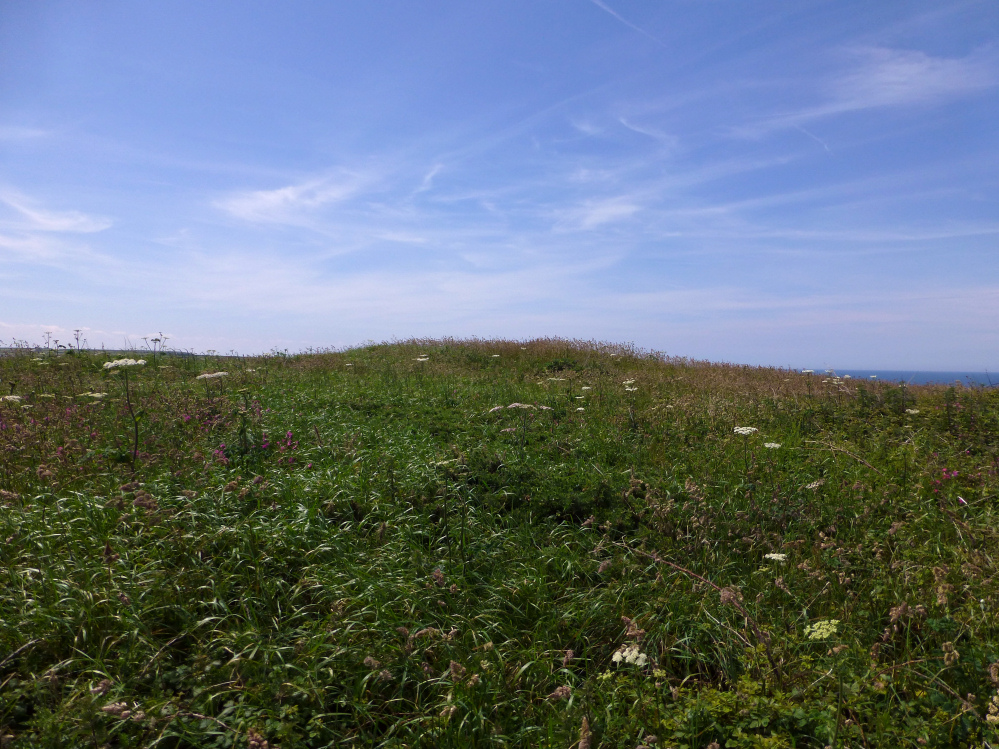
In order to save my lower legs, this was as close as I made it to the barrow. Decent size and no obvious damage, under the vegetation.

The area around the barrow is very overgrown in summer, much of the intervening vegetation is brambles and nettles.

The barrow is a prominent bump when seen from the cliffs to the north.

Looking NNW. Dinas Head, with its kerbed cairn, can be seen on the skyline, right of centre.