Visited June 2026
Image credit: Uwe Häberle 06/2026

Visited June 2026

Visited June 2026

Visited June 2026

Visited June 2026

Visited June 2026

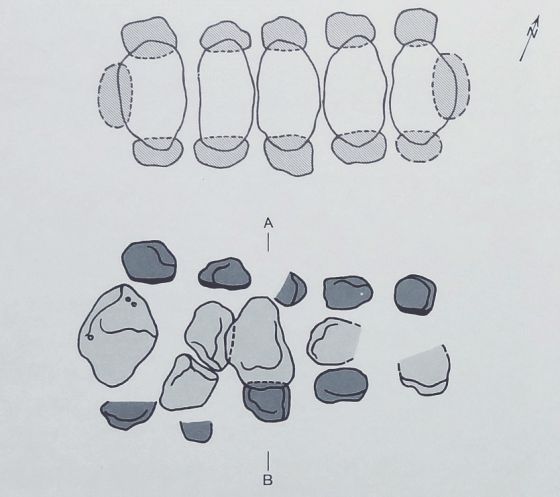
Ernst Sprockhoff
Atlas der Megalithgräber Deutschlands,
Teil 2: Mecklenburg – Brandenburg – Pommern (1967)

Ernst Sprockhoff
Atlas der Megalithgräber Deutschlands,
Teil 2: Mecklenburg – Brandenburg – Pommern (1967)
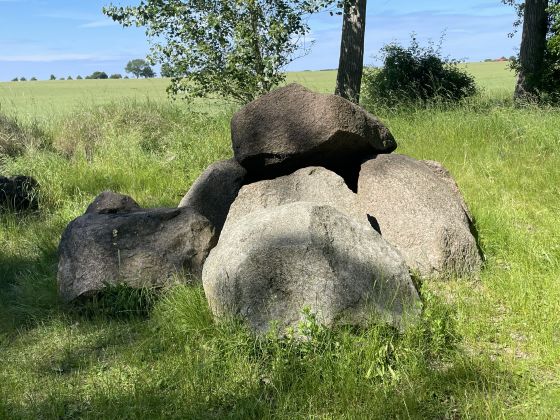
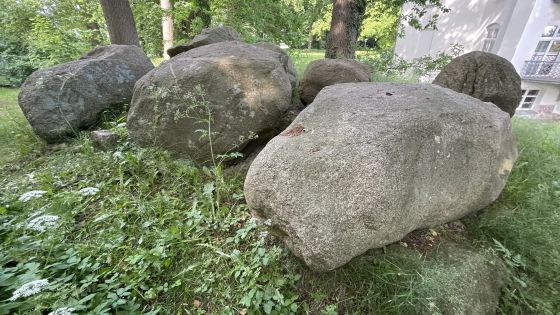
According to Wikipedia, the Neu Gaarz 2 dolmen is a simple dolmen; however, the information sign on site refers to the megalithic tomb as a grand dolmen. Regardless of the correct classification, Neu Gaarz 2 is a beautifully preserved, north-south-facing dolmen.
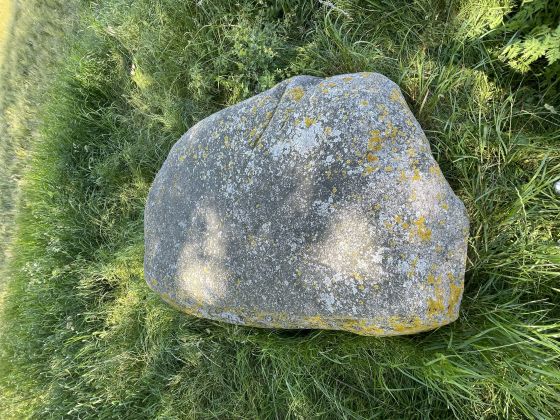
Measuring 2.8 m in length, 1.5 m in width and 1.3 m in height, the chamber is exceptionally large for a simple dolmen, which is characterised by the sideways positioning of its supporting stones (it is the largest known simple dolmen). The passage, which is unusually long for a simple dolmen and set at an angle, is also a distinctive feature. It is 1.9 m long, approximately 0.8 m wide and the same height, and consisted of four supporting stones and two capstones, which now lie beside the passage. Originally, the chamber and passage were covered by a round mound of rolled stones. Eight small cup marks are carved into the chamber’s sole capstone, and 12 into one of the three supporting stones.
To reach the megalithic tomb, take the Mechelsdorfer Weg from Rerik – the road heading north-east towards Mechelsdorf. At the edge of Rerik, where a small sign points to the Mechelsdorf 3 megalithic tomb on Bastorfer Weg, which branches off to the right, continue straight on for about 1.2 km. Neu Gaarz 2 is clearly visible at the highest point of the road on the right-hand side, about 50 metres into the field.
Visited June 2026
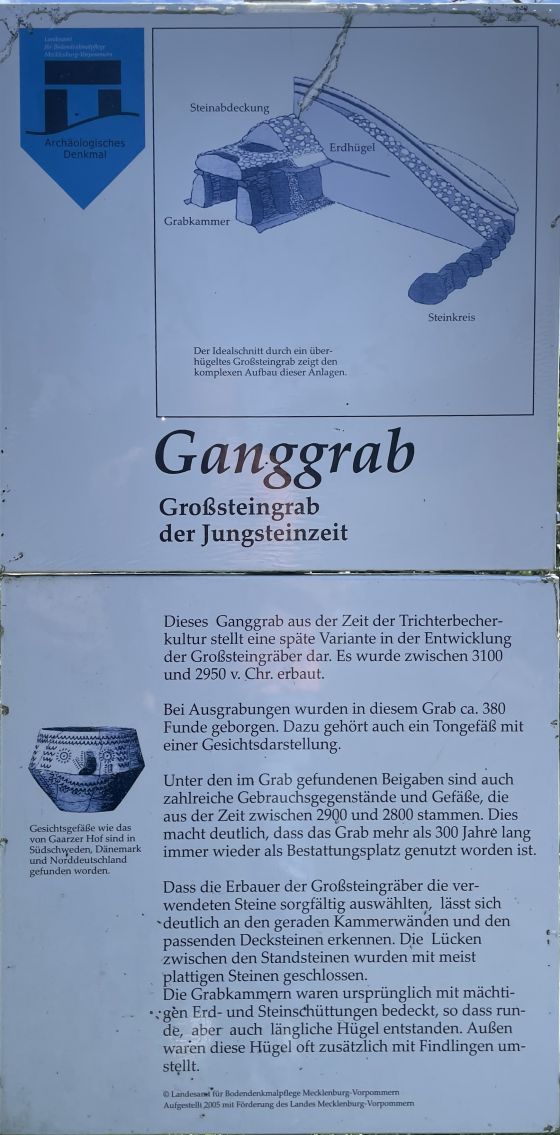
Taken from the on-site information board:
The Mechelsdorf dolmen opens to the south-east via a bent passage. Originally, the chamber and passage were completely covered by a mound of earth. Small cup marks have been chiselled into the capstone of the chamber and into a standing stone.
Dolmen
Neolithic megalithic tomb
(3200–3000 BC)
This tomb is a so-called grand dolmen with an attached passage. The term ‘dolmen’ originates from Breton and literally means ‘stone table’.
Dolmens were probably originally intended as graves for single individuals. They differ in this respect from the larger passage graves or megalithic tombs (collective graves), which were built to accommodate several.
This large dolmen, which was archaeologically investigated in 1967, is a unique example due to its unusually long and angled passage. The passage, composed of four side stones and two capstones, was 2 m long, approx. 0.8 m wide and the same height. The burial chamber itself is also exceptionally large, measuring 2.8 m in length, 1.5 m in width and 1.25 m in height.
Small cup-shaped indentations have been chiselled into the capstone of the chamber and one of the side stones. Such indentations were created during ritual acts which may have served to obtain rock powder considered to have healing properties.