Visited June 2026
Image credit: Uwe Häberle 06/2026

Visited June 2026

Visited June 2026

Visited June 2026

Visited June 2026

Visited June 2026

Visited June 2026

Ernst Sprockhoff
Atlas der Megalithgräber Deutschlands,
Teil 2: Mecklenburg – Brandenburg – Pommern (1967)

Ernst Sprockhoff
Atlas der Megalithgräber Deutschlands,
Teil 2: Mecklenburg – Brandenburg – Pommern (1967)
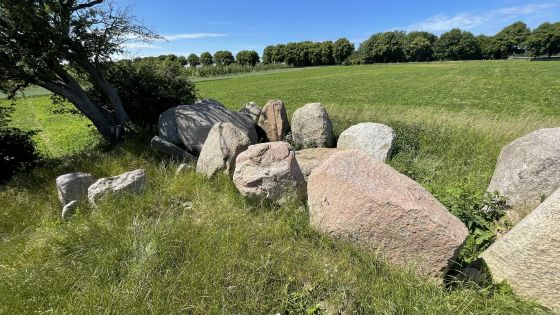
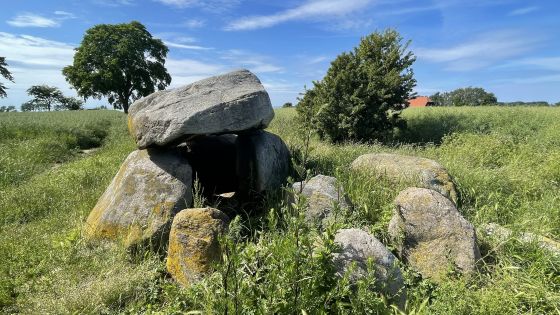
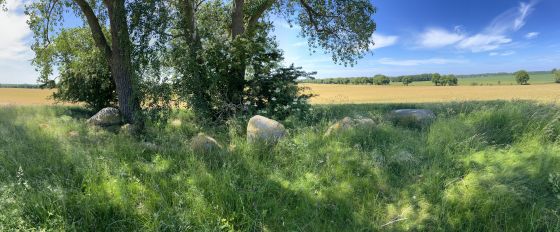
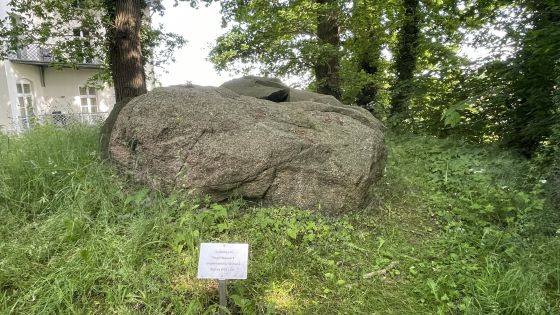
Neu Gaarz 1 is a north-east to south-west oriented passage grave situated in a slight depression. Eleven supporting stones remain, whilst four are missing. The capstones have collapsed into the chamber or are missing. The chamber was divided into a total of nine compartments. A distinctive feature is the entrance porch consisting of four pairs of posts.
From the Rerik–Kröpelin road, a road branches off to the left towards Neu Gaarz at the level of the two graves Gaarzer Hof 1 and Gaarzer Hof 2. Follow this road for just under 700 metres until the road ‘Zum Dolmen’ branches off to the left into a small industrial estate. There is also a signpost indicating the location of the grave. Follow the road for about 100 metres to the end, and you will arrive directly at the site.
Visited June 2026
Taken from the on-site information board:
Passage grave
Neolithic megalithic tomb
(3100–2900 BC)
The construction of passage graves of this type marked the end of a tradition, long held in high regard in Mecklenburg over many centuries, of erecting funerary monuments as central burial sites for entire settlement communities, using boulders weighing several tonnes.
Numerous objects were recovered from the burial chamber of this tomb, which had been placed in the grave with the deceased to accompany them on their journey to the afterlife. These included both pottery vessels and weapons in the form of arrowheads and flint tools, as well as two stone axes.
Of particular interest is the discovery of several pottery fragments and carefully crafted amber beads dating from the mid-3rd millennium BC. These indicate that the passage grave continued to be used as a burial site for many centuries after its construction.
The tomb was archaeologically investigated in 1967, during which it was discovered that the 9.5 m long and 2 m wide burial chamber had an internal partition comprising vertically placed stone slabs. Access was from the south. Here there was a passage approximately 1 m wide, bounded on both sides by wooden posts.