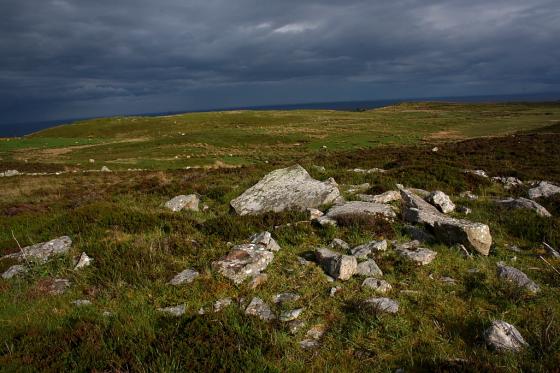
Photo taken on 3rd July 2021.Sweep of the stones of the wonderful ‘U’ shaped setting of Achavanich. The remains of the chambered cairn is visible to the left of the shot.
Image credit: Paul Kesterton

Photo taken on 3rd July 2021.Sweep of the stones of the wonderful ‘U’ shaped setting of Achavanich. The remains of the chambered cairn is visible to the left of the shot.
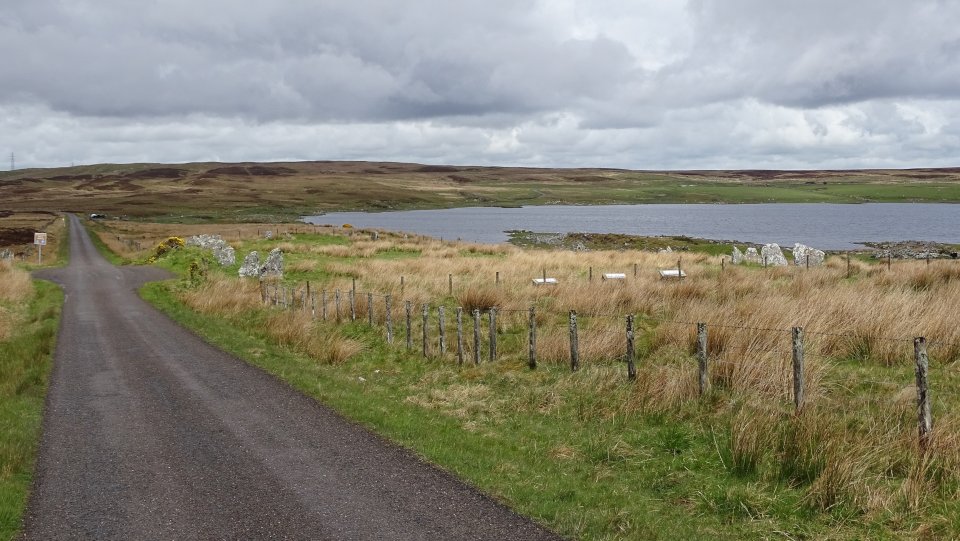
Visited 2nd June 2015


The southwest arc seen from the south
Visited 2nd June 2015

The southwest arc seen from the north
Visited 2nd June 2015

Curiously the broad face of the stones are not facing to the centre of the horseshoe shaped stone setting
Visited 2nd June 2015

The north-east arc with the cairn in the background
Visited 2nd June 2015

Visited 2nd June 2015

03/08/2016 – The Great U


Bit windy, then?.... note the radial configuration of the stones.


When it’s not always raining in Caithness... there’ll be days like this.

Achavanich at dawn, with rainbow.


Achavanich at dawn

The Great U from low angle framing western stones against horizon – the ‘bottom’ of the U is barely visible, the site is so big!


Overview from south

Eastern stones leading away to northern stones forming one side and bottom of U

Eastern stones from ‘bottom’ of U, looking southish

The ‘bottom’ (north) of the U, looking roughly east

Western stones from ‘bottom’ of U (looking southish)

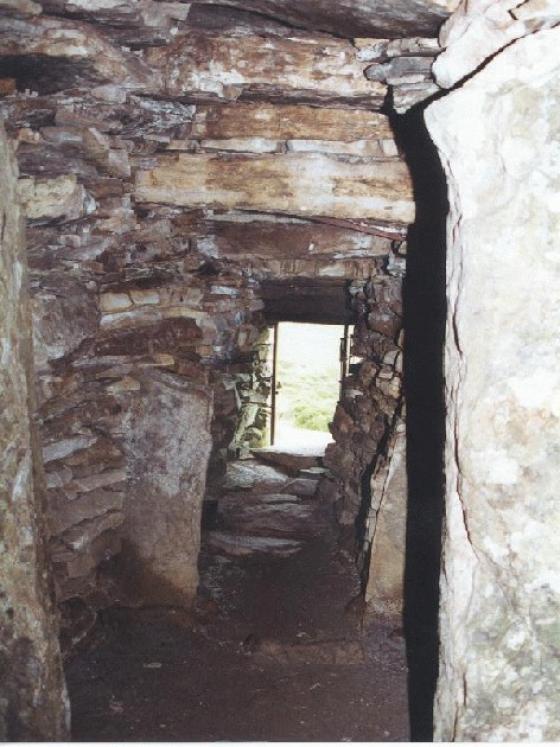
Nearby cairn
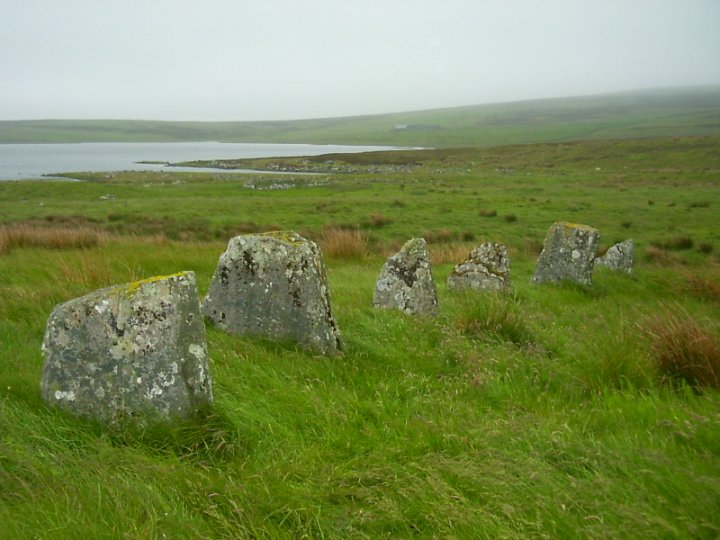


W line of stones


General view showing stones to E and W

Achavanich Standing Stones forming an oval shape. about One Third Of Stones Missing
John O’Groat Journal
A BUNGLING roads boss unwittingly ordered the destruction of part of a 4000-year-old ancient monument near Lybster.
Highland Council workers were preparing to tarmac over historic ruins to create a lay-by for visitors to the standing stones at Achavanich before a concerned local historian pointed out the gaffe to embarrassed council chiefs.
Work ground to a halt last week while Historic Scotland assessed the damage and the local authority employed an archaeologist to ensure work can continue without further damage to the site.
The £10,000 project was funded by the Highland Council’s recent Scottish Executive windfall under a quality of life and environment initiative. It was hoped the lay-by would provide “safe and convenient” access for the public to reach the ancient monument.
Ian Hargrave, acting Caithness area manager, claims the blunder was “largely a technicality”.
He revealed that the Highland Council believed the scheduled monumental site stopped at the fence, in off the roadside, when in fact it extends to the edge of the road.
“That’s why people got a wee bit excited about it,” he said. “Historic Scotland has examined the site and an archaeologist consultant has been engaged to ensure the project can be completed.”
The council did not need planning permission for the project because it falls under the auspices of the roads authority. However, Richard Guest, the area transport, environmental and community services manager, admitted it would have been wise to consult Historic Scotland over the plans.
Mr Guest added that an initial report by the archaeologist employed by the council suggested that the area dug up by the council to lay the foundations for the lay-by did not hold anything of archaeological importance.
However, an Historic Scotland spokeswoman yesterday said she believes the site destroyed by the council is part of the unusual horseshoe-shaped arrangement of small standing stones at Achavanich. She added: “Fortunately the damage was minimal.”
The standing stones are believed to date back to the Bronze Age and have held ritual importance in the county for centuries, although their precise purpose and date is unknown. The tallest is two metres high. Some stones may have been taller, but weathering has caused them to crack and split.
Only 36 stones remain in the setting, although there may have been about 54 originally.
Achavanich is in Councillor Billy Mowat’s Caithness South-East ward. He declined to comment on the council’s gaffe because he said he was sure the situation would be resolved.
Mr Mowat welcomes the lay-by which he hopes will encourage more visitors to the area.
Visited 3rd July 2021
High up the northern fastness of Scotland, nearly as far north as you can get on the British mainland, the windswept bleakness and sense of isolation makes a visit to a site up here take on an extra poignancy.
So close to the main A9, and the town of Thurso, Achavanich is an easy place to visit if you’re in these parts. On our regular trips up to Orkney the sight of the small brown signpost signalling the turn off the main road, often enticing us to stop and visit if we had time to kill before the ferry, became as it were a touchstone, an indication that we were almost ‘home’.
Today the weather is mild, and blue skies emerge through scudding clouds. A walk round the stones, looking down towards the loch of Stemster, and the stones feel like nowhere else. The side on alignment of the orthostats is puzzling and must have some purpose behind it, but the stones aren’t telling and the place remains as enigmatic as ever.
It’s nice to see how over the years the site has become better kempt, my first time here over 20 years ago, involved clambering over a fence, and trying to make out the stones amongst the overgrown spiky grasses which thronged the site. Now a smart but small layby, along with some unobtrusive information boards make visitors feel welcome. There is even a gate now to access the chambered cairn which sits nearby overlooking the site.
We spend some time with the stones, a couple of campervans turning up and providing a few more visitors, and things just feel a bit otherworldly here. It’s soon time to make our way off to get the ferry, and Achavanich has provided a fine reminder of some of the megalithic riches that can be found in Caithness.
03/08/2016 – After a visit to Broubster, a similar stone setting, a few days earlier we thought a pop in to say hello to the Great U was needed. I love this site. Lots of stones, interesting shape and just a brilliant middle of nowhere feel to the place. One that’s always worth another look. Not sure I’ve been at this time of year before. Loved the wild flowers and grasses growing around and over the stones. Colours of yellow and green against the grey of the stones looked so nice in the sunshine. A must see site.
Visited 24.7.14
Directions:
Sign posted. Approximately 1 mile off the A9. Parking space next to stones.
Visiting the Great U involved a fairly long detour off our planned route but this was a site I was very keen to visit. I wasn’t disappointed.
The stones are surrounded by miles of bleak moorland with hills in the distance.
There are three information boards.
This is an excellent site and has a feeling of remoteness about it.
The stones are quite large and the grass around them not too overgrown.
It is odd how the stones are ‘side on’ instead of the normal ‘front facing’ – there must have been a reason why they set the stones up this way?
If you happen to be heading up the east coast of Scotland try to make time to visit the Great U. It is a most interesting place.
Whereas the site has always been within a fenced area, overgrown and neglected and with a landowner who didn’t want people to enter the site I am happy to report that it is now a delight to visit.
The grass has been cut back, and the fences have been repositioned. There is now no fence between the site and the layby/parking place. If you want to visit the immediately adjacent chambered tomb, though, be prepared to climb a (nice, new, shiny) fence and risk the wrath of the land owner.
Enroute back from John O’Groats, Moth suggested we call in here despite the HIDEOUS weather and the fact it was getting late. I was persuaded that it was a good idea largely because it is next to the road, and actually only about 2ks from the main A9.
I was expecting a horseshoe, or a squashed circle in some way, open at one end, but what greeted me was most unexpected.
Imagine two parallel lines of stones with a semicircle connecting them at one end, the other end left open and you have it! ‘Great U’ is a very accurate description of this site.
The rhythm of the stones is surprisingly complete and regular. Oddly, the playing card shaped stones stand narrow side on to the centre rather than broad side. I have never seen this before. Oh and it’s HUGE!
My God, if you could get here in good weather, it would be unbelievable! As it was, we got cold, wet and windchilled within seconds. Moth climbed up to a nearby cairn to try to get a ‘long shot’, but could see nothing the mizzle was so thick.
This place KICKS ASS!
These stones are very close to the road from Achavanich to Lybster and ¼ mile S. of Loch Stemster.
The stones set out in an incomplete oval measure 225 ft. long by about 100ft wide. About 40 stones set upright averaging 5 feet in height and made of Caithness flagstone look as if they may have formed a complete oval but there is no evidence for this. Probably about one third of the original stones are missing. Set about 8 feet apart the broadest sides are towards each other. A cist is to be found at the most northern stone. The monument is probably Bronze Age.
ND 1567 3035
Near Ballachly Farm, about 5 miles distant, is the Ballachly Burial Grounds, where part of the adjoining land is known as Croit Trolla, or the Croft of Trolla. Trolla is another version of the name Trollhaena, the norse name for Triduana.
Some authors think the Orkneyinga Saga is talking of Croit Trolla as the resting place of Triduana’s bones in the story of King Harold’s blindness being cured (instead of the more well known, but far flung resting place at Restalrig).
In medieval times it was common for a single bone to have a home as a holy relic with healing powers away from the main grave site. Or for the story of such to spring up, in the case of made up saints, who were used over and over to obsfucate similar pagan customs in a variety of areas.
Triduana was one of the saints removed from the saints lists in the sixties because of the lack of evidence she actually existed as the christian nun of the stories.
scotlandsplaces.gov.uk/search_item/index.php?service=RCAHMS&id=8134 has more on Croit Trolla, as found in RCAHMS
Link to Caithness Field Club Bulletin from 2004
Achavanich – A Re-assessment by Leslie J Myatt