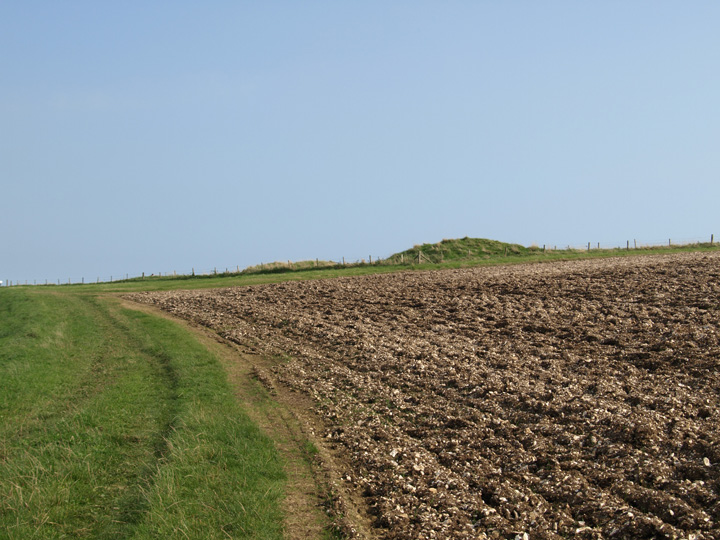
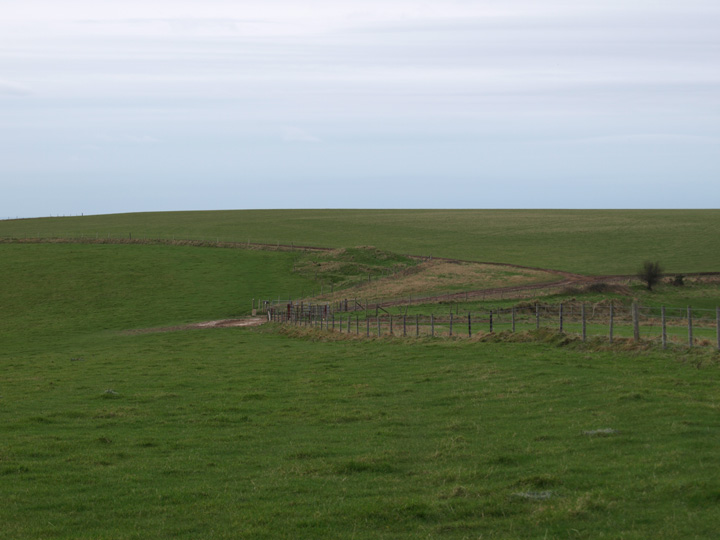
These barrows are fairly easy to get to from a national trust car park at South Down. Public footpaths lead across Chaldon Down, but it was particularly wet and filthy when I went there. The easiest three barrows to see here consist of three and a single round barrow further to the east.
The three barrows are a medium and a small bowl type and a very small low type. Both have large clefts in their tops from old diggings.
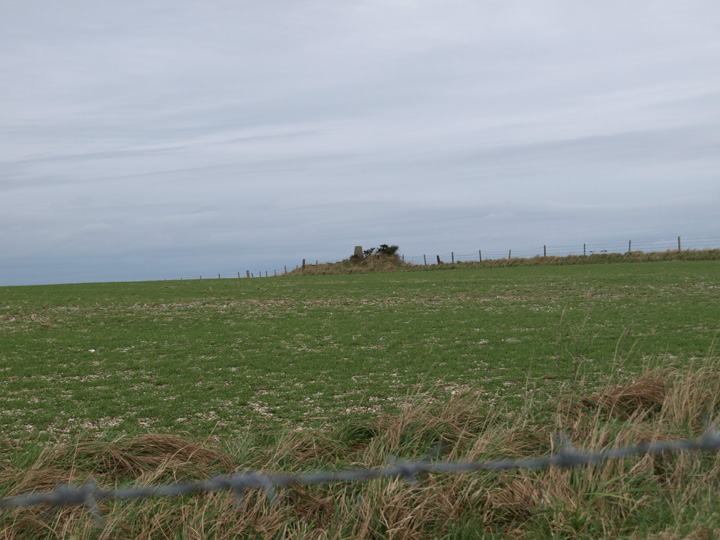
The eastern barrow is on the crest of a hill and has an O.S. concrete trig point on it and overlooks Durdle Door and West Lulworth. A stone is marked on some maps, it is a memorial stone to Llewellyn Powys a local writer.
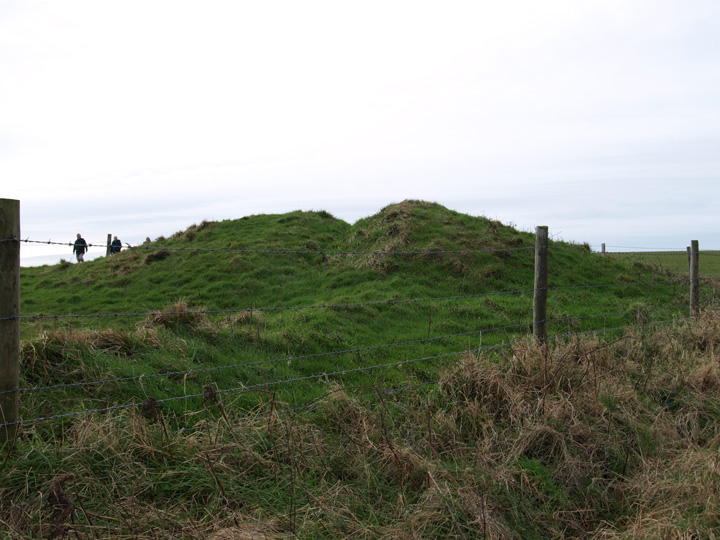
This is a medium sized bowl barrow, 22metres in diameter and 2 metres high. It is to the north of both Round Pound and the Wardstone barrow and lies just below the crest of the hill. It overlooks nearby barrow cemeteries on Winfrith heath rather than the southern hillforts near Lulworth. I assume it used to have bushes or shrubs on it , hence the name, but now it is clean of all vegetation and is in good condition. The farmer or land owner has surrounded the barrow with thick wooden posts in order to protect it from plough damage.
This barrow lies on the crest of a hill a few hundred metres from the coast. It's a bit scruffy and covered in nettles and brambles. It is 15 metres in diameter and 1 1/2 metres in height.
It was excavated in1867 and a cremation in an upright late Bronze Age urn with a flat stone on top of it was found, but has since sadly been destroyed in a fire.
I don't know a lot about this site, magic says the only dateable object found was a piece of Iron Age pottery. So I have to assume it's from that time and is some sort of enclosure / animal pen, whatever it is it's quite a substantial earthwork. The embankmet is built of chalk and turf and is 2 metres in height. The maximum distance between banks is 14 metres and encloses an area of about 0.6 of a hectare.
Close to several barrows, you can see Hambury Tout, Bindon Hill and Flowers Barrow from here. It's on the coast path and can be walked to from a free National Trust car park at Ringstead.