
The western barrow and adjacent cross dyke.
Image credit: Mike Rowland 26/11/2007.

The western barrow and adjacent cross dyke.

The western barrow from the east.

The long / oval barrow, end on view, from the east.
Although listed as a long barrow this is actually one of fewer than 50 oval barrows known to exist and is therefore much more of a rarity. It is sited on the Purbeck hills north of the village of Church Knowle. Its in good condition and is about 30 metres long by 20 wide and nearly 3 metres in height. It has ditches on either side which I would have liked to have seen, unfortunately the field had about 30 bullocks in it and I wimped out, having been chased by them in the past. I will definitely be visiting this site again hopefully minus the cattle.

A side view of the long / oval barrow looking north.

The south west corner of the inner rampart.
This is a single bowl shaped barrow despite it’s name. I think the name comes from the fact that it is perched on top of a small hill which looks like an extension of the barrow. This positioning would have much more obvious in the past, sadly the barrow is now in a plantation of hideous fir trees.
The barrow itself is in poor condition, trees grow on it but most of the damage has been caused by badgers burrowing in to it. Although it is near a footpath it’s not easy to get to through the thick undergrowth, I had to dig quite a lot of thorns out of my jacket and trousers and I could have lived without the stinging nettles.
It appears to be an outlier from the barrow cemetery on Black hill several hundred metres to the east. Also to the west two barrows are marked as being extant on Tolpuddle Ball, which at some stage I’ll try and visit.
To the north west is Wetherby castle which stands prominent on a hill rising out of the valley floor.

A man made dew pond in the interior of the hillfort.


From the east showing the damage done by badger setts.

Weatherby castle from Double barrow looking north.
This large bowl barrow, paired with a smaller one, is to the west of Ackling dyke. On the crest of a hill, to the north is Oakley down and to the south is Wyke down barrow cemetery. This area is covered in barrows of all types including several long barrows. To the east of the barrow is the Dorset cursus, indeed on Bottlebush down is some of the remaining cursus bank.
Incidentally the Anglo – Saxon naming is quite rare in Dorset, the Saxons, it’s reckoned didn’t fully conquer the area until about 700c.e.
The word berende means plentiful or productive and may refer to the large size of the barrow. Beorh is the root of the modern word barrow.
I approached the hillfort from the north, passing close by Lanceborough, the massive bell barrow below Maiden Castle. I was hoping to see a long barrow which is shown on O.S and Magic, this now appears to have been completely ploughed out.
Once inside the hillfort I decided to look mainly at the neolithic origins of it. Still visible is the very long bank barrow or possible cursus feature which curves across the northern part of the interior for about 550 metres. It now shows as a low ridge, this area has been ploughed in the past. The original causewayed enclosure is now no longer visible on the ground and is thought to be overlaid by the first phase of the hillfort.
Also visible in the south west corner is a low bronze age bowl barrow.
From the southern rampart I counted twelve round barrows on the ridge of hills a few miles to the south, one of these is a unique hybrid disc/bowl barrow.

These banks are western extent of the earliest part of the hillfort.
This barrow is only really visible from Shapwick churchyard. It is situated on a flood plain next to the river Stour, Badbury rings is about two miles to the north of this site.
The barrow is relatively well known for the engraving of its excavation in 1838. The person responsible for the dig was the Rev. Charles Wools, the then curate of Sturminster Marshall. Wools wrote that “the examination of the Barrow was continued for Eight Days with an indomitable spirit of perseverance.” Work had to stop when they dug below the level of the river and the trench began to flood. A possible Bronze age cremation burial was found.
Wools wrote up the dig in a book called “The Barrow Diggers; a Dialogue in Imitation of the Grave Diggers in Hamlet” a mixture of farce and serious scholarship.

Woodbury hill, from a drawing by Stukeley of 1724.

A contemporary engraving of Shapwick barrow under excavation.

The barrow from Shapwick churchyard, the river Stour is inbetween.


A side view of the complicated south west entrance.

The barrows from the inner rampart of Badbury rings.
All I can see in this area is one low bowl barrow covered in brambles and scrub. What looks like ditch in the photo is a rut in the track which leads to a gateway into a field. There should be another three barrows in the vicinity, I suspect they’re over a slight rise in the field. As this is private farmland with sheep grazing I didn’t go further into the fields to look for them.
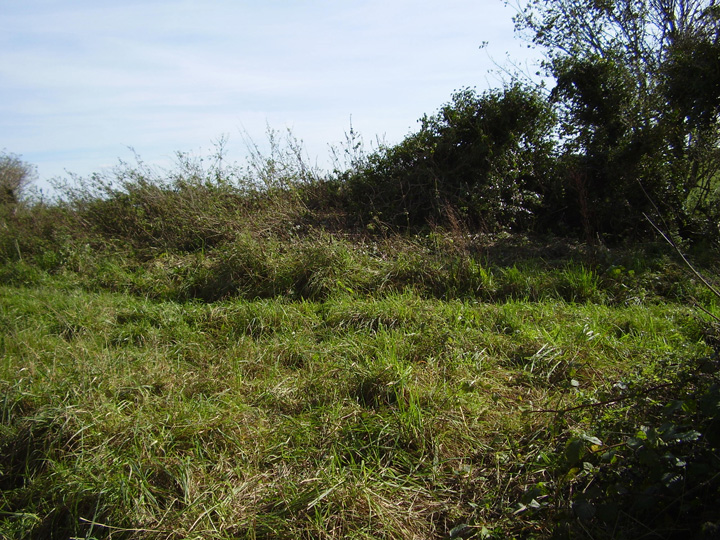
A low, very scruffy bowl barrow.
This is a truly huge earth work. It is higher than some hillfort ramparts I’ve seen and the northern ditch is still at least a metre deep. The southern ditch is less evident and may be the footpath itself.
There is a bowl type barrow with a still visible outer ditch about two hundred yards east of the long barrow.
This long barrow is a couple of hundred yards north west of Buzbury rings. It’s right next to a footpath, I parked in the golf club car park, nobody seemed to mind.
The barrow is in a fenced off area and apart from being rather overgrown appears to be in good condition, with ditches on both sides. It is orientated on a northwest / southeast axis as is the nearby Race down long barrow. It is 125 feet long, 80 feet wide and 6 1/2 feet high.
This long barrow is on M.O.D. land, part of Blandford camp, but public footpaths cross the site so access is allowed. I got there via Tarrant Monkton, drive up a dead end track with a turning circle at its end, park and follow the footpath.
The barrow is well worth the effort, its in great condition, this has been an army camp for two hundred years, so agriculture hasn’t harmed it. It has a very wide base, I couldn’t get close enough to see any side ditches.

The slope of the northern side.

The south side, from the west end, looking along its length.

The height of the barrow looking south.


The east end of the barrow, showing the full width.

The eastern end of the long barrow from the footpath.


Looking west along the full length of the barrow.

A saucer type barrow, about 100 yards east of the long barrow.
This once great long barrow is now very low and difficult to see, I assume it’s been ploughed for many years. The current farmer seems to be trying to protect it’s whereabouts by placing a series of marker poles around it, but sadly the damage has been done.
Close by are several round barrows, two of which I have included, a third is just visible in a dense hedge.
One major bonus on this visit to what could have been a disappointing site was the finding of a beautifully crafted discoid flint scraper.It is 4.5cm wide and 5.5cm long with one very sharp edge and a blunt end.

The long barrow, it shows as a low hump, the three round soil marks are where the poles marking the barrow are sited.

These two poles mark the site of the long barrow.

A discoid flint scraper found on the footpath about 200 yards east of the barrow.

This bowl barrow is to the north east of the long barrow site.

An isolated round barrow, south east of Bere long barrow.
This long barrow is all but invisible at the moment, being as it is in woodland, and heavily covered in undergrowth. I could make it out with some difficulty, and it is surprisingly substsantial. It is about 150 feet long and 40 feet wide, at the moment the ditches are too full of nettles and brambles to see well, but they are still in existance.
I will definitely re-visit this site in the winter when it will be much easier to see and photograph.

This large round barrow sits at the northern end of the long barrow.

This tree covered bowl barrow is almost joined to the pond barrow to the north.

This barrow is just inside Came woods next to a dry stone wall.

A close up of the barrow, the flat top hides a large excavation hole.

Not easy to see, this is further into the woods and heavily covered in trees and brush.
This barrow was opened in the year 1824; and the various Urns which it contained are deposited, some in Whatcombe house, and some in the museum at Bristol. It has been inspected by Sir Richard C Hoare, Bart, F.A.S., who considers it to be more curious than any barrow yet discovered in this island. E.M.P.1827.
From the Salisbury & Winchester Journal, 2 june 1828.
From the Salisbury and Winchester Journal, 2nd June 1828.
“notable antiquity of the Druids on Deverell down, which is only a short distance from the turnpike road....E.M.Pleydell, Esq. has had a wall about 46 yards in cicumference built around this ancient consecrated spot, within which are 25 stones, from 1 1/2 to 25cwt, now lying in the same plan of iconography as when the Druid’s antimensum of earth was spread over this sacred spot. Here the Druids met as judges and arbiters for public and private judgements, took cognizance of murders, inheritances, and boundaries, and decreed rewards and punishments”.
Another visit to this site this time with a bit more information on the barrow itself. Deverel barrow is not as I thought last time the large, low round barrow easily visible from the footpath. It is in fact a clump of trees to the west of it with a circular flint wall surrounding what is left of the barrow.
Apologies to juamei, who I should never have doubted, the remains of the barrow is covered in sarsens. I counted 24, more could be hidden in the undergrowth. Most of the stones are about 18 inches across, the biggest is about 3 feet long and 2 feet high.
A group of the stones lay in a circle in the centre of the site, while the largest stone, which looks to be part of a cist is at the northwest corner of the barrow.
Incidently the information which lead to the correct site came from Peter Stanier’s excellent book Dorset’s Archaeology.