
Large, chunky stones at Knockcurraghbola Commons, including a massive septal stone, 2.3 metres long, half a metre thick and .85 of a metre high.
Image credit: ryaner

Large, chunky stones at Knockcurraghbola Commons, including a massive septal stone, 2.3 metres long, half a metre thick and .85 of a metre high.


Kind of enigmatic, worth checking out if you’re in the vicinity wedge-tomb hunting.


Pano looking roughly south – the inventory entry calls this a pond barrow (see the miscellaneous entry). It’s marked as stones on the OS map.
This is from the Tipperary Archaeological Inventory:
Situated on the summit of a natural rise, close to the W edge of a gradual fall, overlooking a valley at the base of the slope. The site consists of a flat central area (14.3m N-S; 15m E-W) enclosed by a compact earthen bank (Wth 2.3m; int. H 0.35-0.55m; ext. H 0.18-0.35m), less visible at S. An entrance gap (Wth 3m) is visible at ESE. There is a small standing stone (TN039-011002-) in the interior in the SW sector with a second stone (TN039-011003-) standing at the entrance at ESE, in line with the outer edge of the bank.

The one remaining orthostat from the kerb of the cairn – ironically, it looks quite out of place.

The almost 4 metre deep court is on the left of this shot.

Detail of entrance jamb-stones. Almost all of the stones at Shanballyedmond are flag-like slabs.

From just inside the enclosure – that track up the hill is steeper than this shot portrays.

The excavated and partly restored court tomb at Shanballyedmond. It has its own enclosure with pathways and tended grounds and two information boards. Nice, if a tad overdone for the likes of us.

Baurnadomeeny standing stone, with the wedge tomb in front of the trees on the right.


South-west over the tomb entrance towards the Slieve Felim mountains.

There is something really special about this tomb entrance.


There is a cist within the impressive portico at Baurnadomeeny, visible here to the right.


This assemblage of stones is at the back of the tomb. The transverse stone is thought to be part of the outer walling and not the backstone of the chamber.

Mauherslieve (Mother Mountain) over one of the stones at the rear of the tomb.

Knocknabansha Hill in the distance has another wedge tomb near its summit.

The massive, 3.5 metres long septal stone at the front, western end of the tomb.

The back, eastern end of the remains. It seems the gallery has been removed and what remains is the outer walling of the wedge tomb.


I loved this site, from any angle, wild and windswept and rarely visited.
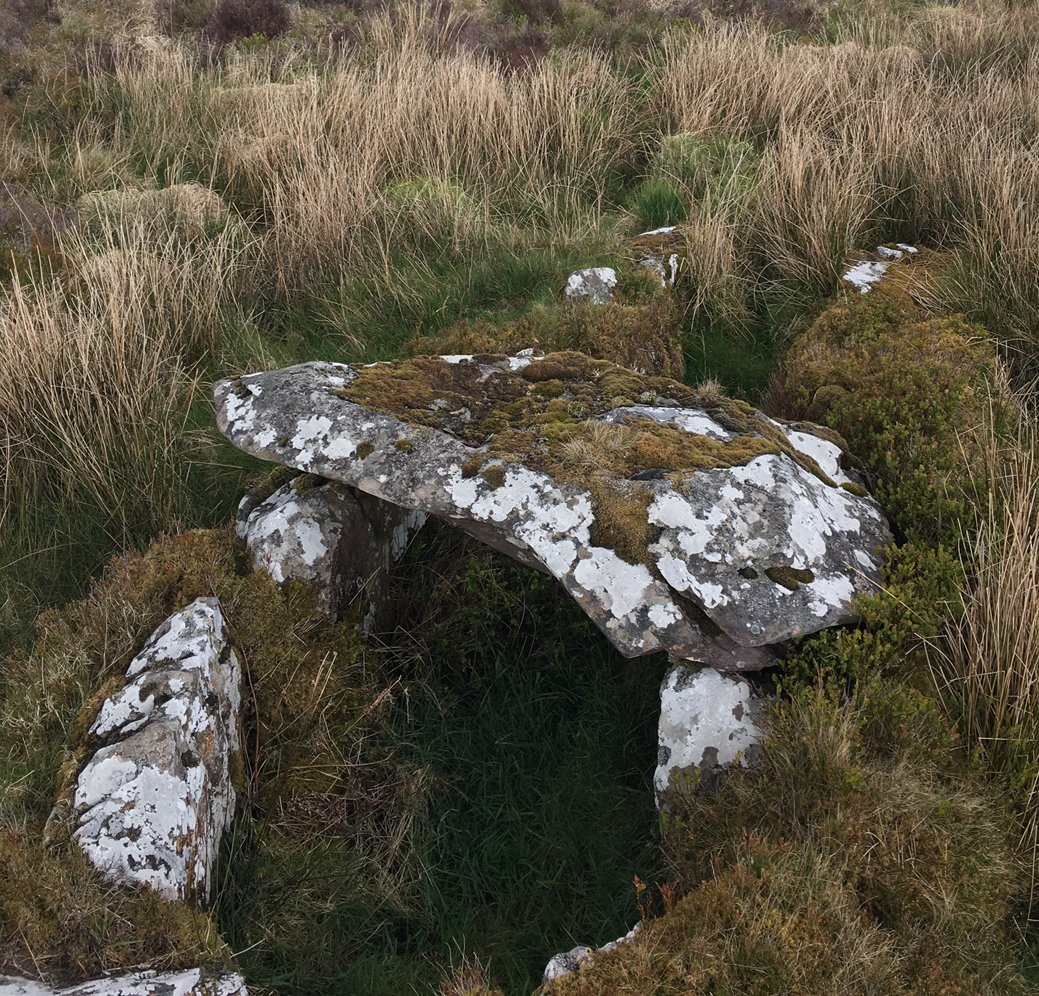
Looking down on the tomb from the large portico stone.


The chamber looked so cozy I fantasised about a tarpaulin and a waterproof sleeping bag (but not for long).

The one remaining chamber roofstone rests precariously on one of the northern sidestones.

Another view over the septal stone. The north-west side-walling is missing towards the front of the chamber.

Looking west over the roofstone towards Keeper Hill and the Silvermines.

The tomb is a bit of a mess, but still retains some of its ancient charm. This is the view from the west.

The one remaining roofstone at this ruined wedge tomb rests on a padstone seen here to the left. The stone in the foreground is the septal stone at the front end of the chamber.

A new angle for me, with 10-year-old LM for scale. “There’s no way I’m going in there,” said she.


Possibly the most immense megalithic pressure point in Ireland.

From the back of the tomb. There’s been a good deal of disturbance to some of the cairn stones, somebody believing that it’s a good idea to build up the side-walling of the main gallery.

The ever vulnerable backstone of the gallery at Kilmashogue. Seems to be irresistible for use as a companion fireplace to your bag of cans.


Distorted pano of the western/south-western arc of the main Knowth mound.

This stone lies where it was found at the western entrance ‘forecourt’. The excavator, George Eogan, was restrained in his interpretation and re-construction at Knowth.


The eastern passage entrance. There is now a large concrete bunker built just beyond the bridge over the entrance stone and inside the mound. Yikes!


Quite the most stonerest of all the stones in Brú na Bóinne.
