


There are said to be 27 stones in the kerb of the 9m diameter cairn.


There is a grassy track up to the tomb from the main forestry track, handily signed by some enthusiasts.

The last site of the day on a great trip to south Sligo. The gallery is 9 metres long. It has a lot of its structure left, embedded in the turf. This is taken from the back of the gallery, this last little chamber nearest the camera is a gem.

Looking out of the entrance jambs into the now non-existent court.


This is taken from the east side of the gallery which is used a a field boundary. The court has been incorporated into another field boundary to the left of this shot.


Pretty messy and difficult to interpret, probably a wedge tomb.

Taken from on top of the cairn, there is this enclosure abutting its southern edge. Lough Arrow is off to the right.
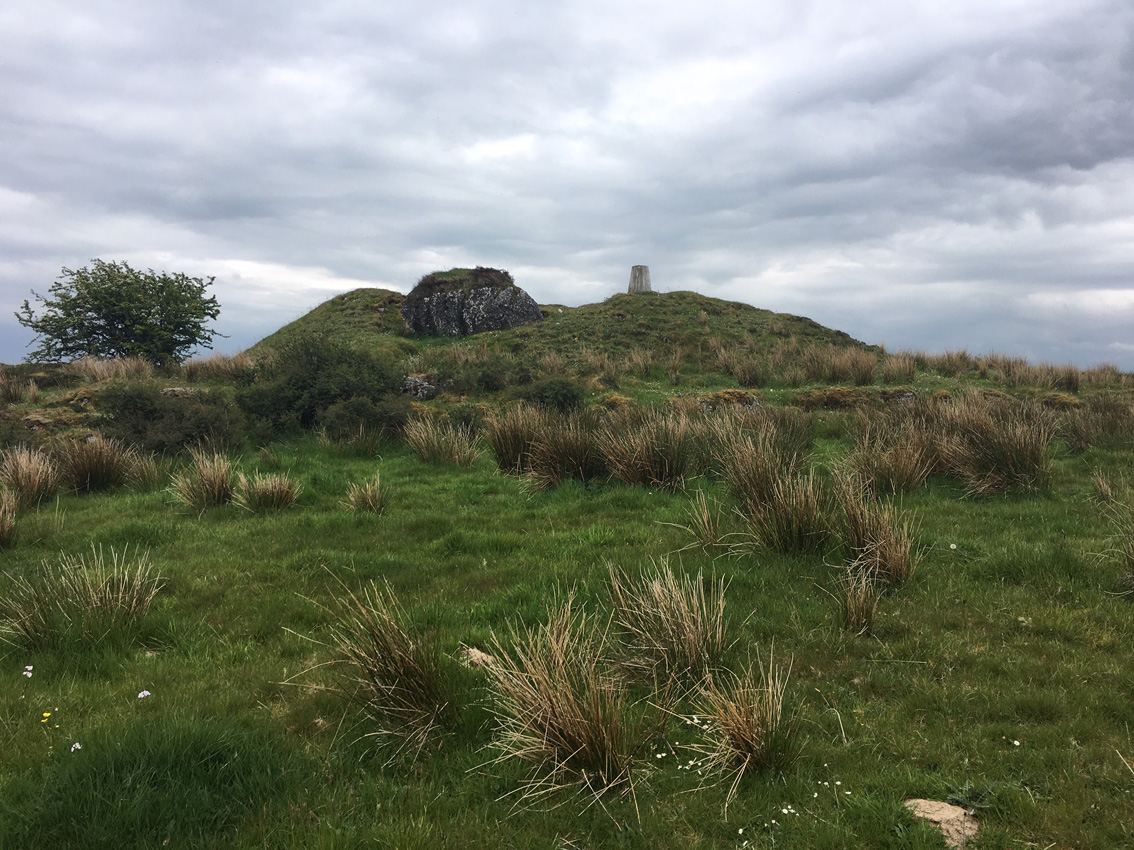
A massive erratic has been incorporated into the cairn. Before or after construction?

25 metres diameter cairn and possible passage grave.

You can see it for years, but when you finally get there you have to engage with it.


Portal, two sidestones, the backstone and the capstone. The chamber is a bit of perfection.

The pine plantation has been cut, opening the views to the north.

The back of the ‘tomb’ – a capstone that has its own peat bog.


I would have had a go at the brambles and nettles to reveal the jambstones but there was livestock in the field.

From the south. The hills to the left are the Bricklieve Mountains with Carrowkeel passage grave cemetery.


Looking east, with Lough Arrow in the distance to the left. This is taken from the back of the tomb. The closest stone is possibly a displaced roofstone or sidestone.

The Survey says: “The monument is ruined and is difficult to examine.”

Stones of the eastern chamber, with Moygara Castle in the distance.

Got here just before it gets completely overgrown for the summer.

The tomb is pretty ruined. The large stone in the foreground is a possible roofstone from one of the side-by-side chambers. The stone to its left is a court stone. Behind is one of the stones of the ante-chamber of the eastern chamber, with the western jambs to the right.

Entrance jambstones of the western gallery, looking out into the court.

The southern stone is 2 metres tall and aligned NNE-SSW on its longer axis.

The southern stone. Paulie stands on the wall of the field boundary, the northern stone just to his right.

The southern stone is 100 metres south-east of the northern stone.


The northern stone leans to the north-west. It’s 2.15 metres tall.

One of the ‘lesser’ sites in Sligo, yet still well worth a visit for its simple beauty.


The boulder is held above the burial by three stones, the one on the left here utilising a padstone to keep it level. Who was the person whose remains are still interred here? Often, caught up in the marvel of their construction, I forget that I’m visiting the graves of our ancestors.

Probably lucky to be still here, given the quarrying marks. We stayed here for a bit listening to the cuckoos and other birdsong. Magical.

Standing stone in Tawnymucklagh townland, 1.3 metres tall.

The photograph, circa 1989, in the Survey of Megalithic Tombs shows a less overgrown site.


The gallery at Tawnymucklagh can just about be made out in this shot. A sad and unloved mess.

Drumanone was satisfyingly larger than I had realised, the G man included for scale.

It’s suggested that the capstone has slipped backwards somewhat off the portals, but if so, it would have to have been way forward of it’s present position as neither of the sidestones, both now inward facing, are over a metre tall and both the portal and the doorstone are over 2 metres tall.