


Bearing in mind that one of the stones has seemingly already worked it’s way to the underground holes in the limestone, the copius quantity of packing stones seems a good idea.
Presumably the water pools that collect at the base of the stones must accelerate the dissolution of the limestone.

If you let your imagination wander slightly, you coud imagine there were once cup marks on the top of this stone (there’s a lot of them about in the vicinity). But then mebbe not.


Slowly sinking down into the hidden stream under the Gill...


Cups on the ridge of the mystery stone.
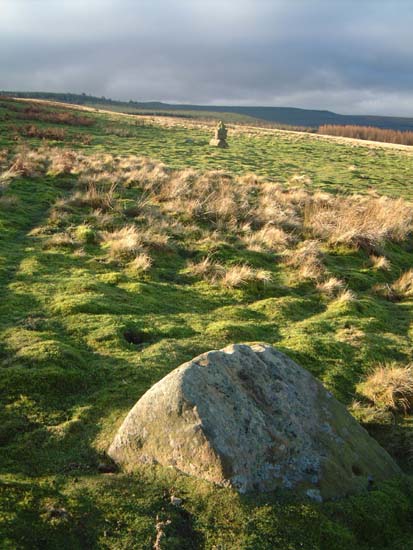
Couldn’t work out which stone this is, I’m sure it’s in the book, but there’s just so many of the things. The cups are along the ridge of the stone.
The cairn marker-thingy Fitzcoraldo mentions can be seen in the background. Look for this and you’re on the right contour.


The large cup on stone 24, showing the vista reaching as far north as Penshaw Hill on Wearside.

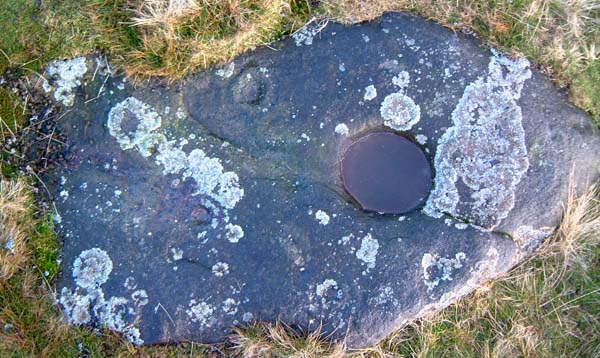


Stone 48, a whopper of a cup, the cigarette papers serve to give an idea of the size. Possibly it’s an artificially enhanced natural feature.

Cup and rings eroding through the grain of the rock.

A fairly complex motif, all alone in a place where sounds emanate from below the ground. Highly intriguing.

Taken from Homer’s Lane ancient cultivation terraces.


The Hogback Stone. Drawn in the late 19th century.

Drawn in the late 19th century.


Rabbit hole. Fresh spoor, so still occupied. Only the bunnies know what what is being disturbed here.

Nearly fallen, but looks like it’s been that way for a good while. Long enough to cause a noticeable difference between the weathering on top and that below.

Possible portable cup mark. Certainly an anomalous feature. found in nearby plantation. Could be from a cairn.


Drawn in 1903 by the brother of Northumberland antiquarian DD Dixon, who specialised in the history and folklore of Coquetdale.