


The cairns are dotted about beneath this monster of an erratic. That can’t just be by chance, can it?

There are a lot more carvings than you’d think at first glance.

I’m not sure if the top’s missed off beacuse there’s nothing there, or because it was too high to reach. either way, it’s quite a feat by Stan the Man.

Possibly the first photograph of Long Meg, 1870.


It seems in 1848 there was a wall along the track.


The eastern little cairn. The figure standing in the background is standing in the circle.

A strange pile of stones about 20m to the west of the circle, it has a mirror on the east side. There’s a lot of symmetry around these parts.



The nearest tumulus is just about visible as the bump in he background.

This is so photoshopped to compensate for bad photography, it’s got quite a bit of the ‘interpretative’ about it.
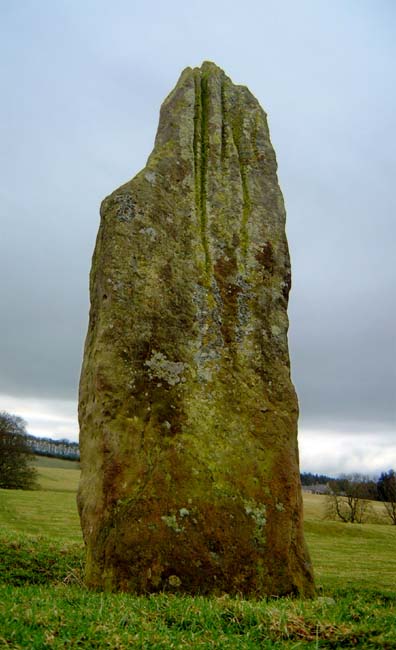
But you get the idea, it’s a slab, not a pillar.


This is the stone at the top of the field clearance strip. It has a couple of possible shallow cups on the side.


Cups, big bowl, and the name ‘Fiona’. In amongst the cairns.


The cist. Which doesn’t even vaguely resemble a football.


Barely discernable cup and ring motif. It’s not quite so faded in the real, but it’s nowhere as clear as the illustration in Bckensall’s book. That Lichen don’t half grow back fast.

Stan the Man’s rubbing, repro’d with permission.


The first couple of cairns, just off the right-hand side of the track from the Rothbury stone.

I’m starting to get hacked off with the way these stones erode on the top. It makes me see cup-marks where there probably are none.

The view from the Debdon Cairnfield just north of Rothbury, on the other side of the Coquet from Simonside.


