Houdorf

Houdorf

All posts 251-262 of 262 posts

Capeshøj

Capeshøj is the best-preserved long dolmen on Tåsinge and a significant archaeological site on South Funen, Denmark. It measures approximately 36 meters long, 7 meters wide, and nearly 1.5 meters high, and was originally encircled by 56 large kerbstones (though some are now missing). Within, it contains a narrow, rectangular burial chamber, which was once sealed with capstones, now absent. Evidence suggests a dry stone wall of red sandstone tiles existed between the kerbstones, with four stones notably bearing cup marks.

Dating to the Younger Stone Age, Capeshøj was constructed by the Funnelbeaker culture (Tragtbægerfolket) between 3400 and 3100 BC.
Its exceptional preservation is due to its discovery in 1976-1979, when it was found concealed for about 3500 years beneath a large burial mound from the Older Bronze Age (approximately 1700-1100 BC). This later mound, about 40 meters in diameter and 1.6 meters high, was built around 1500 BC on the highest point in the area, intentionally using the pre-existing long dolmen as its central feature, thereby protecting it from the elements.

Excavations within the Bronze Age mound unearthed four Bronze Age graves, yielding notable artifacts such as two bronze swords, two bronze bow fibulae, and a double button.
.Other finds included a strike-a-light stone and burned bones. Following its discovery, Capeshøj underwent restoration due to its well-preserved state, despite some kerbstones and chamber capstones having been destroyed between 1950 and 1970. The site also revealed ard traces beneath both the dolmen and the Bronze Age mound, indicating ancient agricultural activity.

The discovery of Capeshøj, hidden for millennia beneath a later burial mound, is like finding a precious time capsule. Just as a modern safe can protect valuable items from the passage of time, the Bronze Age mound acted as a protective vault, preserving the ancient dolmen and its secrets for future generations to uncover and study.

Ingers høj

Ingershøj, also known as Ingers Høj, is a prominent Bronze Age round barrow located just south of Vindeby on Tåsinge, Denmark. Standing approximately 7 meters high and 40-41 meters in diameter, it is situated on a high ridge, making it one of the largest and most magnificent ancient mounds in the Funen area.

Historically, Ingershøj was once surrounded by a large stone circle, which was removed around 150 years ago.
Although damaged by grave robbers in the 1700s, this damage was reportedly repaired. The mound has never been archaeologically investigated, so no finds are known, and its specific dating to the early Bronze Age is presumptive. It is the last surviving monument from a group of burial mounds that once signified local power. A granite postament stone for a trigonometric station was added to its summit in 1901.

Today, Ingershøj is a protected ancient monument (Fredningsnummer: 411721), fully preserved since 1937.

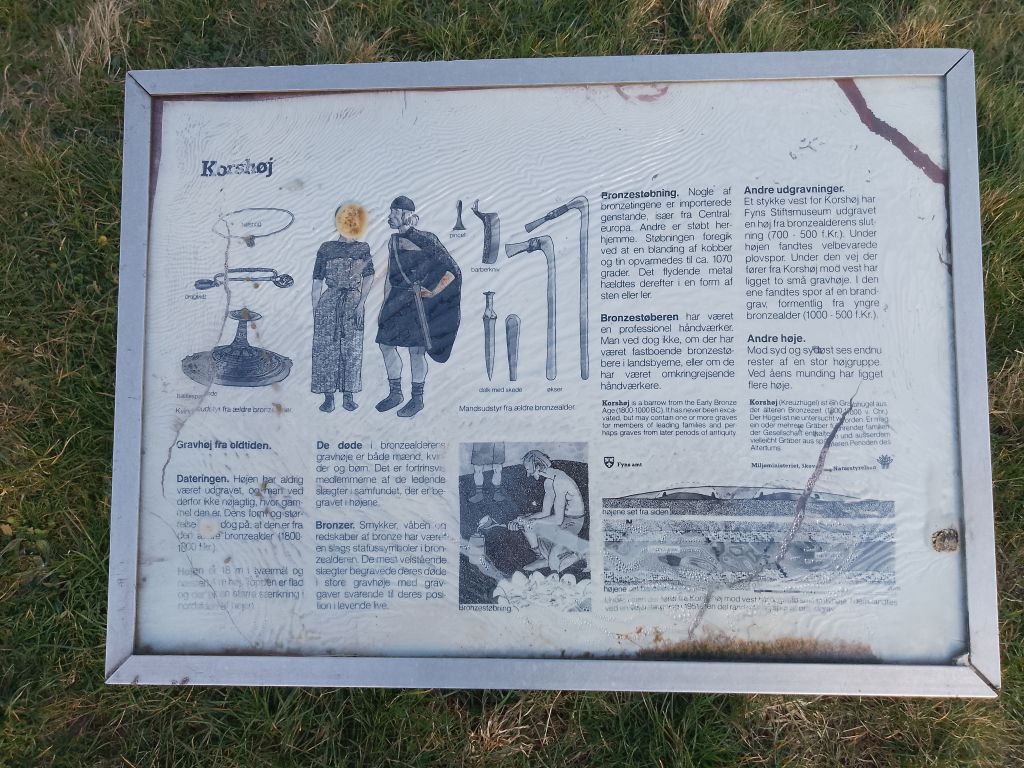
Korshøj

Artificial Mound

Korshøj is a Bronze Age burial mound in Svendborg, probably from the Bronze Age (1800-50 BC). The mound is notable for its unique location in the middle of a roundabout in Svendborg, where Højensvej, Lehnskovvej and Juulgårdsvej meet. The name “Korshøj” refers to this location in a crossroads that forms a cross. The mound has never been the subject of archaeological excavations.

The first official description of Korshøj dates from 1850, when the National Museum registered it.

The mound was protected in 1913. At the time of protection, the mound’s dimensions were stated as 3.9 meters in height and with cross-sections of 18 meters (E-W) and 21 meters (N-S). In 1983, the height was measured at 4.8 meters by the Danish Forest and Nature Agency, which described it as a monumental large mound with a distinctive location. The difference in height can possibly be explained by a lowering of the road around the mound in the 1950s.
On the north side of the mound, a stone staircase has been built, probably at the instigation of Egense Parish Municipality in the late 1940s or early 1950s.
These stairs were repaired by Svendborg Municipality in 2009.

Korshøj has historically served as a gathering place for the young people in the parish. In 1943, it caused a stir when students from the Gymnastikhøj School rode over the mound on their riding horses.
There has been some confusion with another nearby mound called Loddenhøj, which has however been ploughed down.
Korshøj is today registered with the Danish Agency for Palaces and Culture as a protected ancient monument with protection number 41171 and site and locality number 090504-19. The mound is thus a distinctive and protected element in the landscape near Svendborg.

Source:
kulturarv.dk/fundogfortidsminder/Lokalitet/8868/