Searchable database of monuments and finds in the county.

Rhiannon
Courtesy of Oxford University, a book containing lots of earlyish discussion on the horse. It includes
‘A letter to Dr. Mead concerning some antiquities in Berkshire’ by Francis Wise (1738)
and A refutation of said letter, called ‘The Impertinence and Imposture of Modern Antiquaries Displayed’.
“Diary of a Dean. Being an account of the examination of Silbury Hill, and of Various Barrows and other earthworks on the downs of North Wilts, opened and investigated in the months of July and August 1849. With Illustrations.”
How excellent that John Merewether’s book should now be available to read online, and especially at this time when the new excavations are going ahead.
The latter part of the book contains loads of information, if you can pin down the locations he’s talking about. But it might upset people of a delicate constitution as it is basically ‘speed-barrowing’, as seemed to be the fashion of the time.
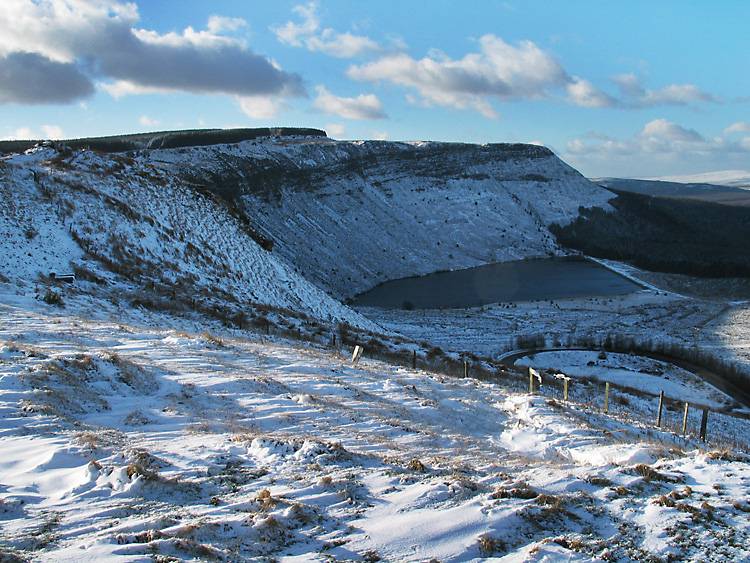
A nice snowy picture of Craig y Llyn and Llyn Fawr.
also see gtj.org.uk/en/small/item/GTJ31687/
These links show a cauldron and some ‘horse gear’ deposited in Llyn Fawr c800-600BC. The artefacts were discovered when the lake was drained during the process of turning it into an unromantic reservoir, in 1911. The finds include some of the earliest British items made of iron.
The marvellous Sacred Text Archive now provides access to “Stonehenge, A Temple Restor’d to the British Druids” by William Stukeley (1740).
A photo of Belas Knap by Alvin Langdon Coburn.
Also one at
geh.org/ar/strip27/htmlsrc/m197926680002_ful.html#topofimage
No date given, but will be sometime between the 1920s and the 1960s.
An amber bead from the Bronze Age, found on Tap O’ Noth.
Mmmm looks like a tempting caramel sweet.
LEMUR (LEarning with MUseum Resources) allows you to see online the holdings of the University of Aberdeen. This link takes you to their collection of pleasing Neolithic/Bronze Age ‘carved stone balls’, most of which were found in Aberdeenshire.
James Mackintosh Gow’s article on ‘Notes in Balquhidder: Saint Angus, curing wells, cup-marked stones, etc’, in the Proc Soc Antiq Scot, 21, 1886-7.
Masses more on the church, skull, well and parish here, in an article by Kemmis Buckley (“MBE, DL, MA”).
Vast amounts of information about the mines (some of which relates to the prehistoric).
‘EXTREME Archaeology’ at Parys Mountain – a television programme with the ubiquitous Alice Roberts. Includes reports, photos, and various ‘video fly throughs’. Focuses on exploration of the prehistoric parts of the mines.
In 1788, a former vicar of the area, William Crowe, published a long poem about walking up the hill on a May morning. Naturally, it was entitled “Lewesdon Hill”. It was widely praised at the time – even Wordsworth, who lived near the hill at one time, approved.
Volume 3 (1852) of the Norfolk Archaeological society journal.
Page one of this book is a letter about the discovery of the grave and its jewellery. On the previous page is a drawing very reminiscent of the Bush Barrow finds?
Here’s the RCAHMS entry for the stone, Fitz. It’s not much more detailed than your own observations, but it does say that a chap called Wyness took a photo of it in the 1960s at c.NJ938060, where it was before being ‘built into the niche at the rear of Messrs. Watt and Grant’s building’ where you saw it. That can’t be far away though, because the street would hardly be called ‘Langstane Place’ otherwise? He thinks it was part of a stone circle, but RCAHMS are hedging their bets. It is apparently marked on a plan of Aberdeen by Paterson from 1746.
(F Wyness, ‘City by the grey North Sea: Aberdeen’, p280 and 292 – 1965).
A dozing horse from the past at Avebury, next to a very large stone, which Pete G tells me is the Devil’s Chair (stone 98).
Photo taken by the eminent Alvin Langdon Coburn.
A number of photos taken in the first half of the 20th century by Alvin Langdon Coburn (they are about half-way down the list).
Ty Newydd without its preposterous brick additions, taken by Alvin Langdon Coburn.
The stones look in pretty much the same places. It makes you feel (from afar at least) that the bricks are sheer paranoia. But the capstone is broken?
Photo by Alvin Langdon Coburn: interestingly, of the barrow in its pre-restored state.
Another at
geh.org/ar/strip27/htmlsrc/m197926730002_ful.html#topofimage
and scroll down on this ‘Clonehenge’ page for another pre-’restored’ photo, which purports to be of WKLB too.
replicahenge.wordpress.com/tag/pete-glastonbury/
Photo taken by Alvin Langdon Coburn.
Photos taken by Alvin Langdon Coburn, apparently during excavations:
geh.org/ar/strip27/htmlsrc/m197926660003_ful.html#topofimage
geh.org/ar/strip27/htmlsrc/m197926660004_ful.html#topofimage
“Scenes and Stories Little Known – Chiefly in North Wales” is now available to read online. It seems that it wasn’t written by the vicar, but his wife(?), Margaret Butler Clough. What’s more, the stories are in verse. The profits went to the Repairing Fund for Bistre church, you’ll be pleased to hear. The relevant chapter is called “The Field of the Golden Corselet” in which she describes “A mist-robed form stood with imperial mien” of which none saw the face, and “sometimes low sweet music stole around.”
Interestingly, in the notes to the poem, she says:
An old man, commonly called “old Hugh of the Pentre,” used to tell children so about 25 years ago. He called the appearance “Brenhin yr Allt,” literally the Ancient King.
- this adds weight to the idea that the story existed before the discovery of the cape? Though the sightings in the verses do not actually mention a gold cape, the hay field was “ever called the Field of Gold” (according to the poem, at least).
The bones found were said to be “those of a man of great stature, and the skull of gigantic proportions; but they crumbled almost immediately to dust.” MBC connects this with stories of “Benlli Gawr, or the Giant, [who] lived at Mold, then called Wydd Grug, in the 5th century. He was lord of an extensive district around, and had a camp or fortress on Moel Benlli.”
The owners of Rosemerryn currently offer bed and breakfast, and a self-catering cottage. On visiting the fogou, their website says:
We would like guests staying at Rosemerryn to feel free to explore the Fogou as often and whenever they wish, and ask only that people are respectful of the site and considerate of each other. We would be grateful if non-resident visitors could phone in advance to arrange a convenient time to visit the site.
Tel: 01736 810530

A photo of Wilbury Hill (the scheduled area of the fort is actually just behind these trees).
The St Piran Trust is “a non-profit-making charitable Trust which is committed to the development, protection and good administration of the historic sites on Gear Sands connected with St Piran” – and that includes looking after St Perran’s Round. This page contains lots of information on the site’s use over the last few centuries.
Drawing of a Stone-With-A-Hole in the main Rollrights circle, through which can be spied the Whispering Knights.

A computer generated view of the landscape you can see from Mither Tap.
An long PSAS article from the 1920s about Broomend of Crichie – it includes a rather nice map of adjacent stones.
“The Balvarran Cupped Stone, the ‘Bloody Stone’ of Dunfallandy, and a Cup-marked Stone in Glen Brerachan ” -an article in the 1920/21 volume of the Proceedings of the Society of Antiquaries of Scotland.
Archive photos of Dartmoor.
Aerial view of the fort.
Notice of the discovery of cup- and ring-sculpturings at Duncrosk [sic], near the falls of Lochay, in Glenlochay. By D Haggart, Killin.
Proceedings of the Society of Antiquaries of Scotland
Volume 29 (1894-95) p92-3.
‘A record of the cup-and-ring-markings in the Stewartry of Kirkcudbright. By Fred R. Coles’ in Proceedings of the Society of Antiquaries of Scotland, Volume 29 (1894-95).
Descriptions and diagrams of the groups of carvings at:
Balmae
Knockshinnie
Torrs
Grange
Milton
Galtway and High Banks
Castle Creavie and Bombie
Little Stockerton
Nether Linkens
Newlaw Burn
Senwick
Anwoth
and Hills Stone-Circle
Aerial photograph of the cairn.
These super little beads were made from natural stone discs found on the shore below, drilled in Mesolithic times. Nab Head was an important Mesolithic seasonal camp.
This link
books.google.co.uk/books?id=v4Lh0xxgVtoC&pg=PA15&dq=%22nab+head%22&lr=&as_brr=3&sig=dCLlaDyGuvSqNp6w-KmTZ8AJ5RE#PPA13,M1
shows another carved shale artefact – its discoverer, J P Gordon-Williams described it as a ‘Duck Head’ but this was probably to cover for its obviously phallic appearance. Though it’s also been interpreted as a stylised Venus figurine.. but let’s face it, men have been scrawling knobs on things for millennia. Does it have to have more significance than that?
Excavations at this cave provided evidence of the earliest known people in Wales, who lived there about 230,000 years ago.
A couple of photographs of finds from the tomb’s excavation (it was only discovered in the 1970s). One is the oldest dated musical instrument from Wales – a flute made from a sheepbone; the other is a human rib bone damaged by an arrow – nasty.
Facts and figures courtesy of Archsearch and the South Gloucestershire SMR.
Facts and figures from the South Gloucestershire SMR.
Searchable database of the NMAS holdings – many of the artefacts have photos, and more are being added “as quickly as possible”. As an example, here is an axe made at Grimes Graves:
culturalmodes.norfolk.gov.uk/projects/nmaspub5.asp?page=item&itemId=NWHCM%20:%201906.28.3%20:%20A
‘The Dover Bronze Age Boat’, said to be the world’s oldest known sea-going boat.
Explanations, photos and diagrams of how the boat was constructed, how it was excavated, and how it was conserved. Basic but nice. Perhaps a trip to the museum to see the boat in person is in order..
Clive Ruggles’s photographic walkabout of the Beaghmore complex.
Clive Ruggles’s photographic walkabout at Avebury (includes resident sheep). You can imagine you’re walking from the Sanctuary down to the circle (amongst other directions).
Information and image of the fort.
Information and photos of the site. The remains of a medieval castle lie inside the remains of the hill fort.
Joseph Turner’s painting of the hill, from 1807.
The hill is skirted by the ancient trackway, the Pilgrim’s Way, and is above its crossing point of the River Wey.
An Account of some Remains of Antiquity In the Island of Lewis, one of the Hebrides. In a letter from Colin M’Kenzie, Esq to John M’Kenzie, Esq;
From Archaeologica Scotica: transactions of the Society of Antiquaries of Scotland
Volume 1 (1792)
Another article by Leeds: “Further Excavations in Barrow Hills Field, Radley, Berks” with map and diagrams. What a straight line those ‘barrows’ made! Mr Leeds has a rather readable style compared to many report writers (despite the kind of dry subject matter). From volume III (1938).
“The Excavation of Cherbury Camp, 1939 – an interim report” by J S P Bradford. From Oxoniensia volume V.