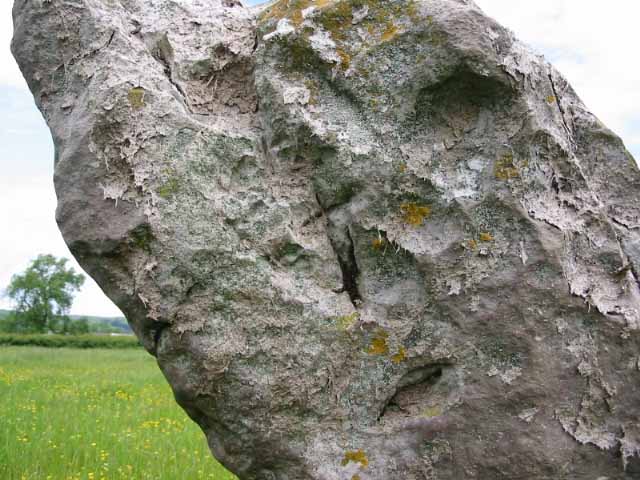
07/06. To the right of the barrow are Hawks Low, middle distance and Moat Low beyond that on the far horizon.

06/06. Three barrows on Calton Pastures, from the Moatless Plantation.
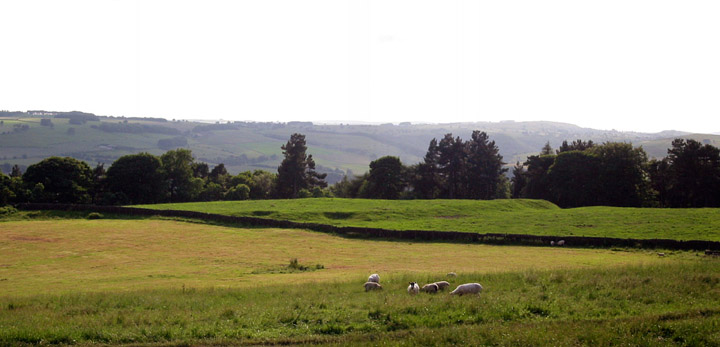

04/06. The barrow with the familiar landmark of Minninglow’s beech trees behind.


03/04. Looking across the barrows ruined cist to the nearby Roystone Rocks Barrow.

04/06. Low barrow just visible in the trees, nothing shows above ground of the massive limestone kerb that surround(ed/s) it.


04/06. When first noted the kerbstones formed a complete circle. Today this section of stones, along NW edge, are the most prominent part of the barrow. Other stones can be found with some poking around.


05/06. In his book ‘Walks in the Ancient Peak’ Robert Harris notes two standing stones aligned with the barrow. The stones are in the field west of Boars Low on the opposite side of the A515.
Not convinced myself like....
A 3rd stone can be seen in the distance (top left) but is not mentioned by Harris.


03/06. The barrow with the tree topped hill of Aleck Low in the distance.


02/06. Low rake sunlight and bare trees provide a rare opportunity to see the carvings around the central cup and ring motif. Note incised lines too in centre left of photo.


01/06. Excellent cist on Swine Sty overlooking the Bar Brook.

01/06. This upright stone near the cairns centre is suggested to be the possible remains of a small cist.


01/06. Looking across the barrow, at SK275 754, to the Barbrook I stone circle (stones marked by red dots). The barrow is sited below the crest and isn’t visible from the stone circles.

01/06. The largest of the Swine Sty barrows. SK275 754.


“I have no scruple to affirm it is the most magnificent mausoleum in the world, without excepting the Egyptian pyramids.”
William Stukeley.

Antiquities of England and Walesby Francis Grose (1783).

Antiquities of England and Wales by Francis Grose (1783).
“Now it’s time to look at your work in the gallery.”

From Antiquities of England and Wales by Francis Grose (1783).
This rather rough looking sketch was drawn before that fateful night in 1815.

Published in Antiquities of England and Wales by F. Gorse (1783).

“Unlike most monuments of the same high antiquity, it remains, in all probability, as originally constructed. It was described two hundred and fifty years ago by the antiquary Stow, and the description is as nearly exact as any that we could write at the present hour.”
(Charles Knight: Old England)

“That marked a is singular in its rugged-ness. The stone b inclines towards the north, and its present position is supposed to be its original one: in its general appearance of bending forward, it is not unlike the single stone in the avenue at Stonehenge. The stone c differs greatly from the others, in being square and massive. The largest stone, d, is prostrate; it is fifteen feet and a half in length. The engraving represents not the circular arrangement, but remarkable separate stones, of which e is at a considerable distance from either of the circles.”
(Charles Knight: Old England)

“In the neighbourhood of Lambourn, in Berkshire, are many barrows, and amongst them is found the cromlech called Wayland Smith.”
(Charles Knight: Old England)

“Near Liskeard, in Cornwall, in the parish of St. Clear, is a cromlech called Trevethy Stone, Trevedi being said to signify in the British language a place of graves”
Charles Knight: Old England.

Public release photograph showing the carving of the stag and other figures in the Church Hole Cave.


Like the henge at Arbor Low, the Bull Ring too has a barrow to the SW of the earthworks.