


As we approached Loughcrew, we wondered about getting the key, as advised in the many books we had read. However, when we got to the car park there was a note saying that guides were up on the hill and to come up and join them. So we did!
There were a group of 5 people head of us so we spent the first 30 minutes looking around the satellite sites and stones & taking some photos. We then approached one of the guides, a really lovely man called George Knight, and spent a good 15 minutes with him, chatting about the sites and asking him about access to Patrickstown. He was so enthusiastic about Loughcrew and had many, many theories about the site that I could’ve talked with him all day. However, we still hadn’t been inside the pasage tomb and he was due to take 4 other people in, so we joined them.
Bugger me, that is one impressive place! I thought Vicky was going to pass out with excitement at one point, the whole place is just so awe-inspiring. My head hurt when we tried to think of the science and maths which must’ve gone into working out all of the alignments. I get that tingly feeling all the time when visiting ancient sites but this was ridiculous! We were like love-struck teenagers!
George spent a good 20 minutes describing the alignments and the way that the sun floods the chamber on the winter solstice. He also talked about the theories he has about the alignment of other passage graves within the area. Other than the light from his torch, it was dark inside the tomb, so we were just pointing and clicking with our cameras, some of the pictures were incredible, others less so; though I really don’t think photos can do this place justice.
If you only have time to visit one place in Ireland, I would suggest you go for this one. It is incredible.
A word of warning. The approach to this beautiful wedge tomb is short but very, very steep! My knee almost gave out but I perservered and I am glad I did because it is well worth it. Although in a ruinous state, it is set amongst some lovely woodland and there is still plenty to see. Andy explained that local youths tend to use this area for partying and car burning but it seems to have survived this latest onslaught.
Again, the views must have been spectacular when it was first built; if you remove the planted forest, you would look straight over what is now Dublin and across to the sea.
Ballybrack is siutated on the beautifully named Cromlech Fields. Someone obviously thought long and hard about that one! It isn’t fields at all, but a council estate just outside Dublin, but never mind.
Having recently visited Hully Hill near Edinburgh, when Andy suggested we visit this site, we both jumped at the chance. It is so unusual to see prehistoric monuments surviving the onslaught of the 20th/21st centrury, that I am always somehow lifted by these sites. Yes, they are shown little respect and are often mis-treated, but they do still exist.
There was broken glass and crisp packets strewn all over but the stones retained some beautiful markings and at least they hadn’t been too badly damaged over the years.
This was our final site on a very short but packed evening in the lovely Ryaner’s company and it seemed fitting to leave him at this site and head back onto the motorway and back into Co. Meath.
This was Vicky’s favourite site of the day. I must admit, the journey up there did help; having to risk the electric fence (switched off!) and the hounds howling in the distance made for an exhilirating few minutes..... and then, when we saw the huge capstone before us, in amongst the gorse, it was incredible. Vicky spotted a fox, running into the gorse which made things even more fantastic!
Having been at Browne’s Hill a couple of hours earlier and being slightly disappointed by the atmosphere of the place, this was just perfect. I like having to make an effort to see a site and the fact that this beautiful portal tomb is siutated in what feels like a wilder, unvisited landscape made the whole thing seem that much more impressive. The capstone is massive and has a “head”, almost serpent-like. Andy said that it has been described as sphynx-like and I really could see the connection.
We explored for a good while and then Andy took us over to some stones which he believed had some markings on them. It was bit of a hairy climb up, trying to get all three of us balanced on the stones below but when Andy pointed out the stone in question, it was worth it. A definite pattern of chevrons was carved into the rock edge and continued on the other side. It was pertty hard to see because of the way the rocks have been dumped by land clearance but it was definitely there.
This is an awe-inspiring place; once again I had to wonder at the ingenuity (or madness) of the people who engineered the massive capstone into place on the dolmen and the fact that it is still intact.


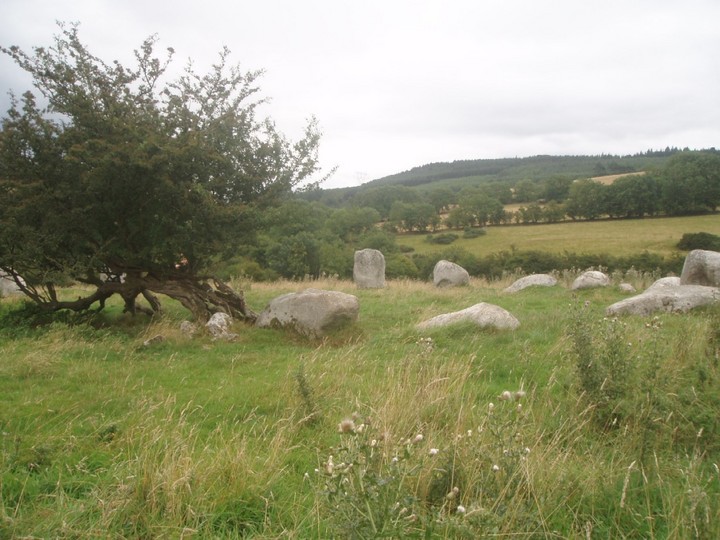
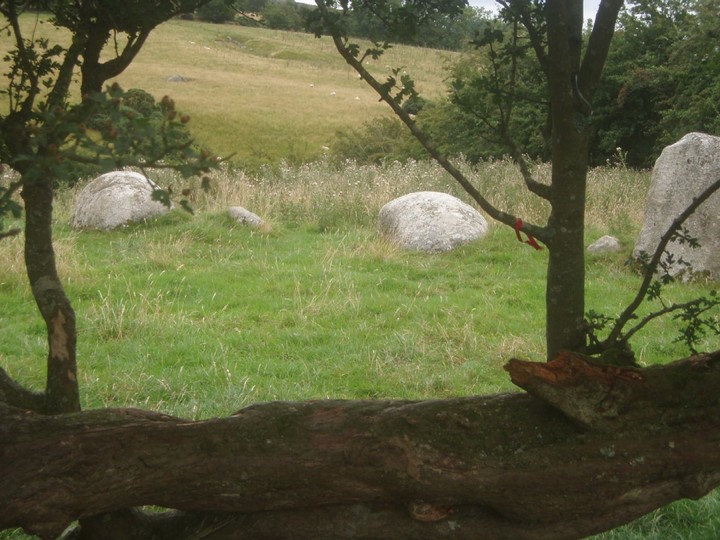
Another arty shot looking through the tree towards the stones.

Me trying out an arty shot from across the top of the largest stone. Not sure it worked!
This was our next stop after Athgreany circle and was just as spectacular. Again, it is signed from the main road and there is a wee parking space by the gateway.
I loved the 2 great hulking quartz stones, surrounded by smaller granite ones (my knowledge of geology isn’t great, so feel free to correct me at any time) but had to wonder at the discarded stones behind a tree; one had been drilled so accurately across that it had broken in two.
Again, this is quite a small and very round circle, set amidst the most stunning of locations. Some of the stones were incredibley weathered, where others have survived the last 4 milleniums quite well.
You can just about make out the inscription marks on this stone, which is rather weirdly placed within a green in the middleof the village and stands alongside a statue of the Virgin Mary!
After the disappointment of not being able to get close to either the Punchestown Stone nor the Craddockstown Stone, we arrived here fairly down-hearted. We pulled onto the side of the road by the sign for the circle and headed up the hill.
When we reached the top of the incline, our mood immediately lifted when we saw the most beautiful circle in front of us. This is a very round circle and reminded me of Glenquickan in Scotland, both in size (although the stones here are much bigger) and the location.
There was a family already there, father and 3 kids and I noiticed that he had Burl’s guide with him. We started chatting and he explained that he had been helping a friend excavate the site on the day the picture for Burl’s book was taken. This was the first time he had been back to the site and he was trying to work out the postion of the photo. After 30 minutes of chatting, he recommended other sites for us to visit in the area and the combination of the stones and the kindness of strangers made our disappointing morning a distant memory.
I think that this was my favourite of the sites we visited on Sunday with Ryaner. Maybe it was the rather hilarious walk, with all 3 of us stumbling and getting caught on bits of dead tree at some point (and me almost falling into the smallest ditch imaginable) but it is more likely the absolutely magical setting of the stones.
Andy’s previous visit was still in evidence and the bracken was quite low, revealing the most beautiful stones. Some of them were almost completely covered in moss and lichen but they still looked amazing. Vicky and I had a good wander around the outside to see if there was an outlier but there doesn’t seem to be anything else in the woods linked to this site.
Andy pointed out and named the hills surrounding the site (which I have now forgotten!) and you can imagine the views from here before the forest was planted up. Fantastic! On the way back down, he noticed a stone amongst a pile of broken wood which could very easily be one of the missing stones; same size and weathering.
Oddly, there were 3 cider drinking Scandinavians sat in the centre of the circle which was pretty unusual because it isn’t the kind of place a causal observer would stumble on and they didn’t actually seem that interested in the circle itself, just their Bulmers! Made photographing the circle a bit hard but nothing could ruin the absolute magic of this place.
We passed by here on our way from Hully Hill to Glenhead Stone Row (we took the scenic route!)
We parked in the handy lay-by but couldn’t find a way into the field. The double row barbed wire fence was more than off-putting and there was no gateway evident, so we had to make do with gazing upon it from the roadside (not ideal)
The large stone looked magnificent and reminded us of some of the Machrie stones, weathered and lined with age......and I do like a stone with a hole in it!
Tried to get some pix but nothing worth posting here came out. It would seem sensible to have a stile to allow people into the field. I guess some farmers just aren’t as open to having folks traipsing around their land as others. Shame.
I like the idea that this stone was used as a marker for travellers who arrived by sea... an early lighthouse, perhaps?
Mind you, this theory doesn’t follow if it was indeed part of a larger complex.
After the disappointment of not being able to get close the to stone row, due to HUGE crops in the field, this beauty more than made up for it!
We followed the path down towards the farm, taking the right turn up a scrubby, nettle-filled pathway. Negotiating our way past copious nettle plants and bitey insects wasn’t fun (it was boiling hot and we weren’t exactly dressed for the jungle!) but when Vicky pointed out the stone through the trees on the left, I got that familiar tingle and felt more than pleased that we had come here.
We turned left at the end of the short path and walked a few yards along the edge of the field – the stone was almost hidden amongst the wild plants and flowers and glowed a wonderful white in the evening sun. In fact, it looked so white that I wondered for a moment whether it was actually real! It looked like it was made out of chalk or plaster.
It is a shame that the metal post is so visible but this stone is really rather beautiful and suits being set amongst the cool, green foliage. A cracker!

An almost magical setting (if you don’t mind biting insects and nettles!)
July 2006

The stone was hard to see in amongst the trees and shrubs
When we arrived it was late afternoon and the sun was still shining and the sky was still a dazzling blue. Excellent photo weather!
However, the field was in full crop and there was no way of getting to the stones. We could just about see the tips of the larger two sticking out over the top of the crop! Vicky had visited about 3 weeks earlier and had presumed the rape seed would’ve been harvested by now but sadly, it hadn’t been. Ah well!
There were quite a few people at the SAS monument but no-one even seemed aware of the fact that there was an even more beautiful and historic monument just a few hundred yards behind them!
I would advise that you visit in early srping or late autumn to avoid disappointment.
Parking is easy, room for a few cars and when we arrived there were about 10 cyclists all parked up too. Access is up a set of stone steps and then a walk up to the site so could be difficult for some. We headed straight for the Nissan hut, wanting to ask the guide whether Galabraes was linked to the site but she didn’t know. However, she was incredibly friendly and more than happy to talk us through the site itself.
Upon entering the cairn, the first thing I noticed was the smell; it was boiling hot outside but as I started climbing down, the smell of damp, dank earth hit me and the coolness of the enclosed chamber was startling. The damp air obviously had it’s effect on the stones, which were bright green in places; so green in fact, that I initially thought it had been painted on for effect!
It is hard to explain just how wonderful it is to see the stones in this way. Although you are surrounded by a fairly modern building, you can forget about that as you see the stones in the half-light and with the smell of the damp earth around you. Most burial chambers are now exposed (certainly the ones I’ve visited) and this just felt more real, somehow. Although the site was fairly busy, we were alone down there for a good 15 minutes. When we came back out, the heat and light was a bit of a shock. I took a 360 degree video from the top of the cairn, taking in the amazing landscape; as Vicky said, it felt like we in the middle of a bowl of hills, and the volcanic ridges to the east looked incredible. It’s not hard to see why Cairnpapple was built in such a place.
The post holes which are exposed on the east side fo the site are huge. You have to wonder at the size of the trees which once filled them and the energy it would have taken to get them there.
The huge mast really didn’t bother me too much, the whole place has such an amazing feel to it that it would take something really monumental to have a negative impace.
Am not sure whether the nearby industrial estate has just grown so much that the directions given by others are now obselete but I would suggest that anyone who wishes to witness just how much of the modern world has engulfed this site follow these simple directions.
Come off the roundabout by the petrol station and take the first left turn into the industrial estate. Take first right turn onto Chariot Way (I kid you not). Next right turn in Hully Hill Road; park along here and make your way towards to the tree lined area across the road. (You can actually see the smallest of the stones if you look to your right as you drive past the petrol station) Then, sit and wait 5 minutes for the first plane to fly overhead, so low that you think it may land on the cairn itself!

Not necessarily within the remit of TMA, I know, but lying on top of Hully Hill, this is how close the planes come in above your head. Sad...
July 2006

Yet another plane approaches Edinburgh airport direclty over the cairn,
July 2006

I’m really not sure you could see a more hideous juxtaposition of cultures.....the McHully stone.
July 2006


One of the saddest sights/sites I have ever seen (hence the odd face!)
July 2006


Vicky screamed and ran round the field when I pointed out the faces on this stone!


The mist and rain adds atmosphere but doesn’t make for easy photography.....
July 2006


