
One of a number of signs outside houses as you approach the henges.
March 2007

One of a number of signs outside houses as you approach the henges.
March 2007
We left it a bit late to look for this stone and it was dusk as we hit the the gardens. After looking at a couple of big stones by bins (“surely they wouldn’t put it be a bin?” we hoped) we spotted it in a line of stones along the path on the right hand side as you approach the museum.
It is strange in that there is NOTHING to alert you to its presence or where it is from (this is a museum garden, after all) – it is as if they don’t even realise it is there. It seems just stuck in with a load of other path-lining rocks. Strange.
The light wasn’t good enough to get any decent shots but it was lovely to see, after being fed a diet of Romans and Vikings all day!
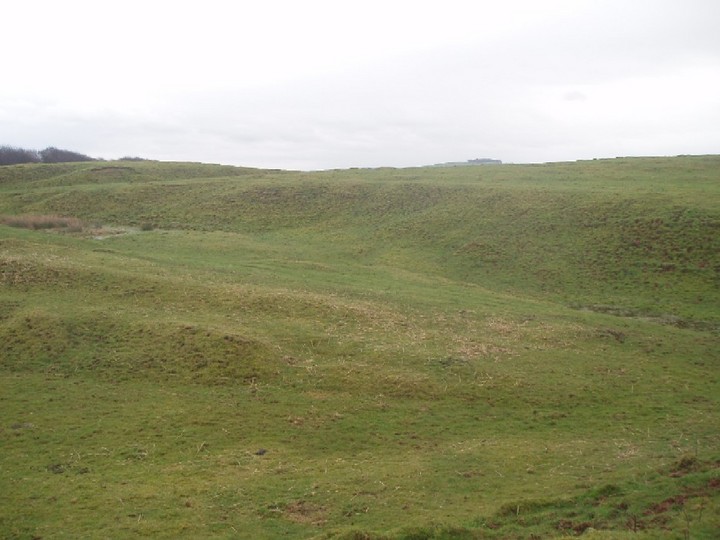
The banks are really quite deep; it seems too much trouble to go to if it was just the remains of the quarried land.
Feb 07

Looking towards the earthworks – Gib Hill is beyong the trees in the background
Feb 07

Looking towards the larger “unfinished henge” – there seems to be a banked pathway which connects the sites. Whether this is modern or not, I have no idea.
Feb 07
Camped in the field next to these last night and took the opportunity to have a good look around. Am now more confused than ever! They do look positively henge-like as you approach but there doesn’t seem to be any continuity and nothing is “finished off” Also, there is evidence of quarrying and there are a couple of large holes (now lovely – but very deep – ponds with ducks a plenty)
If these are the residue of quarrying then it seems that they would be less stylised to me. Also, someone would know because the quarrying would’ve been done in the last couple of hundred years, so there would be records, surely? BUT......why so many half henges???? Agh, it is frustrating. I’ll post some pix and see what you all think
It’s HUGE!!!!
But.....is it a long barrow????? We had just spent the morning at an archaeology conference in Penrith and had been told in no uncertain terms that there aren’t any long barrows in Cumbria. As we had spotted this site on a previous outing last year (as we were on the road to Moor Divock from the Clifton stones) and had promised ourselves a return trip, we felt that today was the day. Could we prove the archaeo bod wrong?
As Dom quite rightly pointed out, its situation is perfect for a LB, on a slight rise and highly visible from all directions. But....if it really is a LB then it should be famous and have a visitor centre because it is absolutely massive!!
We went into the field alongside it and it must measure at least 100m. It ticks most of the boxes but it just seems impossible that such a huge structure could’ve gone un-noticed by so many folks for so long.
So, maybe that guy from Cumbria Archaeology unit was right and there aren’t any LBs in Cumbria afterall?
The planned M6/Heysham road link will run straight through the small village of Torrisholme, causing major disruption to the residents and will pass a few hundred metres from Torrishome Barrow.
The County Council’s planning application admits that there will be “moderate to slight adverse effects” upon the site and that there will increased visual and noise disprution. The heart of village will be cut in 2 and houses which once looked out over green fields will have a 4 lane highway passing by their bedroom windows.
As the road passes through the village (and cuts straight through the grounds of the College where I work) it will be raised above the current road level, thus impacting upon the views from the top of the Barrow which allow a 360 degree view of the area, across to Lancaster and Morecambe Bay.
Locally, few people believe that this monster road will benefit the local area, our MP (Labour) has called it a “white elephant” and the impact it will have upon the life of the residents and the local FE College will be huge.
We have few prehistoric sites of note in this area as it is (the Romans were busy round here!) and the Barrow isn’t particularly renowned but this is just another example of big business and government thinking the “little people” don’t count. There is huge opposition to the road locally as we all know it is LOCAL traffic which causes the problems and this link will not ease any of this.
Local campaigners have set up a lobbying group – details can be found here: heyshamm6link.info/

Dec 06
They are deemed to be “natural” but I honestly believe some manipulation must’ve taken place as they are so perfectly placed.

I found it hard to photograph all 3 stones but you can see how intervisible they are Dec 06


My 2nd attempt to find these stones was fortunately successful; Vicky and I tried around a month ago but the OS map was slightly out and we spent an hour wandering around the woods in the rain geting more and more frustrated.
The easiest way to find them is to park by the picnic benches at the bottom of the public footpath. This is a steep path initially, and very slippy underfoot in the rain so beware, but levels out after about 10 minutes. Just as you start dropping down there is a gate on the right hand side with a map giving directions to “the rocking stones” There were bullocks in the field but they didn’t seem very interested in us and when we finally came across the stones, it felt like we were totally alone in this most beautiful of landscapes.
I would definitely recommend visiting in late autumn when the trees have lost their leaves and you can see the whole landscape, it is stunningly beautiful. When you first approach the stones they seem much smaller than they appear in the pictures on here but when you get up close they seem to grow in stature. Lovely.

This stone has a lovely circular pattern on it which appears natural.
Nov 06
Bloody hell, it was windy! We nearly got blown off the hill when we reached the Broch and Mark gave me one of ‘those’ looks which I took to mean, “never again will I follow you up a hill in a force 8 gale”. Oh well.
Easy to find, with a brown tourist sign pointing you in the right direction. The visitor centre is closed in winter though, although the toilets remain open all year round (very obliging folk, the Hebrideans)
This was my first broch and to say it is impressive is an understatement. When I visited Newgrange I was blown away by the corbelled ceiling and here I was equally amazed at the skill and ingenuity of the people who built this. Incredible.


Nov 06
All of the stones round here seem to be covered by this amazing lichen.
I have driven past this stone on previous visits to Harris but this was the first time I got to see it up close and personal. There is a sign on the road for parking, with a bench by it. Park here and then make your way across the beach and up the sandy headland...it initally looks closer than it is and with the wind howling around us we were knackered by the time we reached the stone. But it was worth it. The views across to Taransay were amazing and the stone is another of those skinny Hebridean ones which shouldn’t still be still be standing after all of these years.
My second visit to this site in 3 years and the most striking difference is that the landscape in November is even more extreme. The peatland is now a glorious rust colour and the hills are covered in low cloud. This time I did the walk between the 3 sites alone and it felt exhilirating. I saw no one else the whole time and other than wondering whether I was about to be consumed by a peat bog at one piont, the whole experience was spine tingling.
I stood at the stones and kept looking around me, surrounded by the stones of Callanish on all sides and with Cailleach na Mointeach on the horizon; it really is the most incredible of places.


The stones on Lewis are so thin you wonder how they have survived the years.

This stone reminds me of one of those foam pointing hands you get at baseball games!
It has been closed every time I’ve tried to visit! Anyone else had better luck?


At last, at last!
Embarrassingly, this was my 4th attempt to find this circle and I set out today in the knowledge that this time I absolutley KNEW where it was. In the past I have parked at Bent Lane but today I continued past for another 1/2 mile or so up the hill until I came to the next public footpath on the left and parked here.
The footpath is really very stoney and uneven so not suitable for those with mobility problems, or pushchairs. When I hit the 5th field boundary, I stood on the gate and spotted the circle; it is tiny so quite easy to miss. Then I spotted the bull....bugger!
There was no way I was going home without getting closer than this, so I hopped over the drystone wall into the adjacent field and walked down the very steep and uneven hill until I was level with the circle. I then had to contend with some of the most belligerent sheep I have come across but finally made it to the circle, keeping my eye on the top end of the field where the bull was residing. It was then I remembered I was wearing a cerise pink top and started wondering whether bulls react to pink in the same way they react to red!
What a beauty! Similar in size to the 9 Ladies on Stanton Moor but with the added bonus of the most spectacular views over the Lune Valley and sitting on it’s own tiny platform, this is just the most perfect of circles. I wish I could’ve stayed longer but I didn’t want to push my luck with the livestock and so took a few pix and a video then headed back up the VERY STEEP hill. Knackering but worth it!


We were taken to Knowth first as part of our “Newgrange Experience” and although the site was amazing, the whole tour side of it was slightly disappointing. Our guide just seemed really, really bored, which I can appreciate when you have to give the same talk 6 times a day to groups of barely interested tourists.... Our group consisted of a large number of people who didn’t really speak English, so the whole thing was just odd. However, I would’ve thought that having 2 excited, squealing women, who were obviously REALLY INTERESTED may have offered a bit of a challenge to him, but it wasn’t to be.
I loved the whole layout of Knowth with the excavated satellite tombs exposed so we could have a good old nosey at them. I also liked the fact that they had made an effort with re-erecting the timber circle but I was more than a little hacked off at the extent of what we got to see inside the tomb.
I did like the exposed wall, showing the depth of the tomb and the layers of construction (I think I am turning into a bloke, I am becoming more fascinated by engineering and construction!!)
I tried to engage the guide in some conversation, hoping he would suddenly become animated and tell us lots of amazing things, but he didn’t. Oh well, you can but try.
The carved kerb stones really were amazing to behold though.

Looking down on the kerbstone, there is no decoration at all on the back and it is much smaller than it seems from the front.

What a beautiful stone, hard to photograph though, due to the hordes of folks! This was my 5th attempt; the first time someone hadn’t just wandered into the shot!
We were luckier at Newgrange with our guide than we had been at Knowth. He was far more interested and interesting, even though he had such a short amount of time to “talk the talk”.
I had been so thoroughly warned about the commercialism of this site that I turned up expecting to be disappointed; a great idea, as it turns out, because it was actually less Disneyfied than I had imagined and I had a great time!
We really didn’t have enough time to walk around the outside of the site though and our photos felt rushed rather than thought out – I think we just pointed and clicked, hoping we could get it all in! That evening, when I read about the site I realised that we had missed loads of interesting stuff. Ah well, good excuse for a return visit.
At Loughcrew I felt quite emotional, seeing inside the passage and into the chamber. A similar thing happened here but it was the roof which took my breath away. I just kept staring up at it, unable to comprehend the incredible feat of engineering I was witnessing. I’m not sure about the facade of the tomb, whether the quartz was indeed used as a covering, although it seems as plausible as using gypsum to cover sites. I liked the idea of it being used as a ceremonial walkway though.
All in all, I was mightily impressed with Newgrange and I have to say that, if you have to have a visitor centre, then have one like this! It was very sympathetically designed and the interpretative centre was pretty good.
Just to echo others here; as we were leaving around 2pm, they were turning people away as all of the tours were fully booked. I would recommend you get there by lunchtime at the latest (oh and the food was great too....I now have a bottle of Bru Na Boinne springwater on my shelf with Newgrange on the label; great souvenir!!)

We were so hungry and tired by the time we got here that we just sat and ate our butties, whilst lots of Italian tourists came by, stood by the dolmen, took a picture and then left. Why is it that men always have to pose for photos like they are trying to pull? One arm, ever so casually raised, resting on the stone and a look of disinterest on their face? Maybe I’ve just met some strange men over the years.
Anyway, when we eventually felt revived by our tuna butties and apple juice, we explored. This is a huge bugger! The capstone is so enormous you just cannot imagine how it ended up on top of the portal stones. It must have been in-situ and the rest built up under it, surely?
The rather industrial backdrop of garages and workshops doesn’t exactly lend itself to an atmospheric location and the chikcen wire fence is less than lovely but this really is a site/sight to behold

Vicky standing in the ditch – it really is much deeper than it appears.

Looking into the passage through the metal gate. It looks neglected and uncared for.

We walked around the whole site, trying to get our bearings and were just amazed by the evidence of 5000 years of habitation, before heading towards the Mound of Hostages (another great name!)
Sadly, after having such excellent access at Loughcrew, the metal gate at the entrance of the tomb was a real downer. I managed to take some photos through the bars but the site felt unloved and neglected, which is strange as there were quite a few people around. Rubbish was strewn on the floor of the passage and it made me feel sad that such a site should be treated like this.
The carvings on the stone in the passage were clearly defined, even from the “outside” and I would’ve loved to have been able to see them closer.
After visiting Loughcrew, we headed for Tara. Unfortunately, before you hit the site of these 2 stones, you have to cross the path of St Patrick, which somewhat offended our lapsed-Catholic sensibilities!!
However, we struggled gamely by and entered the churchyard, the 2 stones immediately apparent on the right hand side. No-one else seemed remotely interested in them and we tried to photograph the larger stone with its carvings but the light just wasn’t right (the pictures I did take are pretty much duplicates of what has already been posted here, so I won’t bother you with them)
I like seeing stones standing in churchyards, there’s something quite heroic about it! Many people we spoke to whilst in Ireland commented upon how superstition had actually saved many of the sites from being destroyed, which is the only good reason I can think of for holding such beliefs!


