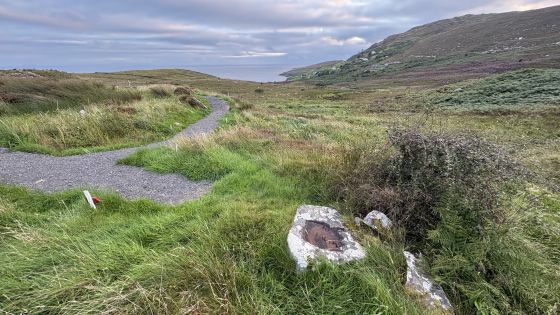
Plan of the six tombs taken from the Survey of the Megalithic Tombs of Ireland, Volume 6, County Donegal. See the recent link posted to TMA for free downloads of all these amazing books.
Image credit: ryaner

Plan of the six tombs taken from the Survey of the Megalithic Tombs of Ireland, Volume 6, County Donegal. See the recent link posted to TMA for free downloads of all these amazing books.

Tomb no. 1, the westernmost, with dreadlocked sheep.

Tomb number 6 according to Cody’s classification in the Survey of the Megalithic Tombs of Ireland, the easternmost, is in the garden of a house.

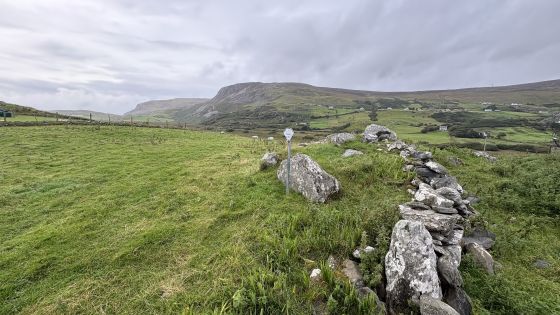
Looking from tomb (SMR DG089-008---- ) eastwards along the line of this cluster of six portal tombs within 100 m.
Visited April 2012


Visited April 2012

Visited April 2012

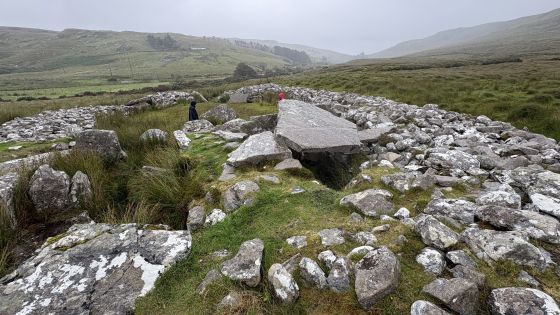
Tomb SMR DG089-008001- is the most impressive one of these cluster of six portal tombs.

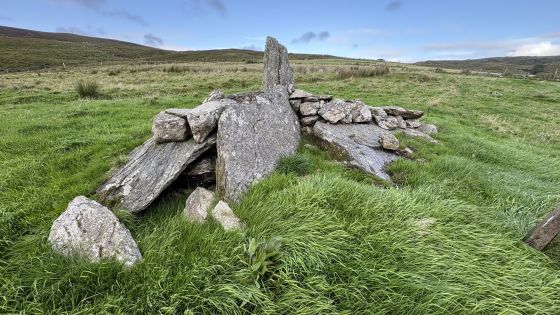
Tomb SMR DG089-008003-
Visited April 2012

Looking from tomb SMR DG089-008003- to the three westernmost tombs SMR DG089-008002-, DG089-008001- and DG089-008----.
Visited April 2012

Tomb SMR DG089-008004-
Visited April 2012

The two easternmost tombs with SMR DG089-008004- in the foreground (left) and DG089-008005- in the background (center).
Visited April 2012

The easternmost of the seven megalithic tombs (SMR DG089-008005-)
Visited April 2012

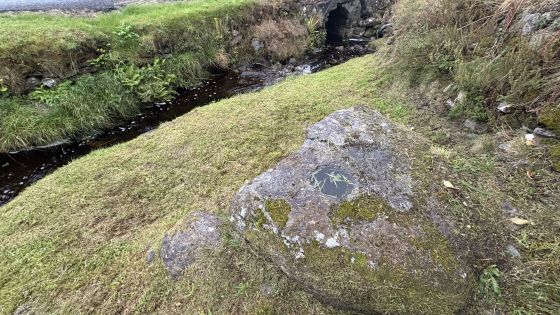
This beautiful white quartz stone is incorporated into the field wall by the Malin More tombs. Given the ruinous state of the tombs I wonder if this stone was taken from one of them.


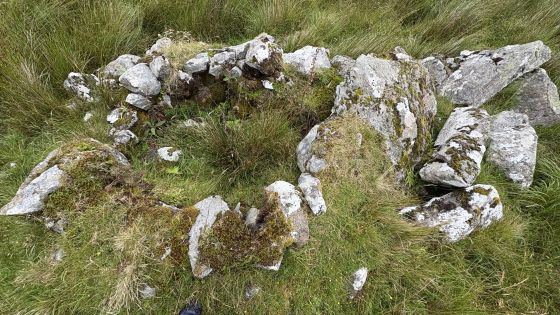
The only partially supported tomb of the six – probably because bordering someone’s garden.


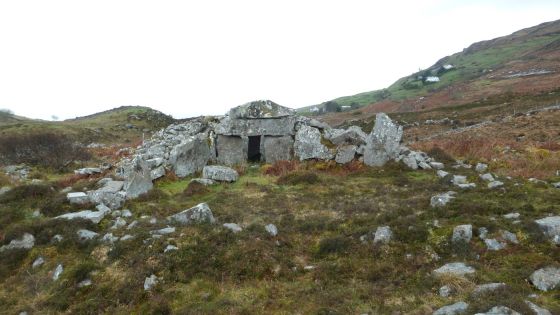
The finest of the six – count ‘em – portal tombs at Malin More. Note the fine quartzite secondary capstone... the main capstone having slipped. Several more tombs can be seen beyond.


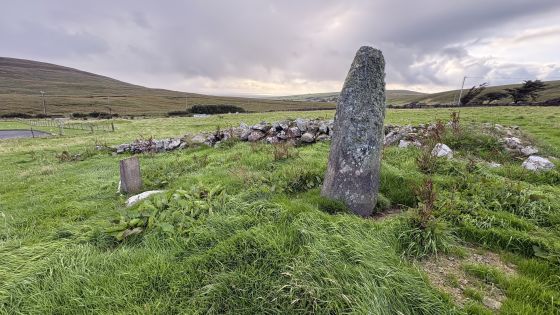
Standing Stone at Malin More


Standing Stone at Malin More

Standing Stone at Malin More

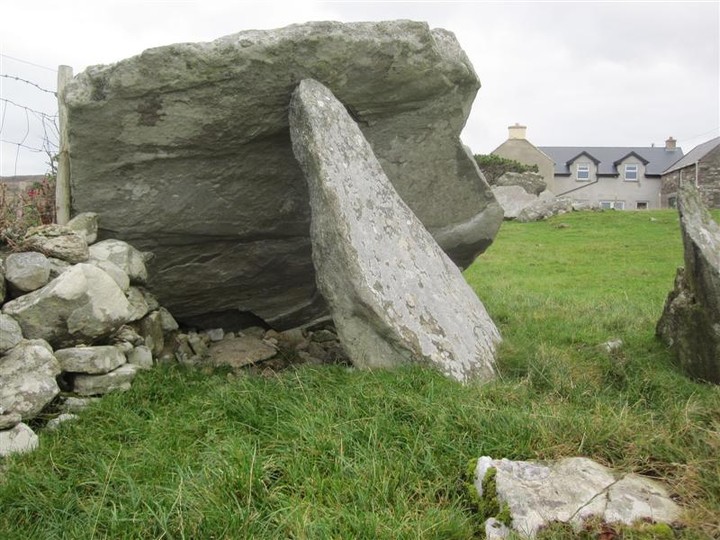


Westernmost tomb.


Westernmost tomb – another view.

The line of tombs looking E.
One of those sites that I’ve seen a lot of shots of, looked forward to visiting, got there finally and found it not remotely similar to what I’d imagined. Which is not to say that it’s not amazing, just that I found it a tad underwhelming, especially after the drenching back and Cloghanmore.
The laneway that runs along the fields that contain the tombs is extremely narrow. Eamonn Cody, in the Survey of the Megalithic Tombs of Ireland, Volume VI, County Donegal (2002) numbers the tombs 1 to 6 from west to east. After Cloghanmore and still in the slipstream of the torrent, I didn’t feel like vaulting the gate, so I only photographed 1 and 6 at opposing ends of the ‘alignment’.
Both 1 and 6 are the two most impressive chambers. Cody mentions that there may have been a seventh and it’s worth quoting from the previous mentioned survey: “Thomas Fagan …, who visited the site in 1847, refers to the existence of seven chambers, … but provides details of only those numbered 1, 3, 4, 5 and 6 here. He claimed that the chambers had stood in one long cairn that he estimated originally measured 100 yards E-W and 20 yards N-S.” Cody notes the larger gap between chambers 5 and 6 and says that this might have contained the destroyed 7th chamber.
There are remnants of a cairn at chamber 6, at the top end of the alignment and in someone’s garden. It’s the largest of the six but difficult to get a sense of given its location. I did clamber up and attempt a shot back west down the alignment, but in our hurried, drenched and flustered state didn’t meet with much success. The bottom chamber, chamber 1, is impressively large, but was surrounded by a flock of dreadlocked sheep so we didn’t enter the field. Another one I’ll have to return to.
We visited these on our second visit to Glencolmcille, after going back to Cloghanmore (and last full day of the wonderful week in Donegal) . Our first attempt had been unsuccessful as we weren’t able to find them. This time we asked in the visitors centre/gift shop and were given a little hand drawn map. Leaving Glencolmcille on the road to Malinbeg just over a bridge we turned right up a narrow road to some farms (a house on this turning had a rather impressive garden ornament in the shape of a small portal tomb). The six great portal tombs were not in such good condition – they span two narrow fields both of which had farm animals in them. The three in the first field had three nursing cows with their off-spring standing close by. The cows became agitated by our presence at the gate so we decided to not go in the field. All three of these enormous tombs were unrestored and partially fallen. The other three tombs were in a similar state although the largest one was partially restored with some supporting stonework – also partly in the garden of a nearby house. The second field had a ram and ewe standing guard – again we erred on the side of caution and didn’t enter the field.
This short passage is taken from “Gleancholmcille – A guide to 5000 years of history in stone” by Michael Herity:
“ … towards 2000BC, Gleancholmcille was lived in by a later group of stone age farms with a rather different style of tomb building. Their monuments are portal tombs. This type is well represented near Gleancholmcille – on the north side of the valley behind the school and again across the valley to the of Cloghanmore. At the west end of Malin More valley, six portal tombs arranged in a line are part of one huge, unusual monument, probably 90m long originally”
Edit: Have belatedly posted a photo of a beautiful white quartz stone which incorporated into the field wall by the Malin More tombs. Given the tombs are in a ruinous state I do wonder if this stone was taken from one of them?
West of Killybegs – apparently Ireland’s ‘premier fishing port’, no less – lies a wild, sparsely populated area known as the Slieve League Peninsular... named after a mountain range possessing (arguably) the highest sea cliffs in all Europe. Although there are few settlements of any size to visit today, the proliferation of megalithic tombs to be found in the locality would strongly suggest that, relatively speaking, this was certainly no prehistoric ‘backwater’. Oh no.
Like a child before the sweetie counter, palms sweating through tightly grasped coins, it’s difficult to know where to start. The fantastic ‘two for the price of one’ tombs of Croaghbeg and Shalwy get the initial verdict on a split points decision. A difficult act to follow, it has to be said. Nevertheless we continue along the R263 towards the road’s near terminus at Malin More, a small cluster of houses set below the western extremity of the aforementioned Slieve League. Although the coastal scenery is exquisite, Malin More is unpretentious almost to the point of submission. No doubt the inhabitants have no wish to engender the wrath of the winter storms through ostentatious display? So it come as a major surprise to find that this little settlement could well be the case study to prove the maxim ‘appearances can be deceptive’. Aye, ‘tis true.... standing in an east-west alignment beside a minor farm road stand (at least) six – count ‘em – portal tombs!
Granted, none of the half dozen monuments is a classic specimen of the type in itself, each sadly having suffered structurally – to a greater or lesser extent – across the millenia. But there are SIX of them! Something I’ve never encountered before.... and probably will never again. Are there any other comparable groups? Dunno. The best preserved – and thus showpiece – tomb of Malin More’s collection is a gigantic edifice of the ‘two-tiered, double capstone’ type, a design perhaps best exemplified at Knockeen, Co. Waterford. Although the main chamber’s massive capstone now rests upon the turf – having slipped from its supporting orthostats some time in antiquity – the secondary example remains in situ, a beautiful slab of shining quartzite. Nice. A little Irish frog, clearly with no qualms concerning the tombs current stability, nevertheless makes a leap for freedom as we enter. Wisely, I think. You know what these clumsy English tourists are like?
So what of the other portal tombs, then? Well, that nearest the farm house is also in pretty good nick... although taking a full on picture of someone’s home didn’t seem right... at the time. Wish I had now, but there you are. The others have fared less well, but can nonetheless still be traced and appreciated within the farmer’s fields. And... well, two out of six ‘aint bad... to paraphrase Mr Meat Loaf himself. Can’t argue with that as we prepare to leave Malin More to revel once again in its obscurity. Especially since the fine court tomb of Cloghanmore lies close at hand....
Six wrecked portal tombs stand in a 90m line running E/W. The westernmost tomb is the best preserved.