Articles

Oak Piece

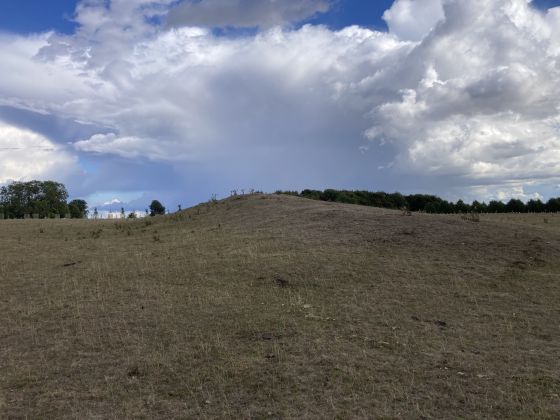
Saw this long barrow on an OS map whilst walking nearby and went to go check it out. It’s clearly visible from afar against an otherwise flat field. I acessed it from a farm track from the north which was easy but involved some climbing.

Up close, there isn’t much to explore. It’s a low mound, about 3 or 4ft high with a single small oak tree in the north-east corner. The banks have been badly damaged whether by ploughing or something else. I was interested to read on a previous post from 2011 about the site that there used to be four trees, one at each corner. Since then, the rest must have died. Speculating why there were trees planted, I thought that it may have something to do with the name, Oak piece, relating to the use of wood in the construction of the burial chambers. I can’t seem to find any more information about the name or whether wood even was used in its construction.

Despite there not being much to see, I found it an atmospheric place. Maybe because it sits isolated in an empty field (on the day I visited) or because the nearby farmhouse that overlooks it was abandoned. I found it easier here than in some of the more well known sites to imagine what it might have been like to follow a funeral procession to the site.

Oak Piece

Spotted this on the O/S map and found a description of the site on Megalithic.
‘Chambered Tomb with badly damaged long mound in Gloucestershire’.

Directions: take the turn off north from the B4077 just before you get to the village of Condicote. Shortly after, pull into the lay by and head through the trees on your left. A ‘path’ was easy to follow through the trees so someone must be walking here?
Once out of the trees you come to a metal field gate and from here the Long Barrow is easy to spot on the brow of the hill in the middle of the field.

I left Karen to take photos of the flora and fauna in the woods and I headed off across the field.
The Barrow is oval shaped about 1 metre high x 30 metres x 20 metres.
Oddly enough a tree has been planted in each ‘corner’ – 3 of the trees still had protective fences around them.

Not much else I can add in all honesty but I am glad I stopped by.

Miscellaneous

Oak Piece
Long Barrow

Details of long barrow on Pastscape

(SP 13312879) Long Barrow (NR) “Oak Piece” long barrow is positioned by O’Neil and Grinsell at SP 13402890 (2), and M Westerling states that it lies 304 yards from the south wall of the field and 107 yards from the east wall (3).
The barrow is oriented E/W and measures 145 ft by 60 ft by 4 ft high, with nearly parallel sides (2). Mr Peachey, formerly estate agent at Trafalgar, dug 5 ft into the mound several times c 1916, but discovered only that it was built of small stones among which were flint flakes. There were no signs of earlier disturbance (3). A leaf-shaped flint was found nearby Mys Westerling (4). (2-4) SP 13312879. Long barrow, very spread by ploughing; now measuring 60.0m E-W by 23.0m laterally and up to 1.3m high. No trace of ditches visible on ground, or OS APs (a). Surveyed at 1:2500 on PFD. (5)
A rapid examination of air photography (6a) shows the long barrow as a cropmark, with dark ditches (?) tapering to the west and a possible horned east end. SP 13352880. A Neolithic long barrow, sometimes known as the Oak Piece long barrow. A survey carried out in 1960 found the barrow mound to have maximum dimensions of 44 metres by 18 metres. It is now visible as a ridge approximately 0.6 metres high, and measuring 25 metres by 15 metres. Scheduled. SP 1335 2880. The long barrow has been mapped from aerial photographs, including those cited as authorities 5a and 6a, by EH’s Gloucestershire NMP. (8)

Sites within 20km of Oak Piece