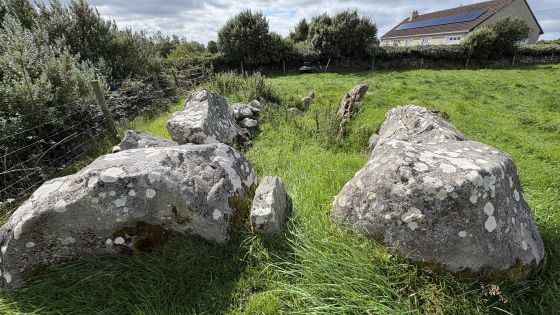
Eire 90
Image by ryaner
Eire

Picts in Ireland

Well - instead of all the "Celtic Twilight" stuff that we have ben force - fed for years, let us celebrate our art, music, literature and culture for what it is. You know what I mean - all those "Celtic harps" and "Celtic crosses" and "Celtic embroideries" in the "Celtic" gift shops. Let us recognise the wonderful music, folklore, metalwork, jewellry etc etc for what it is - home grown native culture and not something imported from Austria. You could check out http://www.le.ac.uk/ar/stj/celtindex.html

Mike Pearce on another list says it very neatly:

"There has been plenty of academic discussion of the Celts over the
last ten years. Caesar only mentions Celts in mid and southern Gaul,
and clearly states that the inhabitants of Britain are indigenous,
except for those in the South, who are Belgians (ie Germanics). From his Gallic Wars
narrative:

"The interior of Britain is inhabited by people who claim, on the
strength of their own tradition, to be indigenous. The coastal areas
are inhabited by invaders who crossed over from Belgium for the sake
of plunder and then, when the fighting was over, settled there and
began to work the land; these people have almost all kept the names
of the tribes from which they originated".

Pytheas the Greek of Marseilles circumnavigated Britain about 350 BC
reporting that the Prettanic Isles were North of the lands of the Celts.

John Collis notes that "the indigenous nature of the British Iron Age
is now generally accepted, but with continuous rather than punctuated
contacts with the continent followed by periods of complete
isolation." (Collis 2000, 181) Collis makes a great case for
rethinking the nature of the Celts in his "The Celts. Origins, Myths,
Inventions" essentially making a critical study of Celtic Studies."

Thanks explaining and for the link! Interesting stuff there.(i note that all your references refere to Britain though and not Ireland) I personally don't think that our ancestors (whatever name you wish to put on them) lived in a mono-cultural society. I would say that the dominate culture was Celtic but there were also the three tribes of Fir Bolg, the De Dannan, the picts (I've discovered thanks to TMA) etc. I know that it is likely my own clan, though indigenous Irish were not Celt's in origin. I have not finished reading everything on the link you gave but I think it is accepted at this stage that there was not a invasion of Celts, as previously thought, that drove out/killed off all others cultures. I agree that the Celts didn't have one, set, across-the-board culture by any means. I believe that there was great variation between the "Celtic Nations".
I was never taught "The idea of a universal 'Celtic cultural package'" but that as a people, culturally, we would be more similar with the Scots than other peoples. I was actually surprised to find out in my own reading that the Welsh were thought to be of Celtic origin too.
I would not go so far as you to think we were "force-fed" this idea of a Celtic nation thought I do think the other groups around that the time are horribly underrepresented in the school history curriculum. I feel, however, that some of the writer's comments were somewhat biased (read below)

• IRELAND Once the Vikings began to raid in 795, Ireland was permanently occupied, wholly or partly, by foreigners. The Danes were followed by the Anglo-Normans in the twefth century. During the sixteenth century the English imperial grip tightened, and relations were further embittered by the Reformation. Protestant England kept Catholic Ireland under subjection, sometimes incredibly brutal, until after the First World War.
Anybody else spot it? "Until after the first World War?? Where was this man in the 60's?
He also said,
"It is also a general rule that people recounting histories always have an axe to grind, or at least, have a set of presuppositions which make them present information in a certain way"

This is true of his own work also, I would very much like to know where he's from maybe then we could see what "axe to grind" he has. while we should always be wary about swallowing all the "facts" we are giving before checking them out you can also go to the other extreme where you end up chucking the good out with the bad, which I think is what this fella did. This is turning out to be thought-provoking and enlightening Peter, thanks again!