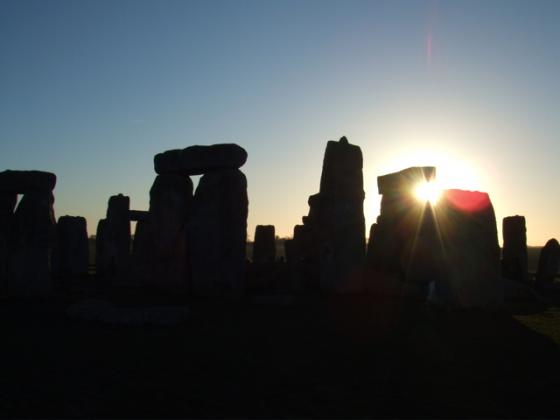
Stonehenge 181
Image by texlahoma

StoneGloves wrote:
Hold on - there is a flaw with your hypothesis! Amazonia insists that reviewers should have purchased a copy of the book through their account and that 24 hours should have elapsed since the purchase. The only way round this would be illegal hacking of their site. I wrote a review but, consequently, was unable to post it. I'd logged on, there, as The Man From Smithills, and, instead, will post that revue below. You may use it freely and without any reward being expected or implied. The reaction of the arch. community to a new concept is to simply pretend you don't exist. It's frustrating but just 'how it is'. The more you shout the harder they push their fingers into their ears. It's the same if you're reporting pollution, incidentally, or melting icecaps (fifteen years ago).


" The pursuit of archaeology is crucial as it defines our cultural roots. To understand where we are going it is vital to understand where we've come from and the school of British archaeologists should keep those sources and our belief in them alive. Sadly this top-down world of authoritarian men can only accept change at a very slow rate and retains mythic states far longer than is actually prudent or polite. Such is the case in the study of the origins of Stonehenge. As a site it was probably sacred - if that is an adequate term - for thousands of years before a single stone was set upright and the first temple was probably of earth and wood. This book is about the boulders that created the earliest stone circle on the Stonehenge site and shows that, contrary to received belief, these 'bluestones' were actually gathered from several sources locally, rather than being laboriously transported from Wales. This commonsense approach is shunned by academic archaeologists as it undermines their 'heavy duty' paradigm and their consequent projects' approval and funding.

Dr John's book, The Bluestone Enigma, tells the story of the bluestones in a straightforward and easily read style, which is well illustrated by colour photographs and line drawings. His description of the pitfalls in an experiment to move a single three tonne stone from Preseli, in South Wales, to the vicinity of Stonehenge, should be required study material for every British prehistorian. It's not unlikely that the ancients also recognised the common geology in both the Salisbury Plain bluestones and the Welsh bedrock but provided a legend of them being moved by giants, or fairies, to explain the transport by glacial drift. It is simply the remnant of that myth that is repeated by many eminent professionals today. Brian John demonstrates quite persuasively in this book that the facts no longer support that crazy hypothesis. This book is for everyone that wants to be ahead of the game and in the know. It will be ignored by stuffy archaeologists but should initiate a process of reappraising British early history. I recommend that everyone with an interest in the British stone monuments obtain two copies of this book - one for themselves, and one for a colleague. Just leave the stuffy academics to their fairy stories for now! "

Well I haven't read the book so can't comment specifically but I'd like to take you up on one theme that both you and Mountainman seem partial to - that academics and archaeologists are stuffy and ruthlessly defensive of the current paradigm. No doubt there's some truth, yes, but it's totally overplayed and unrealistic IMO. And a lousy reason to explain why academics and archaeologists don't generally agree with one. They could easily have their own, perfectly reasonable reasons for so doing. Bear in mind "scientists are afraid of the truth as it threatens their position" is voiced by just about every conspiracy theorist and nutcase on the net so it's not a good theme. And it doesn't even chime with human nature. If there's a chance an academic can make his name with a new theory he will. Or at least, some will and the "truth" will jump out of the bag somehow, if it's good enough. The world of science isn't the sixteenth century Catholic church.

As you'll gather, I’m not sure putting a case for glaciation ought to involve leaning over to demolish the human transport theory and it’s proponents. I don’t buy the idea that archaeologists are quaking in their boots in case human transport is disproved nor that there’s any evidence it is in the least unlikely.

The latest discovered Iron Age log boat (Hasholme) kind of speaks for itself. Personally, I find it incredibly hard not to think there was a heck of a good chance 2 or 3 bluestones could have been safely and easily towed from Wales in something like that and then hauled the last 3 miles by quite a small group. I base this on looking at that real boat and do so without fear of losing my university funding (I wish!) On the other hand, glaciation might be right. But there’s no evidence which is correct, only that both are plausible - is there? You've read the book so perhaps you can correct me.

With two competing theories there is the probability factor and this alters with advances in research. The experiment to move a stone was well carried out and this has moved that probability factor considerably. Your experience with the countries top archaeologists is certainly very different to mine - I've spoken to several of them, written to others, and without exception they (...) . That whole Stonehenge myth needs deconstruction. I write this after watching the DVD 'Hawkwind at Stonehenge - 1984'.

Nigel, you make a good point. This is not confined to archaeology -- all academic disciplines have senior figures who measure their own reputations by the extent to which their ancient theories are preserved and verified. And some -- not all, thank God -- resent the new bloods who come along and demolish the old theories and put new ones in their place. I was an academic geomorphologist long ago, and was mystified when several perfectly good research papers were turned down -- until I discovered that the journals involved had used one particular very senior referee whose ideas I was intent upon challenging and disproving. The papers got published in the end, of course, but that taught me that some academics do take "challenges" and new ideas as threats to their own self-esteem. But as somebody said the other day, the more these guys hang onto their fragile theories, in the face of lack of evidence to support them, the greater is the likelihood of an eventual catastrophic collapse.

Well, to echo the overall point... I had quite a fight in getting the bloodsports theory into the book Standing With Stones as the persistant view is that henges were temples.
We sent a copy of the film to the Time Team crew and within months they had made their own version of our Stanton Drew segment putting the possibility of bloodsports at Woodhenge.

I think it's like dominoes... the stubborn closed minds will fall eventually, it just takes a couple of louder voices. Apparently we on the outside of the archeo establishment are 'nobodies' with no right to opse theories outside our remit.

Keep fighting the good fight I say!