


A falling roofstone, dangling over the eastern end of the chamber – note the quarrying marks on the bottom curve – I thought these may be modern.

Closer in to the entrance – the stone on the left is thought to be a fallen lintel from the entrance jambstones.
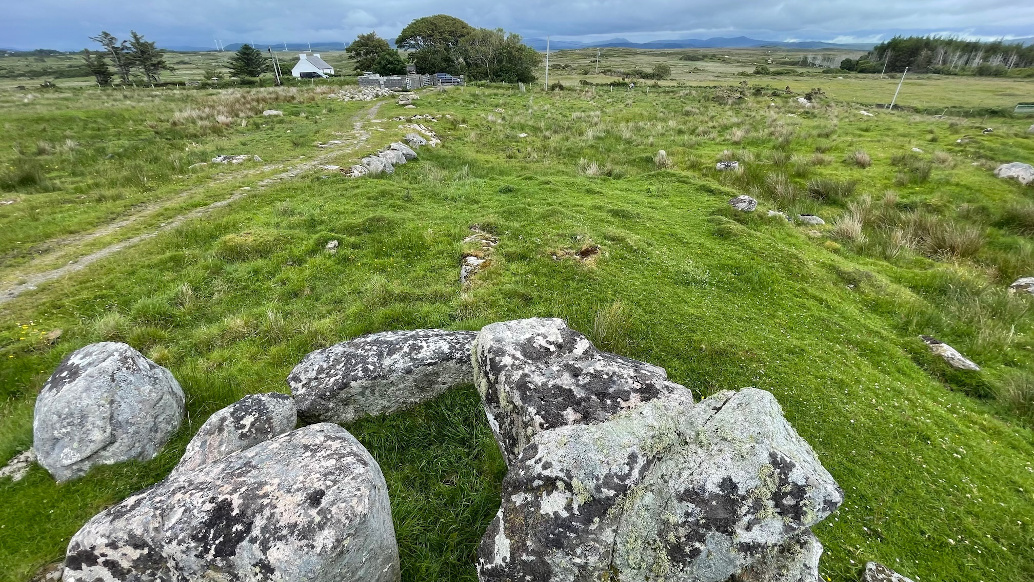
Over the tomb entrance – the landscape of Kilclooney More is rugged.
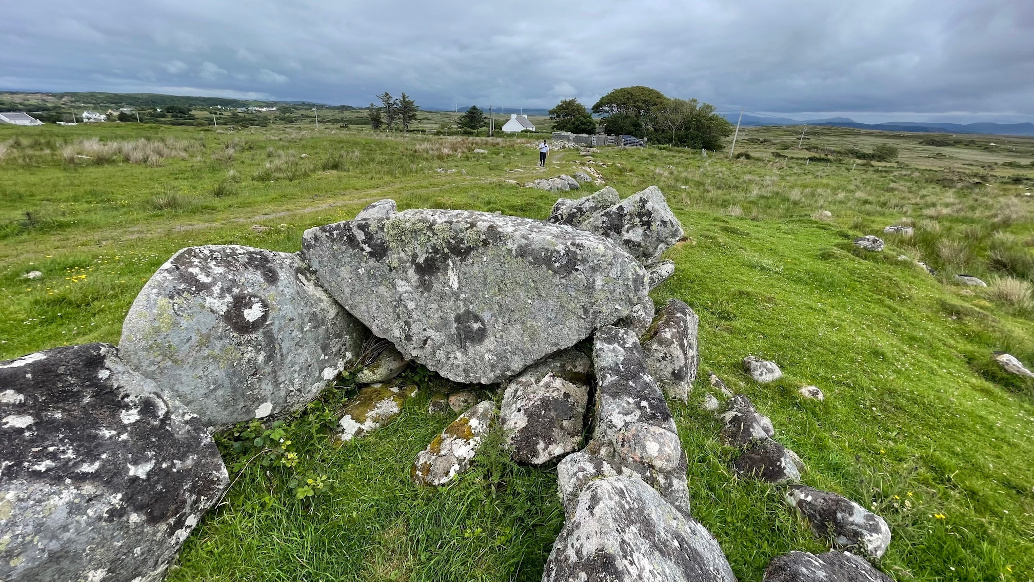
From on top of the southern wall – all the stones here are huge.


Towards the entrance at the east, the stone nearest is one of two court-stones still remaining.


The Owenea Bridge is in the background, just to the right of the stone.


The eastern tomb – the small padstone, sitting on one of the portal stones and propping up the roof for thousands of years, is utterly fascinating.


The padstone, resting on a stone of the western wall of the main chamber, holds the massive roofstone at the desired angle.

The central tomb – the peat on the roof points to this monument having been uncovered and re-discovered after peat harvesting.

Inside the central tomb, over the backstone – the massive roofstone rests on two of the sidestones visible here and on the padstone, top right.

The western chamber from the roof of the central chamber.

From behind a kerbstone at the northern arc of the mound – the monument has been considerably neglected since the last two visits from TMAers.

The western chamber, getting more overgrown all the while.

Front on, looking north, at the three, separate chambers.

The south-western stone on the left is 2.3 metres tall, the one at the north-east is 1.9 metres tall.

The south-western stone on the right is 2.3 metres tall, the one at the north-east is 1.9 metres tall.


Marked as a cairn on the OS map, this is the tomb that probably gives the townland its name.


The place is a bit of a mess but this is probably the facade of the wedge tomb.


The fine facade, antechmber and septal stone at the western end of the tomb – the hill off centre to the right is Carn Hill.

Looking west – two roofstones remain over the chamber, the one on the right resting on the backstone.

South over the tomb towards the Roe valley and, further on, the Sperrins.

North towards Benbradagh over the south-west corner stone of the facade.


The nearest stone in this shot is the backstone of the chamber. The chamber is filled with soil and plant growth.

South into the Sperrins. There’s quite a lot remaining of this ruined megalith.

Looking west at the entrance, possible capstone in the foreground.


There are the remains of a fine wedge tomb in there somewhere.


Like the rest of the complex, the tomb is being gradually inundated.

The floor of the tomb is well below the surrounding ground level.


Looking north at the threatened and neglected, but fine remains of Kilhoyle.

Roofstone in the foreground, septal stone visible further up along the gallery.

North-west over the gallery – got here before the bracken takes hold.