
top of western side of mound with stones outside mound
Image credit: wideford

top of western side of mound with stones outside mound

southern side of mound and stones outwith [but not from downhill]


from top of eastern side across interior to stones outside mound

HY21NE 12 at HY28001647 is a flat-topped turf-covered mound of earth & stones 25’D, a metre high but topped by a 5’D mound of almost the same height. A barrow-digger started work on the ‘building’ but was thankfully stopped byy the farmer. The NMRS reference to a rouge pot etc is an error for my news index for Skara Brae NW 12

open end of passage behind ?lintels, taller stone 0.6m and view 1.2m across, masonry wall behind grass top left quadrant of image

masonry wall of passage, slabs very approx. 1” thick
Don’t know how I missed the entrance to the ?souterrain before, just inside the fence on the S side of the road at HY2706715113. Guess I looked for a channel further down whereas it starts as a hole like a badgers set (no sign of the masonry walls in the dark, should have used the camcorder’s nightlight) literally a couple of feet from the actual fence behind three flat stones. I assume these are a few of the lintels from the intermittent roof of the built passage. This is described as 800cm square to begin with, though perhaps narrowing further on – it goes south-easterly to a ditch but after some 2.5m turns quickly eastwards and then the hillslope and presence of mud stopped investigations progressing to what they describe as the inner end (or else it goes ~100m down to the loch). By the western stone I could see a masonry wall of thin stones behind a grass fringe. Not wishing to be disturbed by the ploughman in the next field I did not enter for a more thorough going over. This side of the road the ‘broken’ mound is ascribed to outbuildings on account of projecting stones but it is obvious that the passage is within the tower’s circuit – at The Howe we found a souterrain which had been struck through the tomb at the centre of the broch so the road might have demolished a northerly continuance (an odd coincidence otherwise).

sides of excavation scar/s at top of mound seen from side facing ferry road

looking along excavation scar/s from partway up landward end

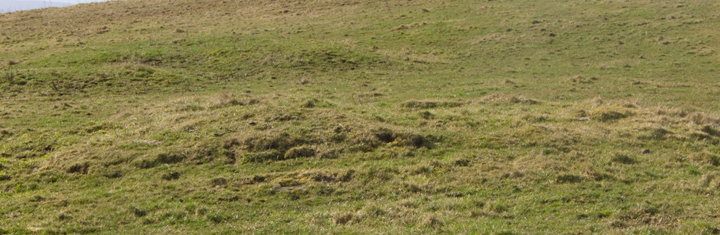

mound looking roughly E or NE with Wasbister Cairn behind


Wasbister Cairn looking S across small ‘lochs’ and monuments to Bigswell


Wasbister Cairn looking N with possible ‘ring’ surrounding it


S-N across Wasbister Cairn’s northern edge with possible wall-face stone R


Wasbister Cairn’s possible wall-face stone with tape out to 1‘

stones in W side of central portion of Wasbister Cairn with tape out to 1m

Wasbister Mound coming from ‘disc barrow’ with small lochan/pool behind


Wasbister Mound seen from the east with ‘disc barrow’ in background
In the same field as the Wasbister ‘disc barrow’ and the Bookan Cairn settlement are two lesser sites, presumably [a lot?] later than the monuments.
The Wasbister Cairn can be found by climbing the hillslope to a bright green grassy mound by the top end of the northern fence. This very rough mound (very very ragged and disjointed it is definitely an item), is only a few yards away from the cairn itself. From some views the ragged mound is so big that this and the cairn could even possibly be a single item subjected to different fates at E and W. But I only found a single flat stone on the whole of the mound’s surface. As for the cairn, though there are some loose stones around the base there is no sign that these have ever been embedded. There are a few horizontal slabs dotted about its surface and one at the northern side with a seemingly curved face sticking out as if originally part of walling – perhaps there are similar out of sight.
The Wasbister Mound lies down near the Dyke of Sean. Rather than a lochan I would consider the body of water a pow or large pool. Either side of the dyke the number and size of pools varies and old maps show many straight lines in and around them of unknown origin, some still visible. The slight mound is most easily seen coming from the barrow to the pool. There is a comparatively large piece of erosion at the highest point showing earth and a couple of smallish stones. In going back to the fieldgate I passed over a large rise – it isn’t on record and there are no stones or anything visible but it has a feeling of settlement





