Jane

Jane

All posts 701-750 of 2,145 posts

Barnenez

Do you know the way to Barnenez?
I’ve never been so
I may go wrong and lose my way
Do you know the way to Barnenez?
I’m going there to find a great big cairn in Barnenez
Allee couverts and some dolmens
See a whole bunch if you’ve got a car
In an hour, maybe two, you’ll get quite far
Don’t go too fast or they’ll quickly pass
And all the stones are lying there amid the gorse for you to find
I’ve got lots of photos from Barnenez
Wo oh oh-oh, oh-oh oh-oh
Can’t wait to get back to Barnenez
Wo oh oh-oh, oh-oh oh-oh
Do you know the way to Barnenez?

Côtes du Nord on a wild, wet Wednesday. Sane people do not go out in weather such as we experienced that day: grey skies and steady rain coming in at a slant with the occasional hailstorm. Sane people especially do not take expensive digital SLR cameras outside in these conditions. Welcome to the madhouse. Welcome to Barnenez, just 40 miles west from our cottage up on the north coast of Brittany.

Barnenez will make you gasp in wonder.

It’s so big and grand, this one has a visitor centre and mighty glad of it we were, too, as a shelter from the storm. 75metres long and with twelve burial chambers within its stony step-pyramid mound this is a beast and reminded me strongly of an out-size Camster grey cairn combined with Egypt’s Saqqara pyramid.

During its excavation and reconstruction, a huge chunk was left missing deliberately to expose the manner of construction.

Four of the burial chambers are open to visitors the others are walled up. Each chamber has a different manner of construction – corbelled vaulting, dolmen-type chamber, side slabs only, etc. Inside the visitor centre are some of the carved, decorated stones found within the cairn which are very intriguing – one looks like a sheaf of corn. There are also some cracking photographs of the cairn before, during and after its excavation and examples of the finds – beads, pottery, axes – discovered there.

We drove back east from Barnenez towards Lannion – there are lots of sites to see round here including many alleé couverts and menhirs.

Alignements de Moulin de St Pierre

The little seaside town of St Pierre Quiberon is home to two fabulous monuments: the St Pierre alignments, which nestle comfortably like a park in the urban setting and within a couple of hundred metres of these alignments is the WONDERFUL Kerbourgnec cromlech.

St Pierre Quiberon town felt very like my home town of Stratford on Avon, satisfied with itself, charming and much-loved by visitors Indeed, if you transported all the stones from West Kennet Avenue to the Royal Shakespeare Theatre gardens, this gives you an idea of the feeling emanating from this monument. The three or four rows of stones (23 in total) were very Avebury-like in size and shape.

Like this one a lot.

La Four Sarrazin

A few hundred metres west of Le Tribunal, up a bit on a rise lies the charming but a bit crumbly allee couverte of La Four Sarrazin

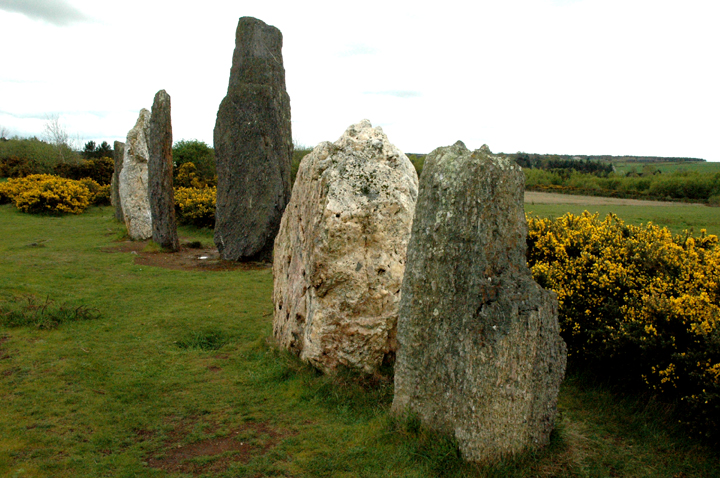
It had one or two underwhelming cup marks on it, but no intriguing carvings of swirls or zigzags, ‘breasts’ or chevrons. From up here there are some magical views back over the heath, with the tallest stones of Chateau Bû poking up from above the gorse.

Le Tribunal

Within shouting distance from La Croix de St Pierre cairn (Le Dolmen West) rather than spitting distance, is Le Tribunal cromlech. This wide horseshoe of zebra-stripey stones swings around from the south of the path. Each stone is so carefully chosen and positioned they each invite special consideration.

Having recently seen all the crazy carved stones at Gavrinis a couple of days before, it occurred to me that the builders of this site, instead of laboriously carving all those motifs into the rock, instead went out and sought stones which already had a natural decoration.

The position of this arc of stones, within metres of the graves of revered ancestors and with a name hinting at tribal law, it felt like a very important meeting place within the Saint-Just complex. But this isn’t the end of the affair. keep going west and there are still more monuments to discover!

West Row

Some 50 metres away from the south row are the third, western alignments which consist of the same white, quartzy, sugar lumps as the northern alignments.

South row

The second row which runs parallel just metres away from the North row, are an elegant series of blade-shaped menhirs of various different sizes, colours and types of stone.

Roche-aux-Fées

Fifteen miles or so to the south east of the city of Rennes, near Essé is one of France’s most famous prehistoric monuments: the super-sized La Roche-aux-Fées.

Well-signposted from the main roads and now with its own small village close by, this colossal construction is more megalithic hall than over-sized allée couverte. Indeed, the size of its groundplan is pretty much the same size as the ground plan of our house.

We’ve all seen pictures in guidebooks and on the telly of famous iconic buildings throughout the world; the Taj Mahal, the Alhambra Palace, the Giza Pyramids, Angkor Wat, and so on. But just like all those places, the familiarity with them doesn’t lessen the impact when you stand face-to-face with them.

And so it was for me at La Roche-aux-Fées on this miserable chucking-it-down April day. It is jaw-droppingly vast; made up of 40 giant slabs of purple cambrian schist, obtained from at least 5kms away. Its six gigantic capstones weigh between 40 to 50 tonnes each. Surely this wasn’t only ever a tomb? Today it wasn’t.

Today it served as a wonderful and roomy shelter from the pelting rain, a place for me to sit, think quietly and sketch; have a cuppa and feel its stones enclose me and protect from the dreary outside world.

The large car park suggests hundreds of visitors come here in good weather but today it was almost entirely ours. I wasn’t going to be rushed here. Feeling safe and dry inside, I got out my paints and make a little sketch. I loved the way the damp stones glistened in the wet and made the massive slabs hanging above my head seem to loom even larger still.

Kong Humble’s Grav

Kong Humbles Grav is in all the guidebooks as the most fabulous langdysse with exposed chambers in Langeland. So what we couldn’t understand was the place that Julian’s instructions took us to in TME…a most underwhelming, crescent shaped long embankment on top of a huge grassy mound overlooking the town of Humble, opposite the church.

Moth and I couldn’t believe it. We were embarrassed to have taken our friends after the major build-up we’d given it. Something was wrong. We left disappointed and highly suspicious.

As I drove us to our next monument, Moth checked other guidebooks, including the Oldtidsminder På Langeland by Jens Bech of Langelands Museum and Jens Kortermann, a jewel among guidebooks (text all in Danish) but with brilliant maps and drawings.

Oops Julian! If you’re reading this, I’m afraid you screwed up, sweetie. The underwhelming earthwork you call Kong Humbles Grav on page 168 of TME is no such thing.

Don’t be fooled!

We found the *REAL* Kong Humbles Grav with not too much trouble. Here’s how to get there. Drive past the church and turn down the first farm track to the left, towards a beautifully kept pink and blue farm house with a monster yellow barn. Park here, put your money in the honesty box and walk north behind the white barn and follow the track through the field. Here is Kong Humbles Grav – a magnificent long barrow with squared off ends and lots of good kerbstones.

The main chamber in the middle is an exposed dolmen in superb condition.

Straw had been put on the ground in the chamber so I shot in, not only to get out of the bitter wind and the threat of rain but because it really was delightfully hygge in there!

D1 Steenbergen

With the light almost gone, we really needed clear directions to get to Steenbergen before dark. I fouled up on the navigation and we went the wrong way. Then, just as we really needed shit-hot directions from Julian (as they had been most of the two days we’d used his instructions) he let us down. However, we found it. (just turn right when you get to the first T-junction in Steenbergen village and follow the lane round till you see the car park.) Just as we had started the day with a rip-roaring beauty, we ended it on a high. Steenbergen is marvellous. Up on a dune this lovely six-capstoned animal perches in the sand, complete with dinky dolmen-style portal. For some reason it had a single strand of barbed wire fence around it. Protection from what, we wondered? We just climbed under.